by Osprey Photo Workshops & Tours | Feb 12, 2024 | Flower Photography, Flowers, Garden Photography, Longwood Gardens, Nature Photography, Photo Technique, Photo Workshops, Uncategorized

Light & Flowers
The first image captures the center of the pink lotus flower beautifully lit by soft diffused light. As opposed to bright sunlight, soft light preserves the individual pastel colors of the flower.
Side light when it creates light shadows and tonal gradient on the petals defines the shape of the flower making it appear three dimensional as with the second lotus blossom.
Back light coming from behind the subject and passing through petals and other flower parts can be dramatic and reveal details not easily apparent otherwise like the fuzz on the sepals of the lady slipper. The shadowed background made this detail more apparent. However, the pink part of the lady slipper was shaded. To improve the image, I used a white card to reflect light into the shadows.
Like all photography patience is required. I searched for a perfect Bird of Paradise flower to photograph but had difficulties finding one that did not fade into the background. Finally I found what I was looking for, an individual flower that was backlit with the orange color portion of the flower glowing against a dark background.
The last flower in this series, was lit by the setting sun from behind. It seemed to glow with a beautiful transition of colors from red to yellow.


Problem Background & Solutions
When the background is extremely distracting, consider selecting an angle of view where it is in shadow like the image above.
With some problem backgrounds I have resorted to using an artificial one behind the subject as with this Himalayan Blue Poppy.
One way to create such a background is to I select a scene outside, set the camera to a low F-stop for a shallow depth of field and defocus the lens before taking the photo. Then I print the image, mount it on a stiff background and hold it behind the subject. Another option is to select an image that you already have in your photo files and use Adobe’s Photoshops blur filter and possibly other adjustments to create a suitable backdrop.

Composition
Before taking a photo decide what attracted you to the subject. Ask why did it catch your attention? What made it special?. Simplicity is the key to success. In the case of this orchid, it was the center of the flower that fascinated me so I filled my frame with the most interesting part, the lip and pollinia where the pollen is located.
The commonly discussed rules of composition are guidelines that can be broken if the situation warrants it. The next flower was centered in the frame, breaking one of the primary rules for good composition, don’t center the subject since it is likely to create a static image.. With the next flower, the center was the key feature that attracted my attention so I put it in the center of the frame. The image almost feels like it is pulsing..
To emphasize patterns like the petals of this Blue Hyacinth, I selected an area of the flower that was flat. I took the photo with the face of the lens parallel to that surface so all the petals were equal distant from the lens (surface of the internal sensor).


Artistic Expression

Blue Hyacinth abstract
For wall displays & interior design, images do not have to represent reality. The two photos below were created by altering images using an Adobe Photoshop mask plus filters (blur and liquify). For the second image, I used double exposure with one photo image liquified and placed over the original photo.


Macro Lenses
Macro lenses are designed for close-up photography and can focus closer than normal lenses of the same focal length. They are often able to reach 1:1 magnification. These lenses are sharp edge to edge and have low perspective distortion. They come in several focal lengths usually varying from 50 to 200 mm. The longer the lens, the more working distance you have from the subject helping you to avoid your shadow falling on your flowert. Also due to its narrower angle of view, you are more able to control what background is behind the flower.

Framing – required moderately soft light


by Osprey Photo Workshops & Tours | Aug 6, 2022 | Bird behavior, Photo Workshops, Tangier Island, Uncategorized, Virginia

Work boat in Tangier Harbor at sunrise.
Over the last 9 years, I have visited Tangier Island a number of times and have conducted photo workshops there in the spring. It lies the middle of the Chesapeake Bay just south of the Maryland line and is famous for its off-shore crab shacks and waterman that harvest crabs and oysters as did their ancestors. Although I enjoy interaction with the community and waterman, I most love photographing the birdlife on the island. I visit the island as often as possible since scientists believe that Tangier will become uninhabitable in the near future as waves and erosion eat away at its margins.

Tangier channel and crab shacks
Tangier Island was once 3 times its current size and included other nearby land masses such as Port Isabel and the area across the channel referred to as the Uppards. On this part of Tangier, there were several populated towns but in the 1920s the island became uninhabitable as the land eroded away and was transformed into mash, mud flats and waterways. Today’s Tangier Island consists of only 3 ridges barely above sea level and subject to frequent flooding. On each ridge there are narrow roads which are connected by bridges spanning tidal guts and brackish marsh. At the far end of the island is a narrow hook shaped undeveloped sand beach with ponds and a large lagoon. The configuration of the Tangier is ideal for wildlife photography with birds feeding in the channels and marsh adjacent to the roads and bridges. In addition, they were used to being undisturbed by local traffic.

Black Ducks, Mallards and Canada Geese nest on Tangier Island. Once spotting me, this family headed towards the water. They turned with their back to me and I no longer had the view I desired.
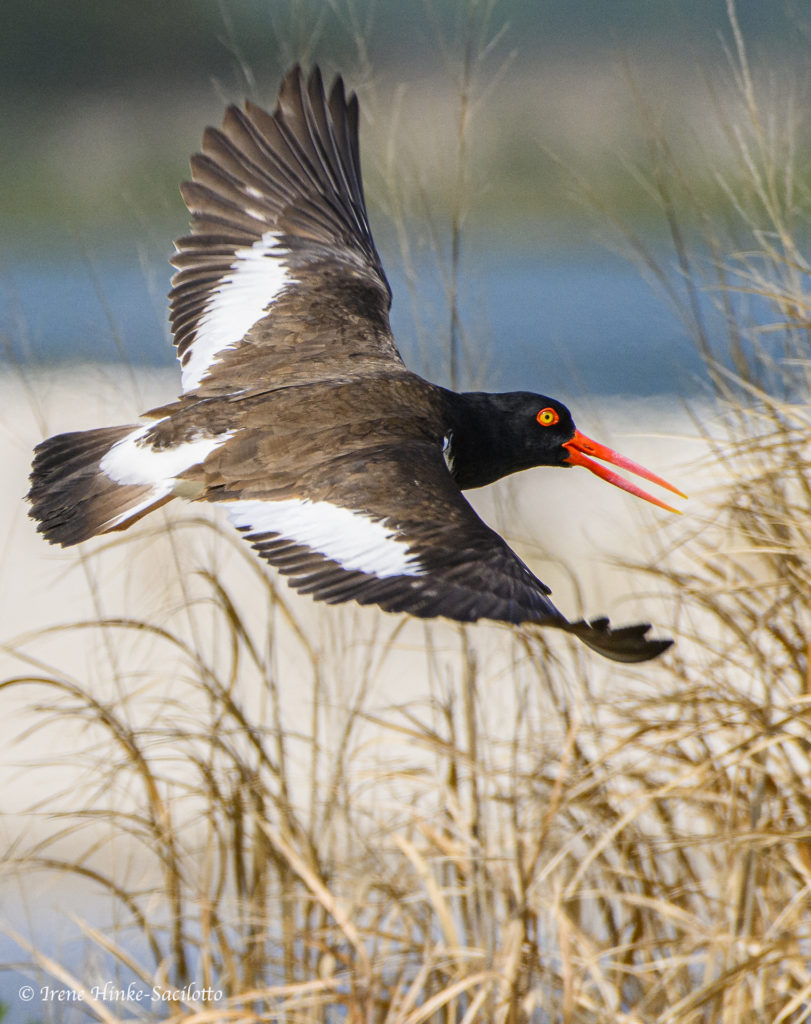
American Oystercatcher flying over grasses on Tangier’s beach. Used animal eye tracking to keep it in focus.
For these American Oystercatcher images, I used my Nikon Z9 mirrorless camera with animal eye tracking to follow the birds’ movement. To lighten my load when hiking across Tangier’s sand beach, I used my Z 70 to 200 mm, F2.8 Nikon zoom lens with a matched Z 2 X teleconverter. The lens/camera combination was light enough for me to get sharp images while handholding it with the help of the camera’s image stabilization. (Most of today’s zoom lenses and teleconverters for mirrorless cameras are far superior to those produced for D-SLR camera systems.) With the 70-200 mm lens fully extended and the camera sensor set to the DX mode instead of full frame, the image size in the frame was comparable to that produced by a 560 mm lens. Because of the large maximum aperture of the 70-200 mm lens (F2.8), even with the 2X teleconverter in place, I still could shoot at fast shutter speeds without outrageously high ISOs. (2X teleconverters reduce the amount of light coming into the lens by 1/4 of the original.)

Oystercatcher pair flying together. Demonstrates the flying precision of this species.

Glossy Ibis feeding in one of the tidal guts. The touch of sunlight brought out the beautiful colors of breeding plumage. With an highly overcast day, the ibis would almost look black.
Photo opportunities on Tangier vary with the tide, season, and weather. When the tide is low and channels are nearly drained of water, Glossy Ibis with long curved bills appear and probe the mud and feed on organisms beneath the surface. Secretive rails which are usually hidden deep within the marsh venture into the open. Supported by their long toes, they easily can walk across the mud snatching up snails, crabs, and other invertebrates. (Their cackle is often heard before the rail is seen.)

Clapper Rail at a standoff with blue crab.
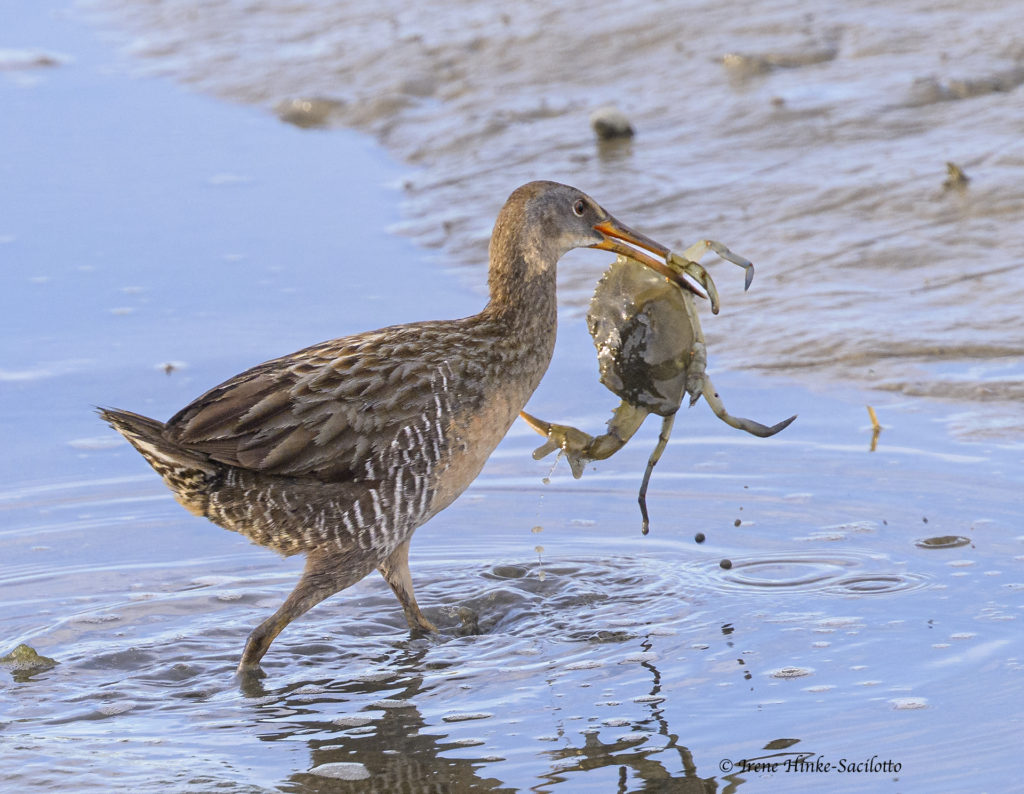
Same Clapper Rail carrying the crab into the marsh in order to eat it.
When the tide shifts and the channels fill with water, egrets and herons fish from the shoreline, the rim of sunken boats, and abandoned crab traps. There are few natural perches along the waterways.

Immature Night Heron fishing from an abandoned crab trap.
Many ospreys nest locally on man-made platforms, channel markers, old duck blinds and abandoned docks. They are often seen flying overhead carrying sticks to reinforce their nests or carrying fish to feed their mate or young.

Osprey carrying fish in its talons with the fish oriented in such a way as to reduce wind resistance.

Yellow-Crowned Night Heron taking flight. Photographed from my porch at The Brigadune Inn where I was staying.
This May I was on Tangier when a high tide combined with a strong stationary off-shore low flooded portions of the island for 4 days. Not able to travel in the high water, I took advantage of the situation and photographed herons and shorebirds from the porch where I was staying. When the water receded, I captured images of migrating shorebirds feeding in the remaining roadside pools of water and neighboring backyards.

Dowitcher taking off after feeding in the yard of the inn where I was staying.

Dunlin is still mainly in winter plumage feeding in neighbors front yard after flooding.
This year in mid-May I was treated to the arrival of migrating songbirds and warblers. Following the Chesapeake Bay northward, sometimes they stop for a few days on Tangier Island to rest and refuel before continuing their journey. Many were attracted to the bushes outside the office of Brigadune Inn. So I concentrated my photography in this area and close-by locations. It was a good strategy since I was able to capture images of 8 species of birds from fairly close distances. I used a 200-500 mm Nikon lens with my mirrorless Z9 camera. Frequently, I shot from the cover of my golf cart where I had a tripod and beanbag mounted. At other times due to the birds location, I took photos by handholding the lens. Image stabilization set on “Sport”definitely helped.
When photographing elsewhere on the island, I often used a golf cart as a mobile blind. The birds ignore the cart since they are used to seeing them traveling the roads. Over the years local folks have gotten use to seeing me with a camera and long lens. Many will wave or nod as they go by. At times they stop and ask questions about what I was photographing or tell me about a bird they had seen. It is great to see them interested in learning more about the wildlife they see every day.

Northern Parula warbler sitting in bush resting during migration

Black and White Warbler perched on the roof of a nearby building.

Immature White ibis feeding in a pond with a third young bird and 2 adults..
When planning a photographic trip involving wildlife, I typically research my subjects in order to locate them and predict their behavior. I check the web and bird guides for information but also find it valuable to talk to locals who know the area well. For instance, I found these immature White Ibis after receiving a tip from a resident of the community of Canton on Tangier. He told me that often in the morning large numbers of herons landed in a pond near his house. So one day, I checked out the location. I photographed these two immature White Ibis feeding along with 2 adults and another young bird. According to local birdwatchers on the island, this was the first time this species nested on Tangier. Two adults had been seen together earlier in the summer in a nearby yard and I suspect they were a nesting pair responsible for these chicks. (In the last couple of years, large numbers of White Ibis have been seen on the barrier island of Assateague, where they now nest. In years past, this species like the Brown Pelican have extended their range farther to the north, possibly in response to climate change and warming temperatures.}

American Oystercatchers on nest with eggs.
Willets and American Oystercatchers nest each year on Tangier’s beach placing their eggs directly on the sand or on low dunes with scattered grasses. This year the high spring tide flooded the Oystercatcher nests but they re-nested later in the spring. This is not unusual for them since they tend to build their nests early and close to the water. Unfortunately, I never got shots of the hatchlings. They were nearly full grown when I returned to Tangier in September. At that time, they were gathering together in groups preparing for their migration south.

Young oystercatcher with adults photographed on the Uppards across the channel from the main portion of Tangier.
The Oystercatchers are fascinating to watch as they react aggressively to each other and other intruders entering their territory. If they feel threatened, they lower their heads, utter a high=pitch squeal, and run at whatever they believe is a threat. This includes Black Skimmers which are much larger.

Oystercatcher aggressively attacking another oystercatcher that landed in their midst.

Black Skimmer fishing.
Black Skimmers are beautiful to watch as they slice through the water in the tidal guts and beach lagoon with their lower mandible submerged. When encountering a fish, the top bill snaps shut capturing it.

Willet landing on post in the marsh.
If anywhere near a willet’s nest they will issue a constant high pitch cry and try to drive you out of their territory. Most of the time, I have no idea where the nest is located so it is hard to out-maneuver the birds.

During a boat ride out to the beach, I photographed these young terns resting on floats associated with oyster aquaculture, a new enterprise on the island.
This year I was disappointed that Black Skimmers, Fosters Terns, and Royal Terns did not nest on Tangier’s beach as they have in the past. Folks with ATVs driving along the beach have discouraged nesting. The hope is that signs will discourage people from disturbing the nesting birds. Today, due to development, erosion, and sea level rise, undisturbed beaches suitable for nesting birds are few but yet critical to the survival of many species.

Royal Tern flying with a fish. Birds are attracted to the waters around Tangier since food is plentiful locally.
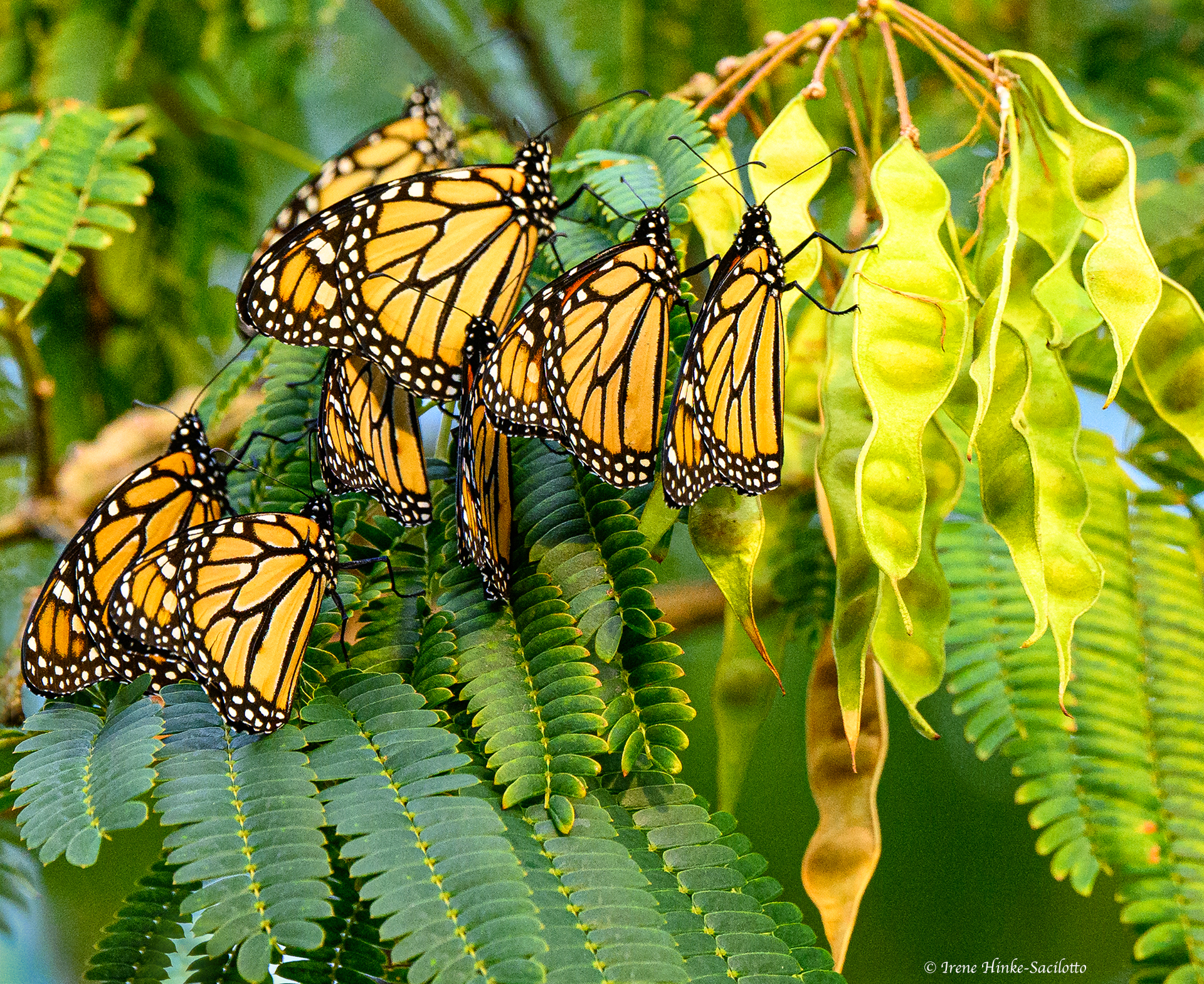
In late September or early October, Monarch Butterflies often stop on Tangier Island on their way to Mexico. This year was the first time I got to witness this spectacle. Groups gather in trees around the island. But photography was difficult because it was very windy when they arrived and keeping them focus was difficult. The butterflies spent the night in the tress and when the sun rose and warmed them, they flexed their wings once or twice and took off. I choose my camera angle carefully so all members of a group were in sharp focus. I had to use a moderately large F#, high ISO, and fast shutter speed to capture all of the individuals in the cluster.
One of the plants they were attracted to was goldenrod. In order to add variety to my photos, I walked down the beach in search of blooms with butterflies clinging to them. In the case of this image, since I was magnifying the butterfly a great deal, I had limited depth of field. Therefore I had to be careful to line up the face of the lens parallel to the wing’s surface and butterfly’s eye.

Monarch resting on a goldenrod bloom.
In the fall and winter, waterfowl flock to the waters around Tangier. I have never visited in the winter but hope to this year. Thousand of waterfowl spend the colder months of the year in the Chesapeake Bay, with many in the waters surrounding Tangier Island.
No matter when you visit Tangier Island, there is always something wild to photograph.

Tundra Swans, Swans, Snow Geese and a variety of ducks arrive in the late fall and stay through the winter.
TRAVEL TIPS
Access to the island is primarily by “passenger only” ferries from Crisfield, MD or Onanock, VA. Be sure to check out the ferry schedules and make reservations. The dates and times vary with the season and days of the week.
Overnight accommodations in Tangier are limited to a few B&Bs. This spring and summer I stayed at the Brigadune Inn with very comfortable accommodations. Currently there are only two restaurants on the island and kiosk where you can purchase hamburgers, etc. However hours of operation and opening dates vary each year and can be effected by local events. There is a grocery store on the island that in the recent past has not been well stocked. But it has a new owner, so this may change.
To travel around the island, you can walk, rent bikes or kayaks. You can rent a golf cart but there only a few available.
Particularly in the spring and summer, bring insect repellant. A head net and insect jacket can be handy since gnats, mosquitos, and biting flies can be can be annoying

Snowy Egret taking flight.

Snowy egret taking flight. Because I shot with continuous auto-focus and at a high number of frames per second, these two images captured very different wing positions.
PHOTO TIPS
Using continuous auto focus, animal eye tracking, and a high number of frames/second you can capture that perfect shot. As above, this technique resulted in two very interesting views of the bird.
When photographing, try to be as close to the subject as you can without disturbing them. The farther you are away, the more likely that heat ripple, dust, pollen, moisture, etc. can soften the image quality.
Try to capture behavior and the bird’s unique features.
Stretching wings, shifting weight, bending knees, nervous chatter, or stretching the neck upward, may indicate the bird is ready to fly.

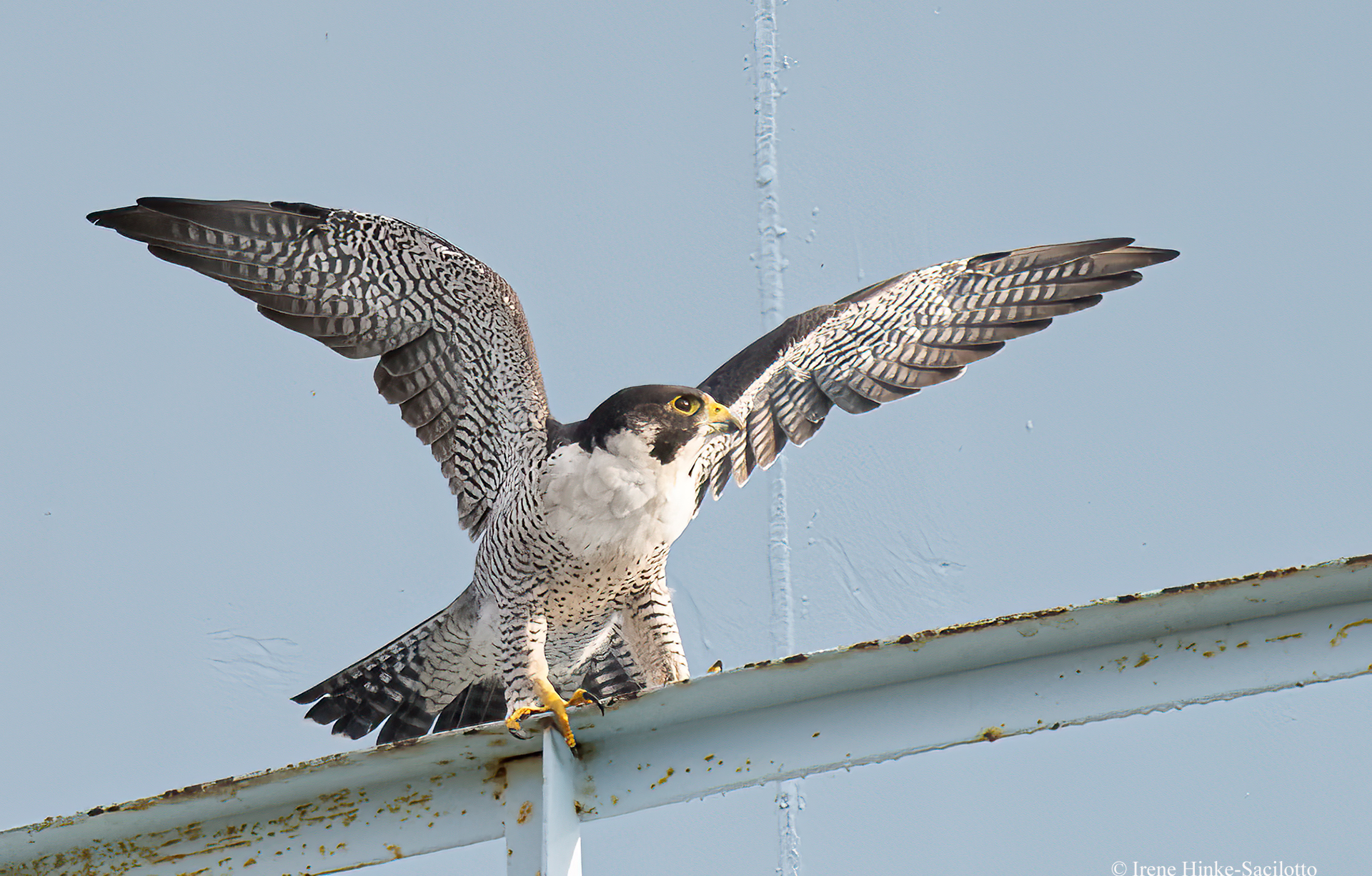
This Peregrin Falcon is stretching wings on top of Tangier’s water tower. For a number of years, a pair of falcons have returned to this high perch. Since the top of the tower was far away, getting. this photo required high magnification. For a sharp image, I needed a windless day, sturdy tripod, and a cable release to fire the camera without touching it.
If your camera system has image stabilization, check what setting should be used if the camera is mounted on a sturdy tripod. This varies with the camera model and lens.
Walking through the marsh and crossing ponds and lagoons can be dangerous. The bottom often consists of soft mud. You can easily sink down to your knees in the mud and lose your balance as well as your equipment.
To photograph flying birds, image stabilization and animal eye tracking on newer mirrorless cameras increases your keeper rate. For a flying bird, it is best to use a shutter speed of 1/2000 of a second or higher if the bird is a fast flier or is close. Start focusing on the bird at a distance using continuous auto focus. Follow it until it is close enough for the image you have in mind. Shoot a burst of shots at a high number of frames/second.
I typically shoot a short burst of shots at a high number of frames per second even if I have a stationary animal to capture the best image with the eye open, best pose and sharp focus.
It is helpful to remember that birds typical take off and land into the wind. Choose your camera position and angle accordingly.
Photograph subjects at eye level for a smooth, blurred, distant background, less distortion, and a more intimate photo. Of course this is not always possible or wise. Always look to avoid distractions behind your subject — bright branches, shiny leaves, a cluttered shoreline, etc. Soft light can minimizes background distractions, with fewer hots spots and dark shadows. Shooting from a low angle is not always good if you are trying to capture reflections. A higher angle may be better.
The more you photograph, the better your images.

Pelicans stacked up on the tip of Tangier’s beach. Most afternoons they are found there.
If you lie on the ground and shoot, look for grasses and other objects that your focus will lock on instead of on your subject. You may have to manually focus. The subjects eye must be sharp or the whole image is compromised. Also if you are shooting at a low angle and there is a rise in the land in front of your subject, it may be out of focus and distracting. Or it may undesirably hide the feet or other critical part of your subject. On the other hand, it can create a soft vignette or frame around your subject.
Refine your images. If the subject is still present, explore alternate camera angles, magnifications, backgrounds, lenses, etc. Look for ways you can improve and vary your approach.
Subjects present, bird behavior, and coloring changes with the season and year. Check field guides and locals for advice.
Get the image right in the camera and don’t depend on post processing to fix it. Many problems are not fixable.
The more you observe wildlife, the more able you are to anticipate what they will do next.
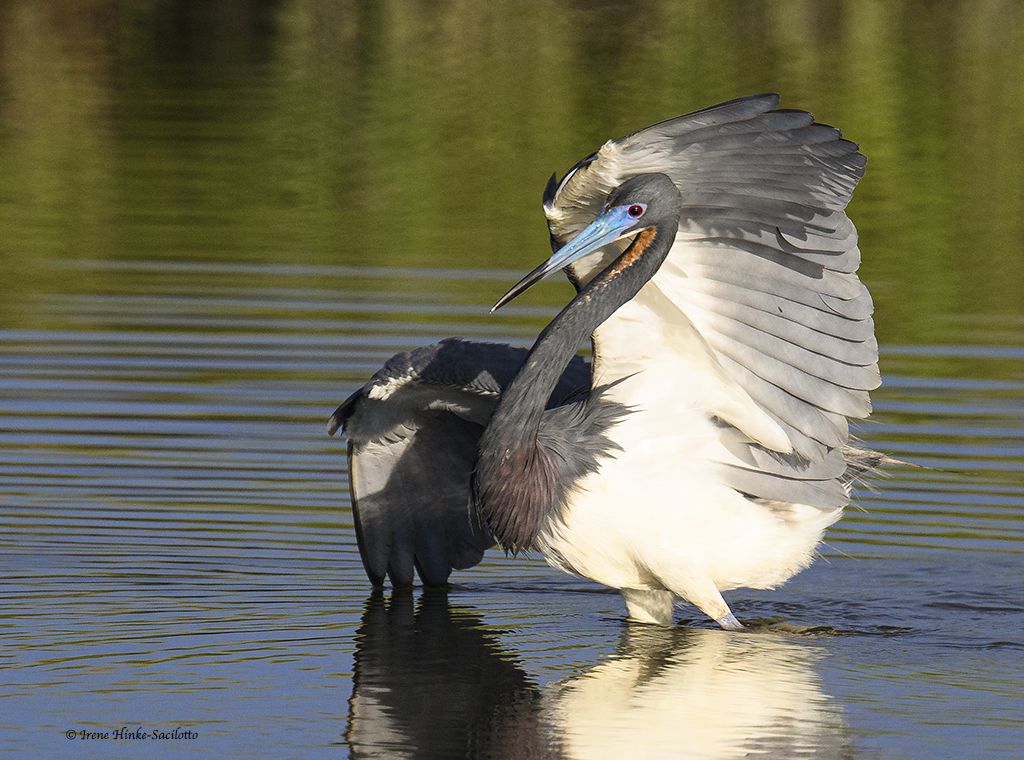
Tri-Color Heron canopy feeding. It creates a shadow that attracts fish. I had to time the shot and choose the camera angle carefully to avoid the heron’s face from being shaded or blocked by the wing.

by Osprey Photo Workshops & Tours | Mar 19, 2022 | Bird photography, Nature Photography, Pennsylvania, Photo Workshops, Snow Geese, Swans, Wildlife Photography, Winter Photography

Snow geese lift off at Middle Creek Wildlife Management Area.
Middle Creek Wildlife Management Area, PA
At the beginning of March I spent a day and a half at Middle Creek Wildlife Management Area in Pennsylvania, approximately a 2.5 hour drive from my home near Baltimore. This was my first visit to the area. I could not resist packing up my camera gear and heading north when a friend from one of my photo workshops sent me a great image she had just taken at Middle Creek of a huge flock of snow geese taking off from a farm field.
Many years ago, 40,000 snow geese visited Chincoteague National Wildlife Refuge in November. I recall one afternoon during one of my photo workshops, while driving the Wildlife Loop we encountered thousands of snow geese in the impoundment and near the road. Periodically they would rise in unison from the ground sounding like a plane taking off. They would fly overhead, circle, and return to the same spot that they had left. Not only did they do this once, but repeated the behavior several times more. I have never forgotten that day. But in recent years the number of geese at Chincoteague has dropped dramatically. Many are now spending the winter at Bombay Hook and Prime Hook National Wildlife Refuges in Delaware with the geese feeding in the fields of the Delmarva Peninsula. It is reported, seasonal counts have exceeded 200,000.
At Middle Creek, I was a reminded of the past scenes at Chincoteague but with even more birds. During my visit on March 4th, there were 78,000 snow geese present with nearly 3,000 tundra swans. Periodically, the number of birds present in the winter were as high as 200,000.

Middle Creek Wildlife Management Area, PA
Middle Creek Wildlife Management Area is located on the boarder of Lebanon and Lancaster Counties in Pennsylvania, north of the town of Lancaster in the middle of Amish Country. Middle Creek is operated by the Pennsylvania Game Commission which is in charge of managing the wild bird and mammal populations at Middle Creek. This roughly 6000-acre wildlife management area is home to hundreds of species of birds and mammals. It is crucial for the hundreds of thousands of ducks, geese, and swans that visit during their spring and fall migration.
A number of accommodations are available approximately 20-25 minutes from Middle Creek at the towns of Ephrata and Lititz, PA.

Middle Creek Wildlife Management Area, PA
At Middle Creek there is a Visitors Center with interpretive displays, an auditorium, and an observation area with feeders and views of Middle Creek Lake. Also there are a number of walking trails, several picnic areas, a vehicle tour loop, and areas set aside for fishing and hunting. During the peak of the fall migration of waterfowl, to reduce disturbance of the birds, portions of the tour loop are closed to vehicles. However, from 1 March until 30 September, vehicles are permitted on the interior, northern part of the tour route.

The Lake
The impoundment (lake) where the snow geese, tundra swans, and other waterfowl congregate was created by the construction of a dam in the early 1970s. It is quite shallow, with an average depth of only three feet. Waterfowl attracted to the lake are those that prefer shallow water, compared to the diving ducks of the Chesapeake Bay. The deepest part of the lake is just above the dam where you might see herons, egrets and kingfishers.

Visitors Center Pond
The Visitors Center pond during the spring and fall migrations is an excellent spot to observe at a distance mallards, black ducks, northern shovelers, ring-necked ducks, wood ducks, hooded mergansers and others. The “tree-house” type structure located behind the pond is a bat condominium intended to serve as a maternal colony for up to 6,000 bats.

Kleinfeltersville Rd
Just past the road to the Visitor Center along Kleinfeltersville Rd on the right is an open area with a relatively clear view of the lake. When I was there, the cove was filled with snow geese in the morning and evening, with some at close range. They shared the area with Tundra Swans.At times more geese joined the group filling the sky with birds before landing. Eventually the main group of geese flushed and in mass, joined the other geese farther back in lake. To my surprise, the swans did not join them.. It may be a good spot to photograph flying geese at sunrise. However, most visitors gather at Willow Point for sunrise.


Willow Point Trail
The Willow Point Trail is very popular when the geese are present. It is an easy 10-minute paved walk that leads visitors to an observation point overlooking a large portion of the 360-acre lake. During spring migration, there are days when the waterfowl put on incredible flight displays, moving from one section of the lake to another. Occasionally, they would fly over the head of visitors before circling back to the lake. It was suggested that they took off in response to a bald eagle that left its perch on a dead tree across the lake and headed towards the flock.


Waterfowl Propagation Areas
From the Observation Point Parking Lot past Willow Point, it is possible to see activity within the waterfowl propagation area which is off limits to people. It is set aside to allow birds a place to nest, rest and feed unmolested year-round. In the spring and early summer you may see a variety of songbirds. Bird boxes attract tree swallows and bluebirds. In the fields you may see bobolinks.
On the southwestern portion of the lake there are three different types of nesting structures provided for waterfowl. Tire and tub structures provide a nesting areas for Canada geese. The straw tubes are provided for mallards and black ducks, while the box style structures are for wood ducks.


View from the interior loop road.
After observing the movement of geese from Willow Point and talking to other photographers, on my last afternoon in the area, I drove to the northern end of the interior tour loop where I thought the geese might be landing in a field close to the road. There were a number of cars parked at the side of the road which suggested I was right. I left may car at the end of the line and walked to where I had a clear view of the field and a number of geese on the ground. As I stood there photographing, other geese left the lake and joined the group. More and more geese arrived with some on the ground taking off and flying overhead to a field behind me. As sunset approached, the parade of geese leaving the lake continued with one “V” formation after another heading in my direction. I had hoped they would pass in front of where the sun was setting but most did not. However, I did capture a few images of lines of geese in front of the warm colors in the sky.


I plan to return in future years. Great wildlife photography opportunities.

by Osprey Photo Workshops & Tours | Aug 9, 2021 | Bird behavior, Bird photography, Chicoteague, Digital Photography, Nature Photography, Photo Tours, Photo Workshops, Rookery, Spring Photography, Spring Photography, Spring Photography, Wetlands, Wildlife Photography
May/June 2021- Heron Rookery Photo Project

From 24 April until 18 June 2021 I was on the road. One of my projects involved documenting the activity in a heron colony populated by a variety of wading birds–Great and Snowy Egrets, Black-Crowned Night Herons, Tri-color & Little Blue Herons, and a few Glossy Ibis. The rookery was in a large marsh on a ridge where low shrubs grow such as Bayberry and Wax Myrtle. Nests were low and among tangled branches that help protect the nests, eggs, and offspring from predators. It was a perfect locations with little chance of flooding and rich waters nearby with abundant food to provide for the growing youngsters.
Photographing colonial birds in a rookery setting requires a very careful approach as to not negatively effect breeding success.
Herring Gulls
Surrounding the heron colony in the tall stands of salt-meadow hay Herring Gulls nested. They chose a perfect location since they could swoop over the rookery harassing the herons and attempting to grab eggs and hatchlings. On several occasions, I saw a gull dive down and hit exposed heron. There was evidence that high water flooded the lower part of the marsh and destroyed some of the nests.


Precautions
I took great care to minimize any disturbance of the nesting birds to avoid interfering with nesting behavior, possibly causing displacement of eggs or the herons abandoning nests. I keep. my visits infrequent, limited in time, and when temperatures were moderate.  Since my intent was to document natural behavior and interactions between individuals, I would have been foolish and unethical to disturb the birds.

My route through the marsh was difficult since I had to avoid soft mud, holes, and tidal guts.   I benefited from past experience reading the marsh and noting what grasses and substrate would support me.

Dressed in camouflage, I approached the colony slowly and indirectly.  I photographed from a  low position, sitting or kneeling on the soggy, water-saturated ground.  Once in place, I  minimized my movement.  It was usually distant noise that would cause the birds to flush from their nests -- the rumble of trucks, planes, boats, and construction projects..  Luckily, the birds quickly returned to their nests and young.

Equipment
Lenses primarily used included my 200-500 mm and 80-400 mm Nikon lenses.with my D500 and D850 Nikon cameras attached. The telephotos were necessary to keep my distance from my subjects and yet isolate them. Zoom lenses provided for flexibility. As the birds moved and interacted, I could adjust my focal length to capture the range of motion. Most shots were taken using a tripod with a sturdy ball head or gimbal mount. I used waterproof sleeves over the base of the tripod legs to protect the joints from damaging grit and corrosive brackish water.


Changes from May into June
During May, many herons displayed breeding plumage and bright colors around the eyes and bill. A few still were engaged in mating, courting and nest building, with some birds carrying sticks. In mid-June, courtship feathers were less obvious and the facial colors had faded a bit. There were eggs in some nests and young birds in others.


Capturing action
One of my goals was to capture arial fighting and aggressive behavior as birds landed in the bushes and jockeyed for position to access their nests. I carefully observed the colony concentrating on areas where there was more activity and less tolerant birds. Aggressive actions included nipping, stabbing, feather pulling, hackle raising, or just landing on the back of an opponent.
I had the best luck capturing the arial fights when using my 80 – 400 mm lens and shorter focal lengths since it was nearly impossible to predict exactly where and when the action would occur.


Focus Difficulties
If the birds were flying with sky in the background, I focused using a small group of focus sensors. When multiple subjects were involved, I selected an f-stop that offered a bit more depth of field than usual such as an F11 or 16.  But to freeze action with high shutter speeds, I had to use higher ISOs than I typically prefer (often 1000 or 1250).  When the birds were perched on branches or were landing,  I often used a single focus point over the bird's eye.

With auto focus, I had problems with the sensor locking on branches and leaves, not the bird.  Sometimes manual focus was required. Because the nest were located deep within shrubs, I struggled to get clear shots of the birds landing and interacting without branches, grass, shadows or the wings blocking their faces.

Final Thoughts
Most folks find marsh foreboding with muck, unpleasant smells, and pesky flies and mosquitoes.  For me, they are marvelous places filled life and new things to discover.  When  involved with projects like this one where I am deep within a marsh, I find solace and a connection with nature.

Marshes are critical ecosystems that need our protection, not destruction  They are highly productive and a haven for wildlife. They trap sediments and remove nutrients and toxins from the water that can clog our waterways, poison wildlife, and deplete life-giving oxygen.

by Osprey Photo Workshops & Tours | Aug 8, 2021 | Autumn photography, Chincoteague NWR, Nature, Nature Photography, Photo Tours, Photo Workshops, Wildlife, Wildlife Photography
Trip Report, Chincoteague NWR, November 2020
Nature Photography
Chincoteague NWR is located on the southern Virginia end of the barrier island of Assateague. In the fall, the refuge attracts large numbers of snow geese along with ducks, swans, herons, ospreys, shorebirds and other migrants. It is also the home to wild horses, deer, raccoon, fox squirrels, and other animals. Used to being protected, the wildlife is unusually tolerant of humans and presents visitors with great photo opportunities. It is one of my favorite places to photograph wildlife in both the fall and spring. I have been conducting photo workshops there for many years. Numbers of species and the variety has shifted over the years. The refuge is located along the Atlantic Flyway. Once over 40,000 snow geese stopped at the refuge doing fall migration Now they stop farther north but still several thousands visit the refuge today along with shorebirds, swans, and other waterfowl.


Chincoteague NWR website:
https://www.fws.gov/refuge/chincoteague/
Trip report – Fall 2020
First Stop – Sunrise
For sunrise I typically stop along Beach Road at the first large pool on the right after passing the visitors center– Black Duck Pool. There are convenient pull offs for cars on both sides of the road. At sunrise, I often see deer crossing the water.
I had a treat one morning at sunrise when a large flock of White Ibis circled overhead with many landing in front of me. They were joined by herons and a few ducks. When photographing the birds against colored sky and water, I had to be careful that their silhouettes did not merge with the silhouettes of other birds or the surrounding grasses.
Several mornings were foggy and allowed me to create images different from many I have taken here before at this location. The two photos below were taken on one of those mornings. I like the layers revealed by the lifting fog and sense of calm these images invoke. In terms of exposure if using aperture priority, I had to increase my exposure compensation by at least +2. Remember that the light meter assumes it is pointed at something mid-tone and will darken the exposure to make it so, thereby underexposing the image.


First Stop – Sunrise
For sunrise I typically stop along Beach Road at the first large pool on the right after passing the visitors center– Black Duck Pool. There are convenient pull offs for cars on both sides of the road. At sunrise, I often see deer crossing the water.
I had a treat one morning at sunrise when a large flock of White Ibis circled overhead with many landing in front of me. They were joined by herons and a few ducks. When photographing the birds against colored sky and water, I had to be careful that their silhouettes did not merge with the silhouettes of other birds or the surrounding grasses.
Several mornings were foggy and allowed me to create images different from many I have taken here before at this location. The two photos below were taken on one of those mornings. I like the layers revealed by the lifting fog and sense of calm these images invoke.

In terms of exposure if using aperture priority, I had to increase my exposure compensation by at least +2. Remember that the light meter assumes it is pointed at something mid-tone and will darken the exposure to make it so, thereby underexposing the image.

Black Duck Pool
After shooting sunrise, I will check out the scene across the road for horses and herons in the early morning light. If there is nothing of interest, I typically drive towards the beach checking out the borrow ditches on the side of the road for herons, ducks and other visitor that are in good light and in a suitable non-distractive background.
Note: In the summer it is difficult to photograph wildlife other than in the early morning and late in the pm since there is a lot of traffic on Beach Road as folks head to the public beach for the day.
On the morning that I saw the flock of ibis at sunrise, I found a large number of individuals engaging in a feeding frenzy at the junction between the borrow ditch on the left and Swan Cove. They were joined by a few herons. This is the first time that I have witnessed such a high number of ibis together. When they finished feeding in one area, they moved up the borrow ditch congregating at various points along the way. My car worked beautifully as a mobile blind. I could move the car and follow the birds as they traveled upstream. I shot from the car as to not disturb the birds and used a bean bag on the window sill to securely support my lens and camera.

Occasionally in the same area I have encountered a fox or raccoon, so I am always checking the edges of the road for cooperative subjects.

Swan Cove
One of my favorite spots to photograph is Swan Cove. It typically attracts are large number of birds including shorebirds that often feed in the shallows near the road at low tide. On this trip I encountered a group of Yellowlegs and Dowitchers feeding close to the shore. Again I used my car as a mobile blind, shooting from the window with my 600 mm lens mounted on my home-made beanbag. On a day there was little wind and I was able to capture images of the birds with their reflection in the water. I always look for small ducks and grebes in this pool. On this trip I was able to photograph several tolerant Pied-Billed Grebes, Buffleheads and Ruddy Ducks close to shore, sleeping, preening and diving for food.


Black Duck Pond
Often later in the morning I check out the marsh and fields across from Black Duck Pond. I typically look for horses in the marsh and around small stands of trees. Around 9 a.m. on more than one morning, I got a number of photos as the horses crossed the marsh and fed on the grasses. Sometimes blackbirds would land on their backs, I am guessing, eating insects.

In this same area I found a cooperative female Belted Kingfisher sitting on a post. I spent a delightful hour with her as she flewdown to catch fish, landed on the post again, shook off water, preened. and stretched its wings. I got a number of great images shooting from my car with my 600 mm F4 lens combined with a 1.4 teleconverter


Also in the same marsh where there were pools of water and a channel, I was able to photograph herons feeding, groups of Buffleheads swimming the channel as well as Double-crested Cormorants swimming, diving or sitting on dead snags drying their wings. This past year the water level in the marsh was perfect for shooting across marsh at sunset.

Little Toms Cove
I frequently check out this area near the water control devices that allow water to pass under the road to Swan Cove. Often when you have an obstruction in waterway, macroinvertebrates and other organisms accumulate around the opening often attracting fish and birds. This year I encountered a bird that I had not photographed before, a Surf Scoter, a sea duck typically seen flying over the ocean. This past November there was a Horned Grebe hanging out in the same location. When the tide is out, I often see rails or oystercatchers feeding on the exposed mud flats.


Sea Ducks
In the winter some photographers go to Barnegat Light and State Park in New Jersey, The photographers brave the cold to photograph sea ducks from the jetty at the inlet — a favorite is the Harlequin Duck. I have not visited the site in the winter but have seen great results. However, conditions can be dangerous with icy rocks and a rough surf with waves that might swamp you and your equipment.
 Atlantic Shore
I always check out the beach for a colorful sunrise or shorebirds feeding along the water’s edge. The best time to photography is when the tide is low and when more of the beach is exposed. When photographing shorebirds, in the morning at Chincoteague it is difficult to avoid shadows covering much of the bird without moving out into the surf. However with post processing in Lightroom and Camera Raw, you can lighten the shadows with a selection brush. I always concentrate on birds that are moving towards me, not retreating. In the afternoon, it is easier to capture these images since the bird often is lit by the soft warm light at the end of the day.


 x
x
Bayside
On the bayside of Little Toms Cove opposite the beach, I often find an assortment of shorebirds, herons and an occasional fox. On this visit, there were Great Egrets flying back and forth feeding near posts marking private clam beds. I also photographed aa Black-bellied Plover and a Dunlin in winter plumage feeding amongst the oddly colored organism called Sea Pork. It is a colony of tunicate organisms which are plankton feeders. Though an oral siphon, they draw seawater through their bodies and pass it through a sieve-like structure that traps food particles and oxygen, eventually to exit through the atrial siphon. One sunset when the tide was out, I captured the remarkable colors and patterns as the setting sun lite the mud flats.


Wildlife Loop
On fall afternoons, I often checked out the wildlife drive around Snow Goose Pool (only open to cars after 3 pm). This time not long after I entered the drive, I saw a flock of ducks explode in flight from the marsh. It took me a minute to realize that a bald eagle had swooped over the group. It missed catching a duck and flew back to the pine tree where it often perched near its nest. Unfortunately, I was distracted by the ducks, I missed the shot of the eagle. On other trips I have seen a pair of eagles siting on the edge of the marsh in the same area. Northern Harrier (Marsh Hawks) also hunt in the area.


Shoveler Pool
Farther around the Wildlife Loop is Shoveler Pool which typically attracts ducks, geese, and swans. I was not disappointed this year for small groups of Pintail Duck, Green-wing Teal and Black Ducks took off and landed in the pool. Each day there were a number of Tundra Swans resting and feeding in the same area. Some individuals were quite aggressive, chasing geese and other swans. Before attacking, they often became very vocal, extending their necks low to the water and picking up speed. This fall the water level was low with weeds poking through the water’s surface, often leaving me with a somewhat distracting background behind the birds.
In the background of this pool was a stand of dead pines. These are Loblolly Pines which were killed by an infestation of Southern Bark Beetles that attack old or diseased trees. In several places in the refuge you will see similar stands of dead trunks. Refuge personnel replaces these dead pine trees with hardwoods such as red maple, water oak, and sassafras, creating a more varied habitat for wildlife. During your visit you may see young trees wrapped in plastic for protection.
If all goes well in May, I will return to Chincoteague NWR to photograph, hopefully to capture new and different images.


by Osprey Photo Workshops & Tours | Oct 7, 2020 | MD, Nature Photography, Photo instruction, Photo Technique, Photo Workshops, Wildlife, Wildlife Photography
My COVID 19 Quarantine Survival Story
With the emergence of the COVID 19 virus and the “Stay at Home Order”, like many people, I temporarily panicked. How long would the virus be an issue, two weeks, a month? I could deal that. But a year or more, I had no concept how I would emotionally and financially survive. Almost all my in-person speaking in engagements and photo workshops scheduled for the spring and summer had to be cancelled. Even my fall programs are in question.

Cardinal in spring
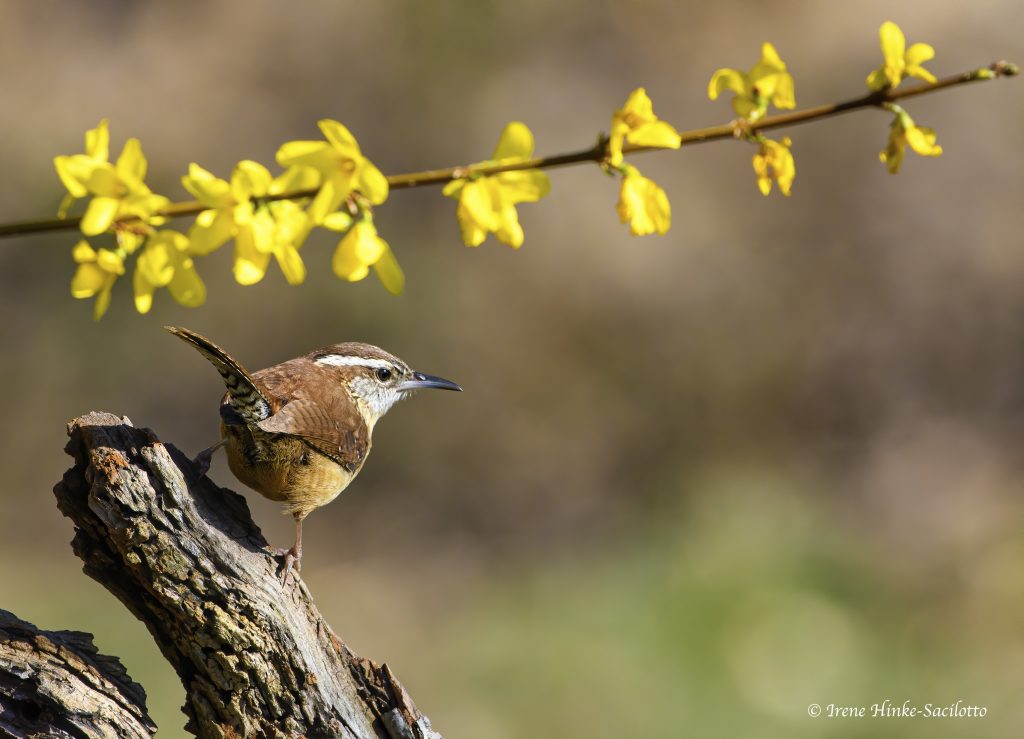
Carolina Wren photographed in local park attracted by feeder.
But I could not change conditions and was not financially destitute like many people, so I started to look for ways to turn this situation into a positive opportunity. I had plenty work to do on the computer—organizing and editing images, updating presentations, prepare advertising, producing a newsletter, etc. But I needed to be outside photographing at least part of the time. With no backyard where I could photograph, I decided to look for photo opportunities in my neighborhood. I checked out a number of trails and parks searching for non-crowded places with urban wildlife. Although some areas had limited possibilities, I did discover two gems.

Red-bellied Woodpecker landing on tree trunk.

Male Red-Bellied Woodpecker spotted when I heard it.
Initial Project:
At one park there was an osprey nest where I spent some time and I got the image above. Another park, five minutes from home, offered a number of opportunities to photograph squirrels, groundhogs, ospreys and an assortment of other birds. I created a feeder station in an open field near a line of shrubs. I baited the scene with birdseed, peanuts, suet and peanut butter. I added small evergreen branches and blooms from nearby trees for a natural looking environment. Squirrels and a variety of birds such as cardinals, wrens, sparrows, and grackles visited the site. Unfortunately, my setup disappeared when park maintenance workers unexpectedly cut the grass in the field. In addition, when the “Stay at Home Order” was issued, the park became a popular place to exercise. Many visitors came with huge bags of peanuts and bird seed which they liberally spread along the trails, attracting the resident squirrels for entertainment. With food everywhere, nothing came to my feeders. So, I had to find another location for photography.

Osprey with fish often head before seen.
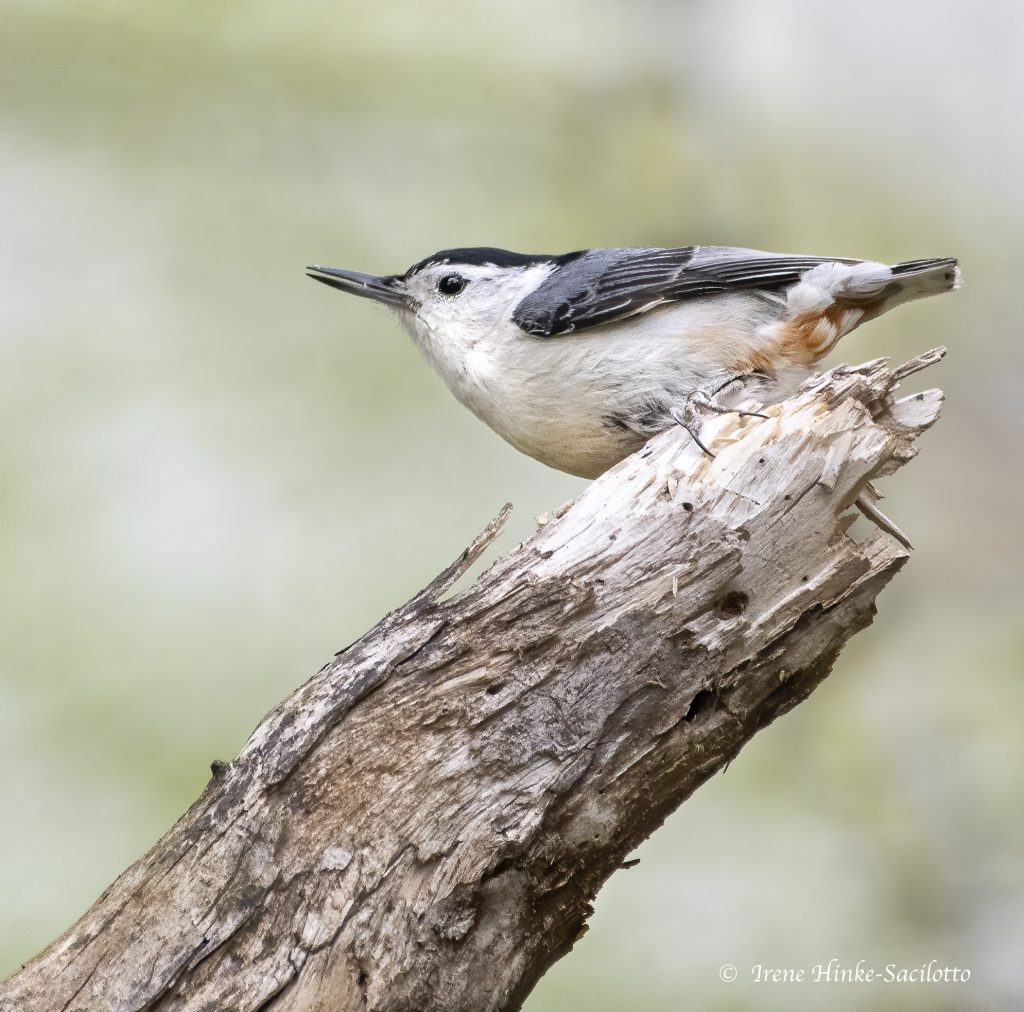
Nuthatch on branch in park.
2nd Project
Elsewhere in the park, I located a large old tree stump. It was adjacent to a path and as people passed by, they tossed peanuts and seeds on it attracting squirrels and also a variety of birds –chickadees, titmice, wrens, doves, blue jays, nuthatches, and red-bellied woodpeckers. To the scene, I added perches for the birds and some extra bird seed. I set up my tripod and camera just off of the path and was able to photograph a number of bird species. But more people kept coming to the park, making photography here more difficult.

Young Gray Squirrels in tree cavity.
3rd Project
While I was taking my daily walk for exercise, I discovered a tree cavity that was home to a family of young gray squirrels. I placed my tripod just off the path and for several days photograph the activity at the hole until the young squirrels outgrew their living quarters and left.

Young Gray Squirrel in tree cavity stretching.
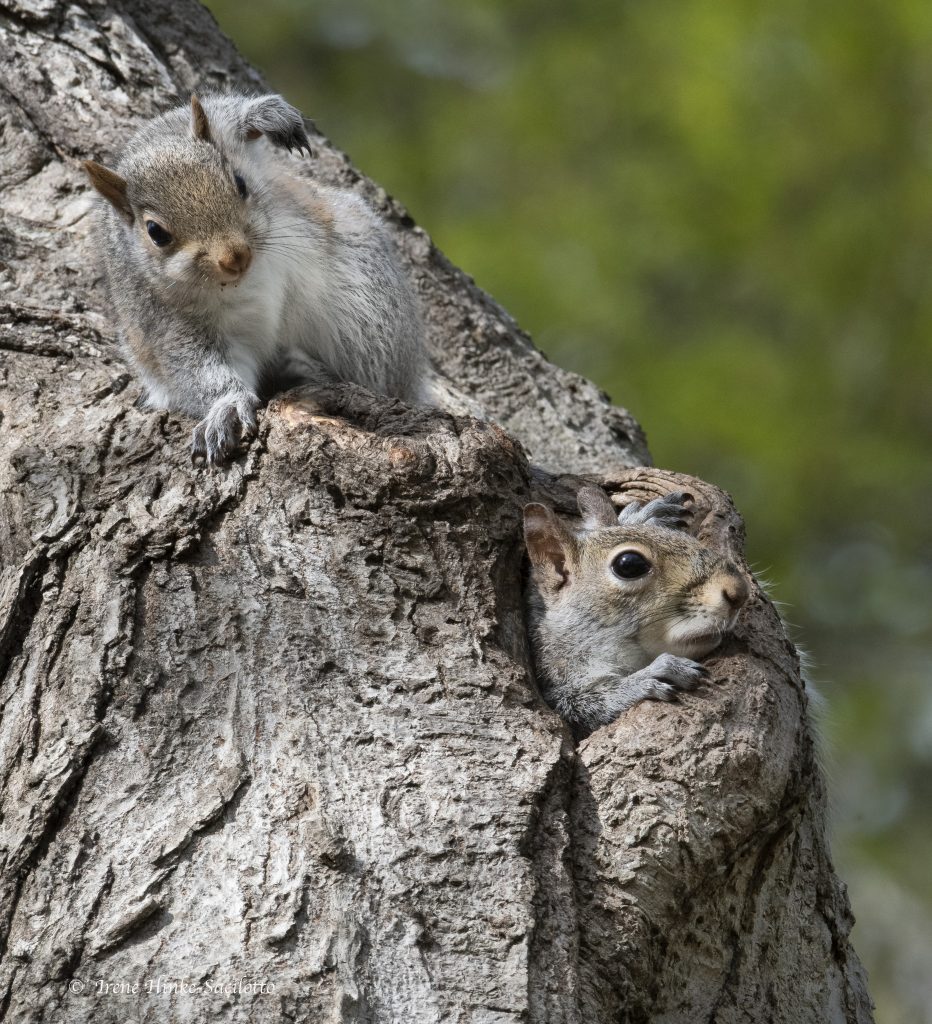
Young Gray Squirrels in cavity.
4th & Continuing Project
During the spring, I had reconnected with old friends. One living nearby owed several acres of land with an open field, a vegetable and flower garden, and woods. She is an animal lover and already had bird feeders at two locations in her yard. Better yet, on occasions, she saw foxes, groundhogs, and racoons from her porch. She was kind enough to allow me to photograph at her home and set up a blind. She loved seeing the resulting images. The experiences photographing at her house during June and July, and August will be covered in my next newsletter.

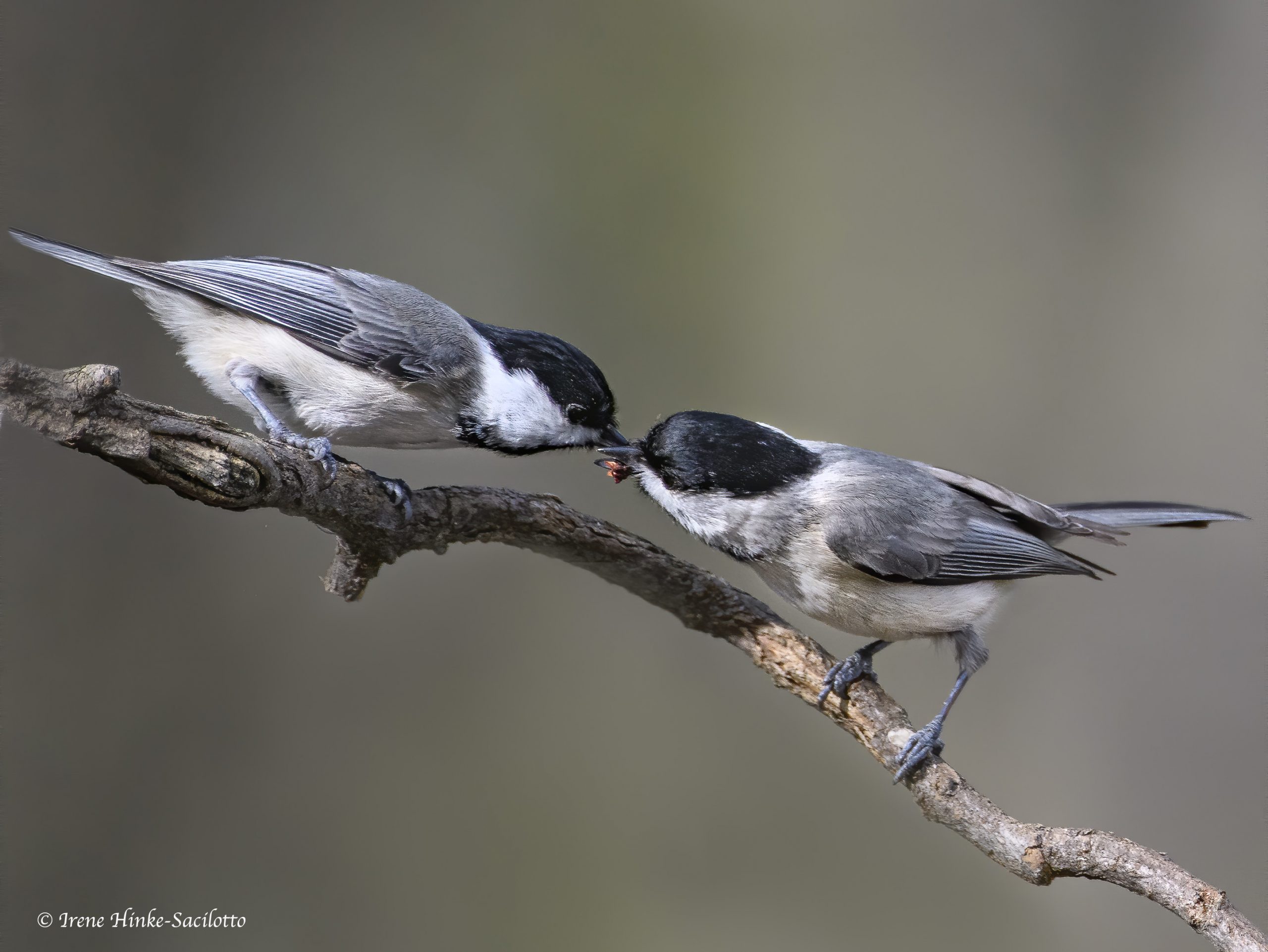
Pair of Black-capped Chickadees