by Osprey Photo Workshops & Tours | Oct 21, 2015 | Autumn photography, Fall photography, Nature Photography, Photo Tour, Photo Tours, West Virginia

Dolly Sods
West Virginia Fall PhotoTour (Trip Report)
Blackwater Falls State Park is situated in the West Virginia mountains near the town of Davis and is approximately a 5 hour drive from my home on the East side of Baltimore. Canaan Valley National Wildlife Refuge and Canaan Valley State Park are only a short distance from Blackwater. They all lie within Canaan Valley, a 13 mile long high valley, nestled among the higher ranges of the Allegheny Mountains. The average valley floor elevation is 3,200 feet (980 m) above sea level which accounts for its cooler temperatures and early arrival of fall. Within the valley are extensive wetlands and the headwaters of the Blackwater River which spills out of the valley as Blackwater Falls. Highly photogenic, its amber-colored water plunges down 62 feet before cascading through an eight-mile long gorge (Blackwater Canyon).

Blackwater Falls
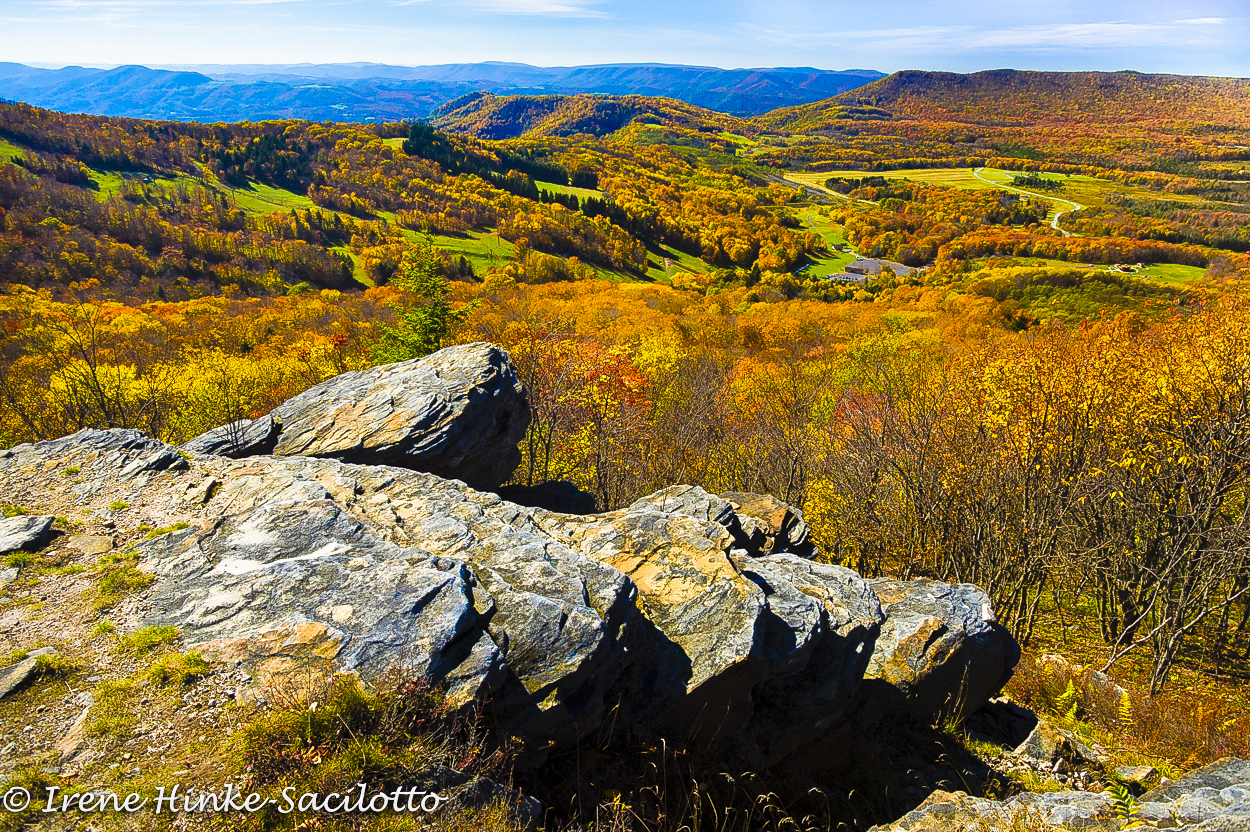
This part of West Virginia is a favorite destination of mine during the first two weeks of October when the hillsides are ablaze with the colors of autumn. This year the colors were less then prime due to wet weather and warmer temperatures but still beautiful. Views from the overlooks at Blackwater Falls State Park such as Pendleton, Linde, and lodge provided ample photo opportunities. Canaan Valley State Park offered more opportunities to capture fall color as the sun back-lit the leaves of aspen, maple, oak, and fern. In ponds and along the Blackwater River, the colors from the surrounding vegetation reflected in their surface. For the first time in a long while, I took the Canaan Valley ski lift to a ridge opposite the park. (The lift does not operate all year so check the schedule if you are interested). Once I step off the lift, it was a bit of a hike to reach an open area with a clear view of the valley, but the trek is worth it. As I climbed towards rocks of Bald Knob, along side the trail I encountered a large group of vibrantly colored red-leaved blue berry bushes which begged to be photographed. From here, I continued to follow the trail upward until I finally reached the rocky overlook with a panoramic view of Canaan Valley. After sitting down for a few minutes and enjoying the view, I began to photograph the valley below using the large bolders as foreground. (You can either return to the parking area the way you came using the lift or follow a steep, leaf covered trail to the bottom. The later can be a bit challenging but I made it down despite being a little sore the next day).

View or Canaan Valley.

Way to Elkins, WV
While in the area, it is worth visiting Dolly Sods, a high rocky plateau. Its 10,215 acres, are part of the Monongahela National Forest and Allegheny mountain range. As a result of logging, fires, and harsh winters, the plant life is unique and more similar to that found much farther north with one-sided trees, sphagnum bogs, and low growing bushes. There are 3 main access roads to the road that runs the length of the ridge of Dolly Sods. All are gravel and can be a bit challenging for cars with low clearance. There are a number of overlooks of the Allegheny mountain range once you reach the top. My favorite area is the end near the end of the road in a section known as Bear Rocks. Here there are few trees, large lichen covered boulders, and fields of blueberry and cranberry bushes with leaves that turn red in the fall. Late in the afternoon, these leaves glow when backlit by the setting sun. (See under tips, notes for avoiding flare in your photo). This year the leaves were more brown than previously but there were still some areas where the color was nearly prime. It had rained the day before I arrived and puddles had formed on the trails. The water reflected the blue of the sky and the colors from the surrounding vegetation offering some unique opportunities for photography.

Dolly Sods

Dolly Sods
No mater when you visit, these West Virginia treasures offer the photographer plenty to photograph. There are more possibilities in Southern West Virginia, where I have done workshops in the past–the New River Gorge, Sandstone Falls, Grand View, Babcock Mill, Pipestem State Park, Hawks Nest, and other locations offer photographers great photo opportunities in the fall. Fall comes a bit later in these locations – late October. No matter where you go, think of photographing more that the grand vistas and consider simple things like bubbles in a stream, water droplets on the grass, a caterpillar, a backlit fern, or a deer drinking from a pool of water. The possibilities are endless for an autumn photo tour.


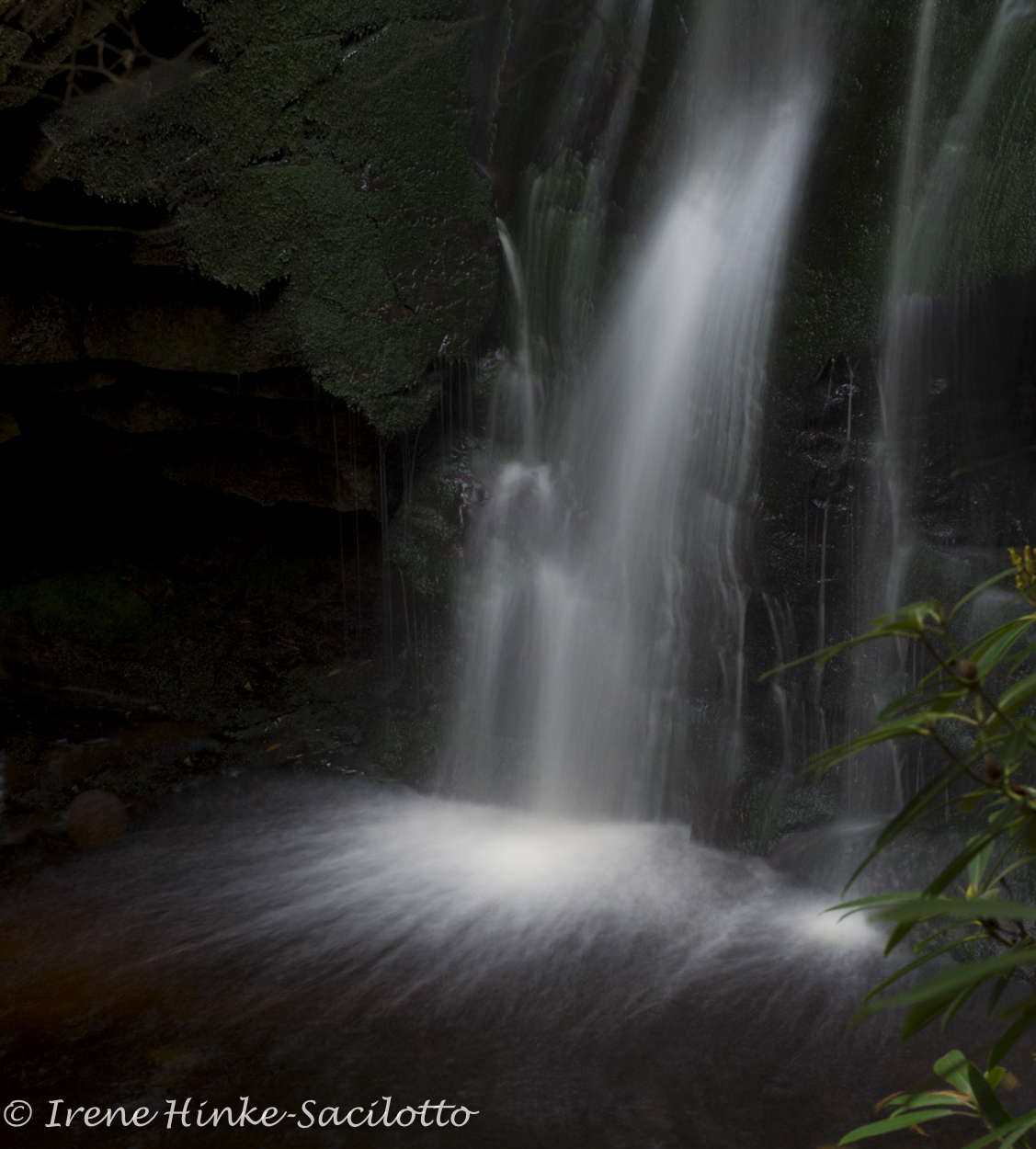
Elakala Falls near blackwater lodge
Robert Hitchman in his “Photograph America Newsletter” describes autumn photo opportunities in locations across the U.S. including Vermont, Connecticut, Michigan, New Hampshire, and more. wwww.photographamerica.com

by Osprey Photo Workshops & Tours | Oct 5, 2015 | Canadian Rockies, Nature Photography, Photo Tour, Photo Tours, Sunrise, Wildlife Photography

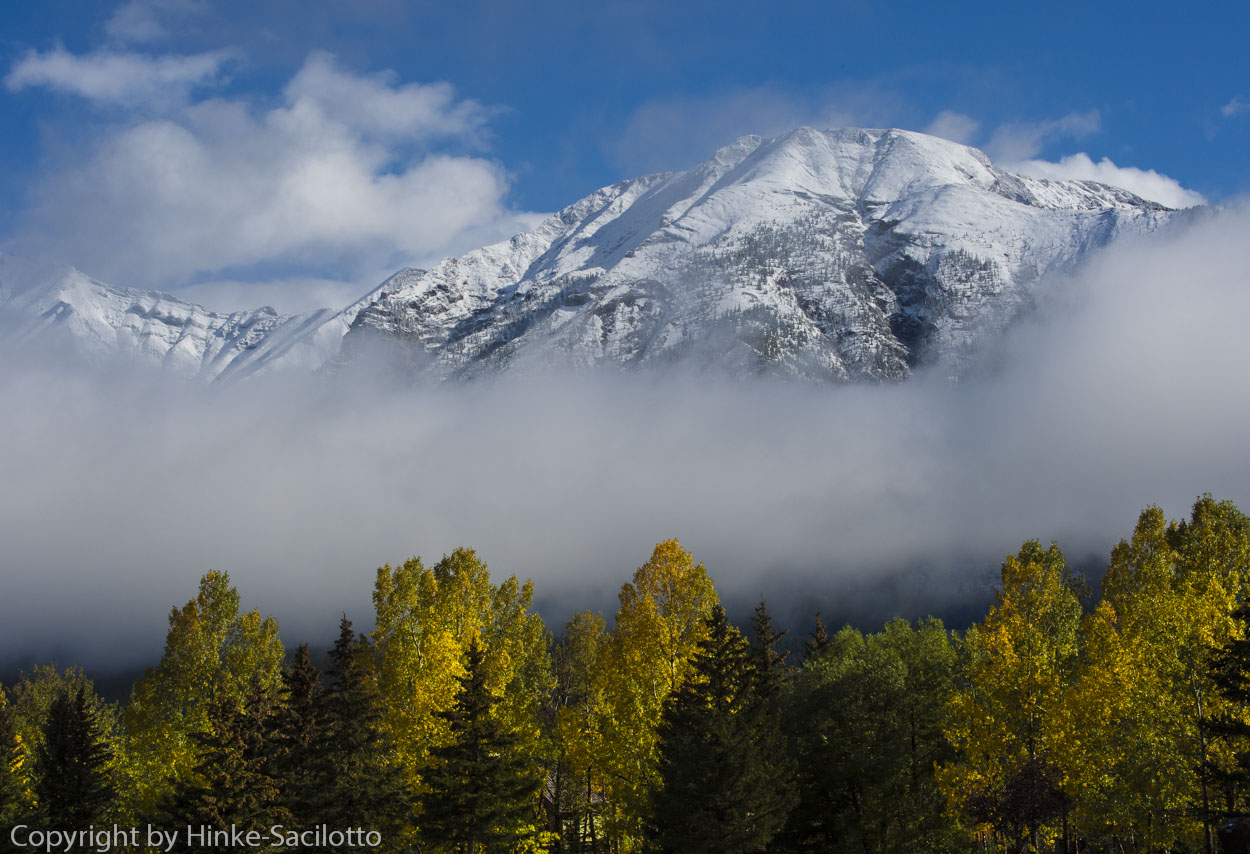
Fog Lifting
Photo Tour of the Canadian Rockies – a brief trip report of our adventures
This is far from a complete review of the photo opportunities in the Canadian Rockies. Just some highlights from my recent trip this fall. Summer is the high tourist season and to my mind, not the best for photography and reasonable cost for lodging.
I visited the Canadian Rockies 13 – 26 Sep 2015. Early in the trip, I stayed in the town of Canmore which is bisected by the Trans-Canadian highway and located 50 miles west of the City of Calgary. It is within a 15 to 20 minute drive to Banff National Park and is located in the Bow Valley near the park’s Southeast boundary. It served as a good base of operation to explore Banff NP and the surrounding area. It was a peaceful town with reasonable hotel rates and not as crowed and filled with tourists as the town of Banff. A variety of good restaurants are found on Main St including an Argentine Grill. Impressive mountains are nearby for early morning photography that could be done from right outside your hotel. Local hiking trails offered access to other scenic views of the mountain range along the Bow River.
A friend and I visited Banff, Kootenay, Yoho, and Jasper National Parks on this trip. Banff NP, with more than 25 peaks over 9800 ft was my favorite with regard to scenery. I loved its snow-capped mountains and beautiful lakes such as the elongated, turquoise colored Peyto Lake. Like many lakes and rivers, its color is attributable to an influx of the fine particles of glacial flour. Near Lake Minnewanka, my friend spotted our first black bear. Unfortunately, like the one we saw later in Jasper, it stayed just inside the protection of the forest making photographing it impossible. Lake Louise was impressive but the crowds and heavily overcast sky made the experience less enjoyable. In one photo, I featured a person sitting alone by the lake implying he was enjoying the solitude of the wilderness. If you were there and looked behind him at the crowds of people, you might doubt he found the location is as peaceful as the image suggests. I preferred nearby Lake Moraine where a path leads you to a high overview of the lake and large boulders could be used as the foreground of your photos.

Horse with aspen in fall
One day we took the 48 km long Bow Valley Parkway which paralleled the Trans Canada Highway leading from of the town of Banff. We took photos of the golden aspen along the way and Steller’s jays in a garden at an inn just before the Parkway ended. We also checked out Mount Norquay where a small group of bighorn sheep grazed and where we could photograph the Vermillion Lakes below with fall color. (Also shot the lakes from below. Beautiful reflections). We stayed at the Lake Louise Inn and then Saskatchewan Crossing on our way to Jasper to give us more time to explore the areas. (Note: The Crossing hotel (the only hotel in this area) closes early Oct. The Icefield Parkway heading to Jasper is not maintained once winter comes. Significant snows can begin as early as the beginning of October and sometimes before that date. Snow is possible in any month. The road from Edmonton through Jasper is maintained and open year-round since it is a major route for trucks moving cross country. Flying into Edmonton may be a better choice for visits to Jasper in October.

Ground Squirrel staring at me hoping for food.
In Kootenay NP, the Marble Canyon was a worthwhile stop with water running through a deep crevice. But the best part was the friendly squirrels who played hide-and-seek beneath the cars in the parking lot. In Yoho NP, we checked out the tall Takakkaw Falls reached from the main highway by a road that climbs to the falls parking lot with extreme switchbacks. The flow of the falls was slow and photos uninteresting, so we retreated to a bridge down-stream of the falls for some interesting slow motion photography. (There is always an alternative photo opportunity if you look hard enough.)
Jasper offered the best opportunities for wildlife photography with salt licks that attracted goats and bighorn sheep and open areas where elk grazed. The mountains were not as snow covered as those in Banff but were still beautiful. They were spaced farther apart than those along the Tans Canada Highway and Icefields Parkway allowing light to strike meadows and lakes earlier and later in the day. Therefore, the geography made it easier to spot wildlife while in good light. (Note: Due to the northern location of the parks, the sun was never directly overhead even at noon. Therefore the light was softer and at a lower angle to better accent the topography and illuminate the wildlife.) In September, it was rutting season for the elk with the males gathering their females and bugling. (Love the sound). In terms of small animals, some Columbian ground squirrels, red squirrels, and chipmunks were still above ground busily eating and gathering food for the winter.
It rained and often poured constantly for two days mid-way through the trip. This was a good time for a little scouting and working on images but not for photography. The situation was a bit disappointing until we woke on the morning of the third day and saw that the rain had stopped and fresh snow covered the surrounding mountain peaks. What was perceived as a negative event initially, offered us great opportunities to photograph locally and as we moved north. Even the waterfalls benefited from the fresh supply of water and were more photogenic. The change in color of the aspen leaves from green to gold even seemed accelerated. (The leaf color seemed to peak during the 2nd half our trip, particularly on the southern part of our journey back to Calgary to catch our flight home.)
NOTE: In late Sep and early Oct, crowds thin out, animals are more visible, and snow coats the mountain peaks. However, the chance of bad weather increases, possibly hindering travel.

Sunrise near Canmore Alberta Canada

by Osprey Photo Workshops & Tours | Sep 20, 2015 | Digital Photography, Nature Photography, Uncategorized
Nature Photography highlights from Canadian Rockies

Sunrise view from hotel in Canmore, Alberta, Canada, Canadian Rockies
Arrived in Canadian Rockies 13 Sep. It was in the mid-80s that I was here last. Lots more buses and tourist now. Points accumulated on IHG rewards credit card and previous stays at IHG hotels qualified us for free overnight stays in several locations. IHG rewards club Good way to save money and extend our stay. First nights stayed in Canmore, approximately 20 km from Banff. Quieter town with fewer tourists. Beautiful view of mountains in front of hotel and behind town but warm light striking mountain tops did not last long, 6:45 to 715 PM. Aspen were yellow and were a striking contrast to the evergreens. Wildlife around Banff was limited – black bear inside forest edge & several elk on Banff Golf Course. More critters later. Raining yesterday and today. Hoping for better weather ahead.

by Osprey Photo Workshops & Tours | Jul 28, 2015 | Bird photography, Nature Photography, Photo instruction, Photo Workshops, Tangier Island

Photo taken at Bosque del Apache in NM from rental vehicle
I often photograph animals from vehicles, which serve as mobile photo blinds with a telephoto lens supported on its foot by a beanbag resting on the window sill. In wildlife refuges and places where animals are protected and are used to seeing vehicles, you and your vehicle are not perceived as a threat. When photographing, if your subject moves, you can move with it and slowly close the distance between you and it. My bean bags are homemade and are filled with rice. When I travel by air, the bags can be emptied by opening the Velcro closure and refilled once I reach my new destination. The material used allows the lens position to be easily altered. I have several sizes suitable for different lenses. They can be stacked to raise the lenses to the height needed or they can brace a lens solidly in place in an awkward situation. I can also use the beanbag to support a long lens when shooting from ground.

10 to 12 pounds of rice. Len foot place

Shot from beanbag placed on ground to shoot at eye level.

This Eastern Cottontail was photographed from my vehicle on Assateague Island where I conduct photo workshops each year.
Shot at entrance to Mattamuskeet National Wildlife Refuge in NC from vehicle.

I was on the wrong side of the car to use the window for shooting. I slipped out of the passenger seat and placed the bean bag on hood of car and the lens on top;
On Tangier Island, I found them useful to secure my tripod in place while photographing from one of the golf carts, which are the main means of transportation on the island. With my setup, I was able to photograph from the driver’s seat of the vehicle or slip out of the cart and shoot from other angles where I am minimally visible. Since the animals are used to seeing the carts and they are relatively quiet, they often do flee when I approach. The heron with the turtle in its bill was shot from my golf cart. It took 15 minutes and several drinks of water before the bird finally swallowed it. The night heron was also photographed in a similar fashion. (Later article will provide tips for using stationary blinds.)

Braced tripod in place in a golf cart to support my 600 mm lens. Animals were more cooperative than if I was on foot

Heron used water to help swallow the turtle.

Night Heron with crab. Walking into a marsh can be dangerous. Mud can suck off your shoes, you can fall, and may have difficulty finding firm ground. In many areas tidal guts criss-cross the marsh and make it difficult to navigate. On the coast changing tides can complicate the problem.

by Osprey Photo Workshops & Tours | Jun 6, 2015 | Bird behavior, Bird photography, Digital Photography, Nature Photography, Photo classes, Photo instruction, Photo Technique, Photo Workshops

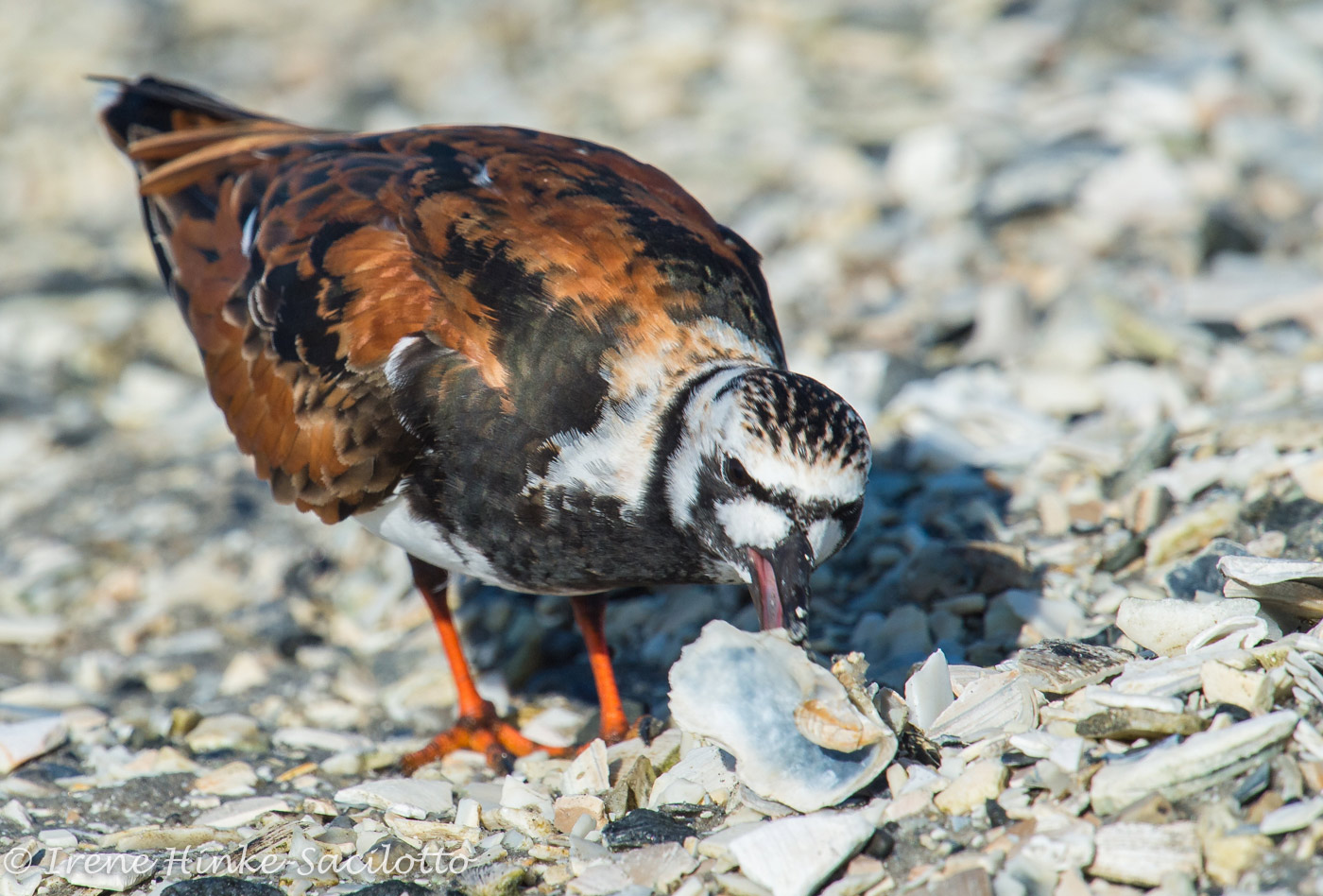
Rudy Turnstone.
Value of Patience when photographing wildlife.
The key to good wildlife photography is patience. During my photo workshop on Assateague Island, I observed two ruddy turnstones at Ferry Landing. Class participants took several fine photos capturing interaction between the two. Since I don’t typically photogrpah with the class, I could not resist returning to the same area on the following day in hopes of having similar success. That morning I spent several hours photographing ruddy turnstones, willets, and least sandpipers until canoers arrived interested in launching their boats from the shore. My patience resulted in several great shots including one showing the turnstone flipping shells in search of food, another feeding on eggs, one bathing, another stretching its wings, etc. If you want to capture action, you must watch and wait. If lucky, you will be able to capture behavior that you can not see with your eye. Of course you need fast shutter speeds for this. That is where fast lenses and cameras that perform well at high ISOs give you an advantage, With careful observation, you may be able to predict what is coming next which makes your images more unique. This sense of satisfaction is part of the reward for pursuing wildlife photography.

RuddyTurnstone

Ruddy Turnstone

Ruddy Turnstone bathing.

ruddy turnstone