by Osprey Photo Workshops & Tours | Feb 20, 2015 | Assateague, Bird behavior, Brazil, Chicoteague, Nature Photography, Photo Technique, Photo Tours, Photo Workshops, Wildlife, Wildlife Photography
Animals are more active early I the morning and late in the day as opposed to mid-day when the light is harsh and temperatures are higher. Therefore you have the best chance to capture images that are dynamic at these times. Cameras that perform well (little noise) at higher ISOs are beneficial when the light is low and yet fast shutter speeds are still required.

Spectacled caiman on a ranch in Ibera Argentina. Late afternoon and warm color.
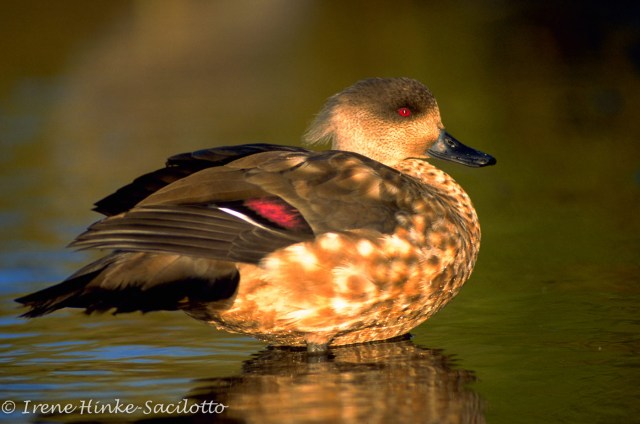
On a pond in the Falklands. Skipped dinner to photograph this and other birds on the pond.
Careful observation of your subject over time is the key to capturing action and behavior. Alterations in body posture, shifting weight, and adjustment in muscle tension (whether noted cognitively or sensed subliminally) can suggest some change in behavior. For instance, shifting of body weight of a resting animal may indicate it is ready to stand or possibly stretch.
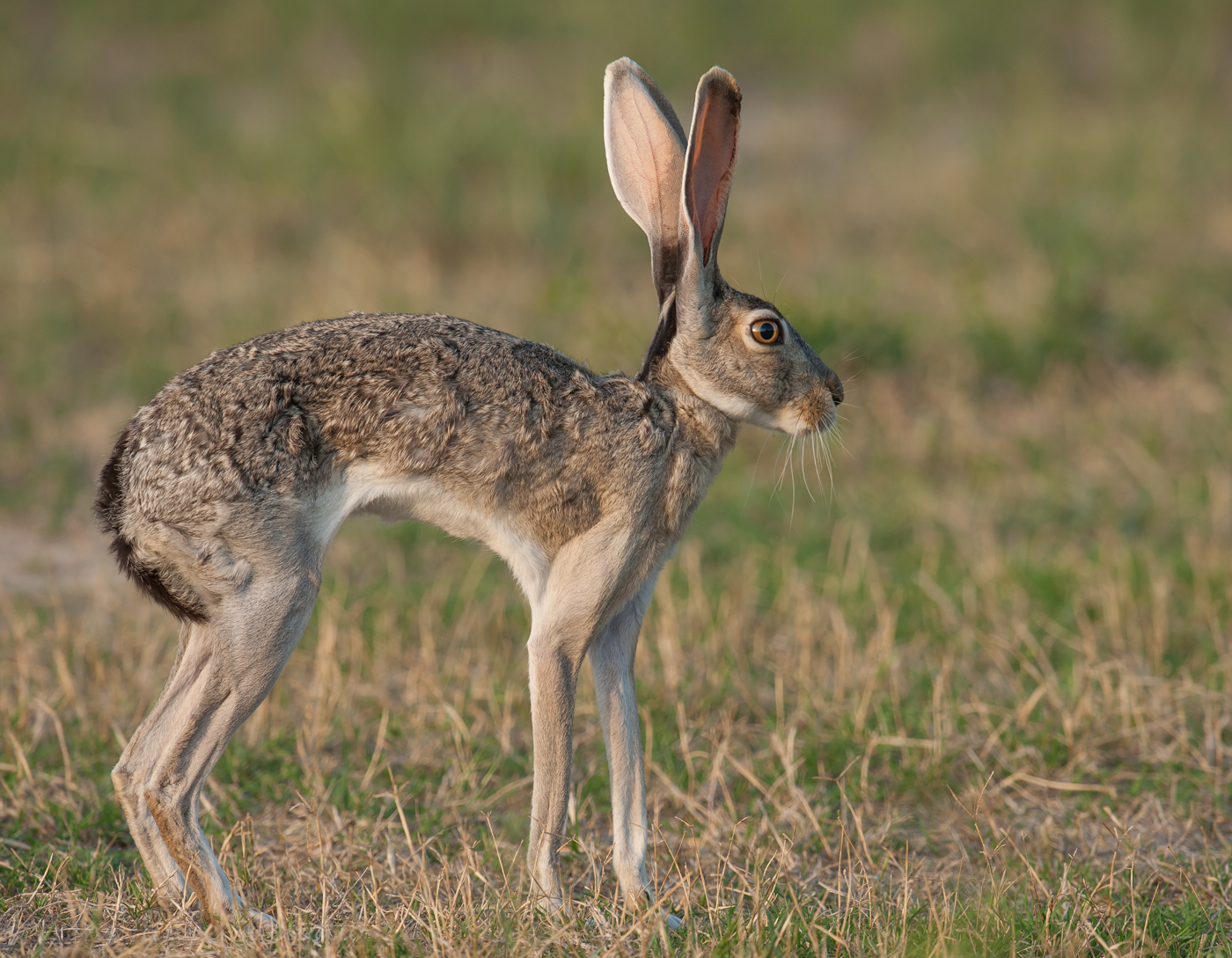
Jack Rabbit stretching.
Birds stretching or flapping wings can often precede flight. Sandhill cranes lean forward before flying. Herons often bend knees and stretch out neck before flying. Seabirds landing on rocky cliffs often employ their wings to provide stability. Birds bathing typically splash while cleaning feathers and then shake off the excess water.

Catching its balance after landing on rock ledge.

Canvas back bathing.

Cinnamon teal bathing.

Black-necked swan taking off from pond. Neck outstretched preceded flight.

Humpback whale preparing to dive. Can predict the point at which the fluke will appear dripping water by observing the curvature of the tail at its base.

Leaning forward before flight. Sandhill cranes, Bosque del Apache.

Bends knees and leans forward before flight.
Chattering and agitated movements within a flock of birds frequently precedes the arrival of more members of their flock, the departure of birds, or the approach of a threatening predator.

Puffin landing. Birds on the ground became animated as the other approach.

Greese were vocal and agitated before leaving the pond.
Photography during breeding season is often rewarding since activities increase – turkeys strut, elk lock antlers, deer mark territory, etc. Nurturing behavior between adult and young often results in touching photos.

Black Browed Albatross preening each other. Pair bonding during breeding season.

Otter protecting young. Difficult to get this photo since rocks were slippery.

King penguin caring for new born.
by Osprey Photo Workshops & Tours | Feb 2, 2015 | Bird behavior, Nature, Nature Photography, Photo Technique, Photo Tours, Photo Workshops, Wildlife, Wildlife Photography
If you can predict what your subject may do next, you can select equipment, settings, and camera angle to take advantage of the information. There are a number of hints suggesting an animal’s next move. I will discuss some of them in this and the following blog. 1) Repeated behavior, 2) reaction to the approach of another animal (friend or foe), 3) assuming a subservient pose, 4) behavior after preening, 5) preparation for flight, 6) nervousness (turning head side to side or bobbing) suggesting flight, and 6) changes in muscle tone or shifting of weight. If I am lucky, such observations allow me to capture the action. See the following images.

Osprey carrying grass to next

It was easier to capture the images of these birds in flight since I knew where the birds were going – to their nest.

American oystercatchers attempting to fighter off black skimmers attempting to nest nearby.

Pelican landing initiates defense on part of other pelicans with young in the area.

Egrets fighting over fish concentrated in a small pool of water

Guanaco fight. Anticipated when one approached other running with its head down and neck out-stretched.

One puffin invades the territory of another and a fight ensues.

Turkey. As it happens with other species of birds, female assumes subservient position in the presence of a strutting male indicating its willingness to mate.

Sanderlings fighting. When meeting another bird entering what it considers its territory, the defender sometimes puffs up making itself look more formidable or it may immediately attack the other bird. If it squats, it is indicating that it is the weaker of the two trying to avoid confrontation.

Puffins announcing to intruding bird that they are a pair.
When one animal approaches another it initiates some kind of behavioral response – a warm reception, indication of a willingness to mate, or an aggressive reaction. I prepare to capture whatever occurs when I always prepare for a photo opportunity when this occurs. See descriptions above.

Bufflehead in channel at Chincoteague, VA after preening.

Puffin after preening.

Canvasback Duck flapping wings to rid itself of loose feathers.
Preening is often followed by the flapping of wings in terms of birds to rid itself of loose feathers.

Black skimmer baring gifts as part of courtship.
If see one adult bird approach another adult with a fish or other gift, watch carefully for what will happen next. In this case, both are carrying fish. Predicting behavior often requires careful observation of the scene in front of you. More info & photos in next blog.
by Osprey Photo Workshops & Tours | Jan 24, 2015 | Assateague, Brazil, Chicoteague, Digital Photography, Nature Photography, Pantanal, Photo Technique, Photo Tours, Photo Workshops, Wildlife, Wildlife Photography
CAMERA CLUBS & OTHER SOURCES OF INFO
Your fellow camera club members can be helpful pointing out local hotspots for wildlife photography. At one such club meeting in Manassas where I was delivering a lecture, I learned that elk herds exist in Pennsylvania, near Benesette http://elkcountryvisitorcenter.com/drupal/ . They are typically found where there is fresh browse. In the fall, the males bugled just like courtship in Yellowstone. Magazines such as Outdoor Photographer www.outdoorphotographer.com can be a great resource describing favorite locations for photography. Robert Hitchman has a newsletter “Photograph America” with detailed info on trails and photo perspectives for all types of photography. It’s a great resource if planning a trip. www.photographamerica.com Well worth the price.

WATER
Animals require 3 key things for survival, food, water and shelter. Therefore areas that provide these elements attract wildlife add offer photo opportunities. They are also good locations to place photo blinds (later discussion). For example, a pond or spring in an arid area can draw wildlife from great distances. On a ranch in south Texas I placed blinds (hides) near ponds that contained water during the hotter months of the year. At the end of the summer at Chincoteague NWR, water evaporates from the impoundments and waterways. Fish become trapped in the shallows where water remains and attract large numbers of hungry herons, raccoons, and other wildlife. Similarly, during the dry season in the wetlands of Brazil(the Pantanal) http://www.pantanal.org/Mainpant.htm, completion for food becomes fierce and animals become more visible as the water disappears.

Coatimundi drinking at pond in Mexico.

Roadrunner drinking at small pool of water during drought in South Texas.

Deer drinking in one of the few ponds with water on a ranch in south Texas.
Bufflehead in channel at Chincoteague, VA
FOOD
A reliable source of food will attract wildlife. Ripening seeds, acorns, crab apples, and fruit will attract monkeys, bears, and squirrels, as well as songbirds and other bird life. The upwelling of nutrients and food caused by strong currents such as those off the southern tip of South America attract marine life and provide food for whales, seals, sea lions, and penguins as seen in the Falkland Islands. The protected waters around Peninsula Valdes in Argentina offer shelter to elephant seals, southern sea lions, penguins, and calving southern right whales and attract photographers from around the world. But you don’t have to go to exotic places to attract and photograph wildlife. In your own backyard you can put out feeders with seed or suet, add a source of water and include an interesting perch nearby so you can capture images in what appears to be a natural setting.

Squirrel storing nut for the winter.

Chickadee feeding on berries.

Giant River Otter eating fish in the Pantanal.

Great Blue Heron with fish.

Rose-breasted Grosbeak at bird feeder.
FAVORITE PERCHES
Birds such as kingfishers, cormorants, and kiskadees often dive for fish from the same perch and return there to consume their fish offering excellent opportunities for photographs. Turkeys, vultures, snail kites, and other birds often roost in the same location each night. These are perfect places to stake out with your camera.

Kiskadee fishing from favorite branch.

Thick-billed tern perched on pole preening and fishing.

Belted Kingfisher fishing from its favorite perch.
DUSTING AREA & MINERAL LICKS
Mineral licks are also great places to photograph wildlife. At Custer State Park, SD http://gfp.sd.gov/state-parks/directory/custer/ buffalo, mule deer, and pronghorn frequent these bare patches of ground rich in minerals and nutrients. These spots are easy to recognize by the reddish color of the dirt. Other locations where animals return repeatedly are dusting areas, sections of bare ground and loose dirt where “wild burros”, buffalo, guanaco, horses, road runners and other animals kick up and roll in the dust to rid themselves of pests.

Burro dusting in Custer State Park, SD

Elephant seal throwing sand perhaps to cool off.
ICE, ROCKS & ISLANDS
If on a boat in Alaska, ice flows area good areas to look for seals. Round Island is prefect if interested in photographing walrus.

Walrus warming in the sun on Round Island.
by Osprey Photo Workshops & Tours | Jan 17, 2015 | Digital Photography, Nature Photography, Photo Technique, Photo Tours, Photo Workshops, Travel, Wildlife, Wildlife Photography
LOCATIONS (PART 4)
Several of the best locations to photograph wildlife are ones where the animals are acclimated to the presence of people or vehicles. These include county, state, and national parks, wildlife refuges & sanctuaries, and eco-friendly ranches (South Texas & South America). In terms of wildlife refuges, I tend to favor those with roads that run along the dikes that separate the impoundments. Parallel to the roads are ditches that typically hold water even when the other ponds are dry and therefore attract wading birds and other wildlife. If these channels are close to the road and vegetation does not block the view, photos of the animals can be taken easily from the car. The vehicle serves as a mobile blind that allows you to move along with the subject and adjust your angle of view and distance. To photograph out the car window, I place the telephoto lens on one or two large home-made bean bags filled with rice which I place on the window sill. You can also purchase bags from Lens Coat http://www.lenscoat.com , Birds as Art https://store.birdsasart.com or other suppliers. Two of my favorite wildlife refuges that are perfect for this style of shooting are Chincoteague NWR and Bosque del Apache NWR. http://www.fws.gov/refuge/chincoteague/ & http://www.fws.gov/refuge/bosque_del_apache/
PHOTOGRAPHY FROM A VEHICLE

Snow goose, shot from the car on the Loop Rd. @ Chincoteague. NWR, VA

Mallard family in a row. Shot from the car in Chincoteague NWR, VA.

Northern Harrier consuming a duck. Shot from rental car in Bosque del Apache, NM.
PRIVATE RANCHES
Eco-friendly ranches that protect native species and habitat such as those in South Texas, Argentina and Brazil often cater to photographers. These offer excellent opportunities to photograph from vehicles, blinds, or even on foot. (Discussion of blinds in later blog)

Rosette Spoonbill feeding in pond on private ranch in Texas. Photographed from a blind.

Caiman resting on bank at private ranch in Argentina.

Photographed late in the afternoon on Sea Lion Island in the Falkland Islands
HIKING
Photographing while randomly hiking in your local woods often fails to provide satisfactory result. The animals flee before you are within shooting distance. However if the habitat attracts wildlife and the animals are protected, they sometimes become acclimated to seeing people on foot . Corkscrew Swamp http://corkscrew.audubon.org and Six Mile Cypress Slough Preserve in South Florida with their boardwalks are often worth a visit as well as Loxahatchee NWR. Hiking in other locations such as Yellowstone NP, Glacier NP, and the Badlands of South Dakota can also be productive particularly if your subject is initially spotted from the road. (See stalking techniques in later blogs).

Great Blue Heron shot while I was walking along a ditch filled with water in Chincoteague NWR, VA

Raccoon photographed while walking along one of the ditches at Chincoteague, VA.

Capuchin Money. Photographed while hiking along trails on hotel property near Bonito Brazil. Semi tame since food is readily available there.
DANGER
When hiking in remote areas, care must be taken not to surprise a grazing buffalo, bear, moose and other large mammals. Even though they may be in national parks or reserves they are still wild and potentially dangerous particularly if their young are present or if it is mating season. When photographing such animals, use long lenses to keep a safe distance from them and to isolate the subject. Approach slowing and always leave them a means of escape. (See safety discussion in a later blog)

White-tailed Deer buck photographed at Canaan Valley, WV many years ago while meandering throughout the meadows in search of deer to photograph.

I was photographing a scene away from the car when I spotted this sow and cubs. I stopped and grabbed a quick shot. She bluffed charged me and I carefully retreated to my car a little distance away. The rest of my shooting was done with my 600 mm from inside the car. A black bear with cubs can be very dangerous.

While hiking I spotted two rams. I took my initial photos from a distance. When they resumed their original behavior eating vegetation and slowly moving through the field, I moved a bit closer to them making sure not to pressure the animals or block its means of escape. I spent nearly an hour following and photographing their activities. At times they eveny closed the distance between u without alarm.
More blogs coming covering other topics relative to wildlife photgraphy. Importance of food, water, and shelter plus timing next.
by Osprey Photo Workshops & Tours | Jan 10, 2015 | Nature Photography, Photo Technique, Photo Tours, Photo Workshops, Wildlife, Wildlife Photography
SPOTTING WILDLIFE
SHAPES, COLORS, TONES
Spotting wildlife is a learnable skill. When visiting an unfamiliar area, my ability to see animals in the new habitat improves with time. I become sensitive to colors, shapes, and tones that are out of place in the new environment.

Burrowing Owl – Yellow Eyes

Eastern cottontail, Shape out of place

Badger, White stripes attract attention

Bighorn Sheep, easy to spot white rumps
MOVEMENT
When animals are highly camouflaged by their surroundings, they are more easily spotted when they move. This is ideal for spotting coyotes or grouse hidden by prairie grasses or herons blending in or hidden by reeds.

Coyote hiding in grass

Yellow-crowned Night Heron, feeding on crabs. Most of the time hidden in grass.

American Bittern, When facing forward and pointing the bill skyward, bird is nearly invisible appearing to be grass.

Ghost Crab. Camouflaged with coloration that matches the sand and reflects light keeping it cool. Hard to see until it moves.
SOUND
Characteristic bird calls such as those from an osprey or kingfisher, courtship songs, screams of alarm or distress, rustling brush, spouting whales, the rattle of a rattle snake, splashing water, etc. Just listen.

Sandhill flying to join group, call got my attention

Prairie Rattle Snake

Prairie dog barking a warning brought my attention to the colony.

Osprey, Easily recognized high pitch call

Roadrunner courting. Call woke me from mid-day siesta.
HABITS & PATTERNS
Animals repeat behaviors and knowing the patterns can give you an edge photographing them. When I see an animal in the same area at about the same time each day, I know there is an increased chance I will encounter it again in the same region and hopefully this time with a camera in hand. If a heron is fishing in a pond, does it move in a predictable manner where you could photograph it as it moves or pre-focus at a point where it will cross? Does a heard of pronghorn or elk meander in a consistent direction where you could adjust your movements to intersect their path?

Sanderlings running along edge of surf

Black Skimmer, fishes in shallows often following bank

Pronghorn, herds often move in a particular direction. Anticipate where they are heading and move to intersect their path. Don’t walk directly towards them.
More to come about photographing wildlife in future blogs.
by Osprey Photo Workshops & Tours | Jan 4, 2015 | Digital Photography, Nature, Nature Photography, Photo Tours, Photo Workshops, Wildlife, Wildlife Photography
Requirements
Knowledge of Equipment —
- Check settings heading out for a day of shooting. If camera has be to the shop for repair or cleaning, often the service people change the settings back to the defaults.
- Make sure the camera batteries are fully charged and there is a memory card of an appropriate size in place. Always carry spares.
- When traveling I back up my images onto two 1 or 2 T portable drive connected to my laptop. Then I import them into Lightroom and verify that they were transferred without any glitches or corrupted files. Only then do I format my memory card. I prefer to start with a clean card each day, 16 or 32 G. At home, I will copy the files from the smaller drives to a larger one.
- As you approach your subject, from a distance preselect the lens and settings that are most appropriate. for the situation. Consider the direction, quality, and color of the light when choosing your approach. Be aware of subtle changes in muscle tension and poses that may indicate action (addressed in later blog) and be prepared to act instantaneously.

Sandhill crane. Saw this crane approaching a pond filled with other birds. Selected my 600 mm lens and set aperture large enough so would be using a fast shutter speed. SInce it was the end of the day, also elevated my ISO. Locked focus on bird at a distance and continued to follow it as it landed. Took a series of shots.

Osprey Nest – Selected 80-400 mm zoom lens and elevated ISO. Waited patiently for the osprey t leave the nest. Took a series of shots. Photographed from the water but nearly drowned my camera when stepped into a hole where the water reached my waist.
Knowledge of Subject —
- Research your subject’s behavior. Where and when is it found? What is its temperament?
- Speak with others familiar with your subject including researchers, biologists and even learning tips from hunters as to the subject’s behavior and tolerance.
- Approach from down wind if animal has an elevated sense of smell as does the Giant Anteater. Those with long/pointy noses tend to have better sense of small than others.

Capuchin Monkey. All animals are attracted to food and are easier to photograph when their attention is on something other than you,

Giant Anteater at termite mound, Pantanal, Brazil. Long nose and good sense of smell so approach animal from down-wind.
Patience and persistence —
- Spend as long as possible with your subject. It some times takes a long time to capture what you are after and may required repeated attempts on different days and with different weather conditions. Avoid distractions and keep your focus. However if another great photo opportunity comes along, go ahead and pursue it.
- Before beginning a project and while at the scene, develop in your mind a vision of what you hope for in terms of results but never limit yourself to just this.
- Continue to develop your skills, trying to surpass previous accomplishments.
- Don’t give up. Look at other ways to achieve your goal. Perhaps move to achieve a better camera angle, light, and background.

Herring Gulls, Common bird by interesting pose.

Canvasback. Often after preening, birds flap their wings to get rid of loose feathers. Watched and waited for one of the ducks to splash water as it flapped its wings.

King Eider, Watched the eiders approach to the beach and waited for nearly an hour before captured this shot.
Curiosity & ability to observe —
- Help you be engaged with the subject and become sensitive to subtle changes in posture, etc. that may precede some behavior of interest.
- No time for snoozing. I find my mind engaged in a detective game. What it happening & why”. What’s next? What do you want to show? What fascinates you?

Billing – greeting and pair bonding. Showing intruder that this is there territory.

Northern Shovler. Anticipated flapping affer some time preening.

Atlantic Puffins. When one animal approaches another there is likely to be some interaction – friendly or otherwise.
See next installment regarding wildlife photography – locating subjects.


