

The Wild Side of Tangier Island

Work boat in Tangier Harbor at sunrise.
Over the last 9 years, I have visited Tangier Island a number of times and have conducted photo workshops there in the spring. It lies the middle of the Chesapeake Bay just south of the Maryland line and is famous for its off-shore crab shacks and waterman that harvest crabs and oysters as did their ancestors. Although I enjoy interaction with the community and waterman, I most love photographing the birdlife on the island. I visit the island as often as possible since scientists believe that Tangier will become uninhabitable in the near future as waves and erosion eat away at its margins.

Tangier channel and crab shacks
Tangier Island was once 3 times its current size and included other nearby land masses such as Port Isabel and the area across the channel referred to as the Uppards. On this part of Tangier, there were several populated towns but in the 1920s the island became uninhabitable as the land eroded away and was transformed into mash, mud flats and waterways. Today’s Tangier Island consists of only 3 ridges barely above sea level and subject to frequent flooding. On each ridge there are narrow roads which are connected by bridges spanning tidal guts and brackish marsh. At the far end of the island is a narrow hook shaped undeveloped sand beach with ponds and a large lagoon. The configuration of the Tangier is ideal for wildlife photography with birds feeding in the channels and marsh adjacent to the roads and bridges. In addition, they were used to being undisturbed by local traffic.

Black Ducks, Mallards and Canada Geese nest on Tangier Island. Once spotting me, this family headed towards the water. They turned with their back to me and I no longer had the view I desired.

American Oystercatcher flying over grasses on Tangier’s beach. Used animal eye tracking to keep it in focus.
For these American Oystercatcher images, I used my Nikon Z9 mirrorless camera with animal eye tracking to follow the birds’ movement. To lighten my load when hiking across Tangier’s sand beach, I used my Z 70 to 200 mm, F2.8 Nikon zoom lens with a matched Z 2 X teleconverter. The lens/camera combination was light enough for me to get sharp images while handholding it with the help of the camera’s image stabilization. (Most of today’s zoom lenses and teleconverters for mirrorless cameras are far superior to those produced for D-SLR camera systems.) With the 70-200 mm lens fully extended and the camera sensor set to the DX mode instead of full frame, the image size in the frame was comparable to that produced by a 560 mm lens. Because of the large maximum aperture of the 70-200 mm lens (F2.8), even with the 2X teleconverter in place, I still could shoot at fast shutter speeds without outrageously high ISOs. (2X teleconverters reduce the amount of light coming into the lens by 1/4 of the original.)

Oystercatcher pair flying together. Demonstrates the flying precision of this species.

Glossy Ibis feeding in one of the tidal guts. The touch of sunlight brought out the beautiful colors of breeding plumage. With an highly overcast day, the ibis would almost look black.
Photo opportunities on Tangier vary with the tide, season, and weather. When the tide is low and channels are nearly drained of water, Glossy Ibis with long curved bills appear and probe the mud and feed on organisms beneath the surface. Secretive rails which are usually hidden deep within the marsh venture into the open. Supported by their long toes, they easily can walk across the mud snatching up snails, crabs, and other invertebrates. (Their cackle is often heard before the rail is seen.)

Clapper Rail at a standoff with blue crab.

Same Clapper Rail carrying the crab into the marsh in order to eat it.
When the tide shifts and the channels fill with water, egrets and herons fish from the shoreline, the rim of sunken boats, and abandoned crab traps. There are few natural perches along the waterways.

Immature Night Heron fishing from an abandoned crab trap.
Many ospreys nest locally on man-made platforms, channel markers, old duck blinds and abandoned docks. They are often seen flying overhead carrying sticks to reinforce their nests or carrying fish to feed their mate or young.

Osprey carrying fish in its talons with the fish oriented in such a way as to reduce wind resistance.

Yellow-Crowned Night Heron taking flight. Photographed from my porch at The Brigadune Inn where I was staying.
This May I was on Tangier when a high tide combined with a strong stationary off-shore low flooded portions of the island for 4 days. Not able to travel in the high water, I took advantage of the situation and photographed herons and shorebirds from the porch where I was staying. When the water receded, I captured images of migrating shorebirds feeding in the remaining roadside pools of water and neighboring backyards.

Dowitcher taking off after feeding in the yard of the inn where I was staying.

Dunlin is still mainly in winter plumage feeding in neighbors front yard after flooding.
This year in mid-May I was treated to the arrival of migrating songbirds and warblers. Following the Chesapeake Bay northward, sometimes they stop for a few days on Tangier Island to rest and refuel before continuing their journey. Many were attracted to the bushes outside the office of Brigadune Inn. So I concentrated my photography in this area and close-by locations. It was a good strategy since I was able to capture images of 8 species of birds from fairly close distances. I used a 200-500 mm Nikon lens with my mirrorless Z9 camera. Frequently, I shot from the cover of my golf cart where I had a tripod and beanbag mounted. At other times due to the birds location, I took photos by handholding the lens. Image stabilization set on “Sport”definitely helped.
When photographing elsewhere on the island, I often used a golf cart as a mobile blind. The birds ignore the cart since they are used to seeing them traveling the roads. Over the years local folks have gotten use to seeing me with a camera and long lens. Many will wave or nod as they go by. At times they stop and ask questions about what I was photographing or tell me about a bird they had seen. It is great to see them interested in learning more about the wildlife they see every day.

Northern Parula warbler sitting in bush resting during migration

Black and White Warbler perched on the roof of a nearby building.

Immature White ibis feeding in a pond with a third young bird and 2 adults..
When planning a photographic trip involving wildlife, I typically research my subjects in order to locate them and predict their behavior. I check the web and bird guides for information but also find it valuable to talk to locals who know the area well. For instance, I found these immature White Ibis after receiving a tip from a resident of the community of Canton on Tangier. He told me that often in the morning large numbers of herons landed in a pond near his house. So one day, I checked out the location. I photographed these two immature White Ibis feeding along with 2 adults and another young bird. According to local birdwatchers on the island, this was the first time this species nested on Tangier. Two adults had been seen together earlier in the summer in a nearby yard and I suspect they were a nesting pair responsible for these chicks. (In the last couple of years, large numbers of White Ibis have been seen on the barrier island of Assateague, where they now nest. In years past, this species like the Brown Pelican have extended their range farther to the north, possibly in response to climate change and warming temperatures.}

American Oystercatchers on nest with eggs.
Willets and American Oystercatchers nest each year on Tangier’s beach placing their eggs directly on the sand or on low dunes with scattered grasses. This year the high spring tide flooded the Oystercatcher nests but they re-nested later in the spring. This is not unusual for them since they tend to build their nests early and close to the water. Unfortunately, I never got shots of the hatchlings. They were nearly full grown when I returned to Tangier in September. At that time, they were gathering together in groups preparing for their migration south.

Young oystercatcher with adults photographed on the Uppards across the channel from the main portion of Tangier.
The Oystercatchers are fascinating to watch as they react aggressively to each other and other intruders entering their territory. If they feel threatened, they lower their heads, utter a high=pitch squeal, and run at whatever they believe is a threat. This includes Black Skimmers which are much larger.

Oystercatcher aggressively attacking another oystercatcher that landed in their midst.

Black Skimmer fishing.
Black Skimmers are beautiful to watch as they slice through the water in the tidal guts and beach lagoon with their lower mandible submerged. When encountering a fish, the top bill snaps shut capturing it.

Willet landing on post in the marsh.
If anywhere near a willet’s nest they will issue a constant high pitch cry and try to drive you out of their territory. Most of the time, I have no idea where the nest is located so it is hard to out-maneuver the birds.

During a boat ride out to the beach, I photographed these young terns resting on floats associated with oyster aquaculture, a new enterprise on the island.
This year I was disappointed that Black Skimmers, Fosters Terns, and Royal Terns did not nest on Tangier’s beach as they have in the past. Folks with ATVs driving along the beach have discouraged nesting. The hope is that signs will discourage people from disturbing the nesting birds. Today, due to development, erosion, and sea level rise, undisturbed beaches suitable for nesting birds are few but yet critical to the survival of many species.

Royal Tern flying with a fish. Birds are attracted to the waters around Tangier since food is plentiful locally.
In late September or early October, Monarch Butterflies often stop on Tangier Island on their way to Mexico. This year was the first time I got to witness this spectacle. Groups gather in trees around the island. But photography was difficult because it was very windy when they arrived and keeping them focus was difficult. The butterflies spent the night in the tress and when the sun rose and warmed them, they flexed their wings once or twice and took off. I choose my camera angle carefully so all members of a group were in sharp focus. I had to use a moderately large F#, high ISO, and fast shutter speed to capture all of the individuals in the cluster.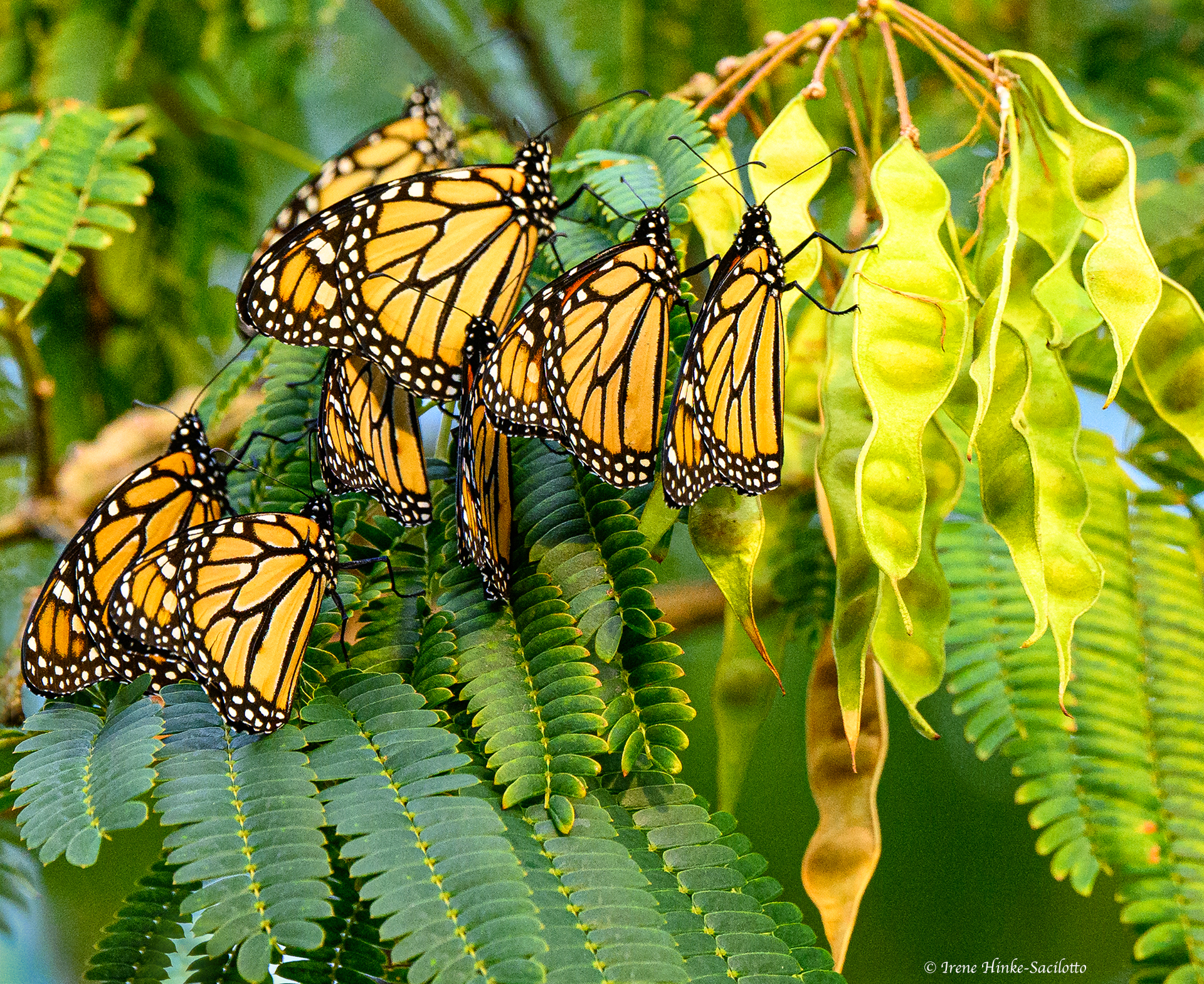
One of the plants they were attracted to was goldenrod. In order to add variety to my photos, I walked down the beach in search of blooms with butterflies clinging to them. In the case of this image, since I was magnifying the butterfly a great deal, I had limited depth of field. Therefore I had to be careful to line up the face of the lens parallel to the wing’s surface and butterfly’s eye.

Monarch resting on a goldenrod bloom.
In the fall and winter, waterfowl flock to the waters around Tangier. I have never visited in the winter but hope to this year. Thousand of waterfowl spend the colder months of the year in the Chesapeake Bay, with many in the waters surrounding Tangier Island.
No matter when you visit Tangier Island, there is always something wild to photograph.

Tundra Swans, Swans, Snow Geese and a variety of ducks arrive in the late fall and stay through the winter.
TRAVEL TIPS
Access to the island is primarily by “passenger only” ferries from Crisfield, MD or Onanock, VA. Be sure to check out the ferry schedules and make reservations. The dates and times vary with the season and days of the week.
Overnight accommodations in Tangier are limited to a few B&Bs. This spring and summer I stayed at the Brigadune Inn with very comfortable accommodations. Currently there are only two restaurants on the island and kiosk where you can purchase hamburgers, etc. However hours of operation and opening dates vary each year and can be effected by local events. There is a grocery store on the island that in the recent past has not been well stocked. But it has a new owner, so this may change.
To travel around the island, you can walk, rent bikes or kayaks. You can rent a golf cart but there only a few available.
Particularly in the spring and summer, bring insect repellant. A head net and insect jacket can be handy since gnats, mosquitos, and biting flies can be can be annoying

Snowy Egret taking flight.

Snowy egret taking flight. Because I shot with continuous auto-focus and at a high number of frames per second, these two images captured very different wing positions.
PHOTO TIPS
Using continuous auto focus, animal eye tracking, and a high number of frames/second you can capture that perfect shot. As above, this technique resulted in two very interesting views of the bird.
When photographing, try to be as close to the subject as you can without disturbing them. The farther you are away, the more likely that heat ripple, dust, pollen, moisture, etc. can soften the image quality.
Try to capture behavior and the bird’s unique features.
Stretching wings, shifting weight, bending knees, nervous chatter, or stretching the neck upward, may indicate the bird is ready to fly.
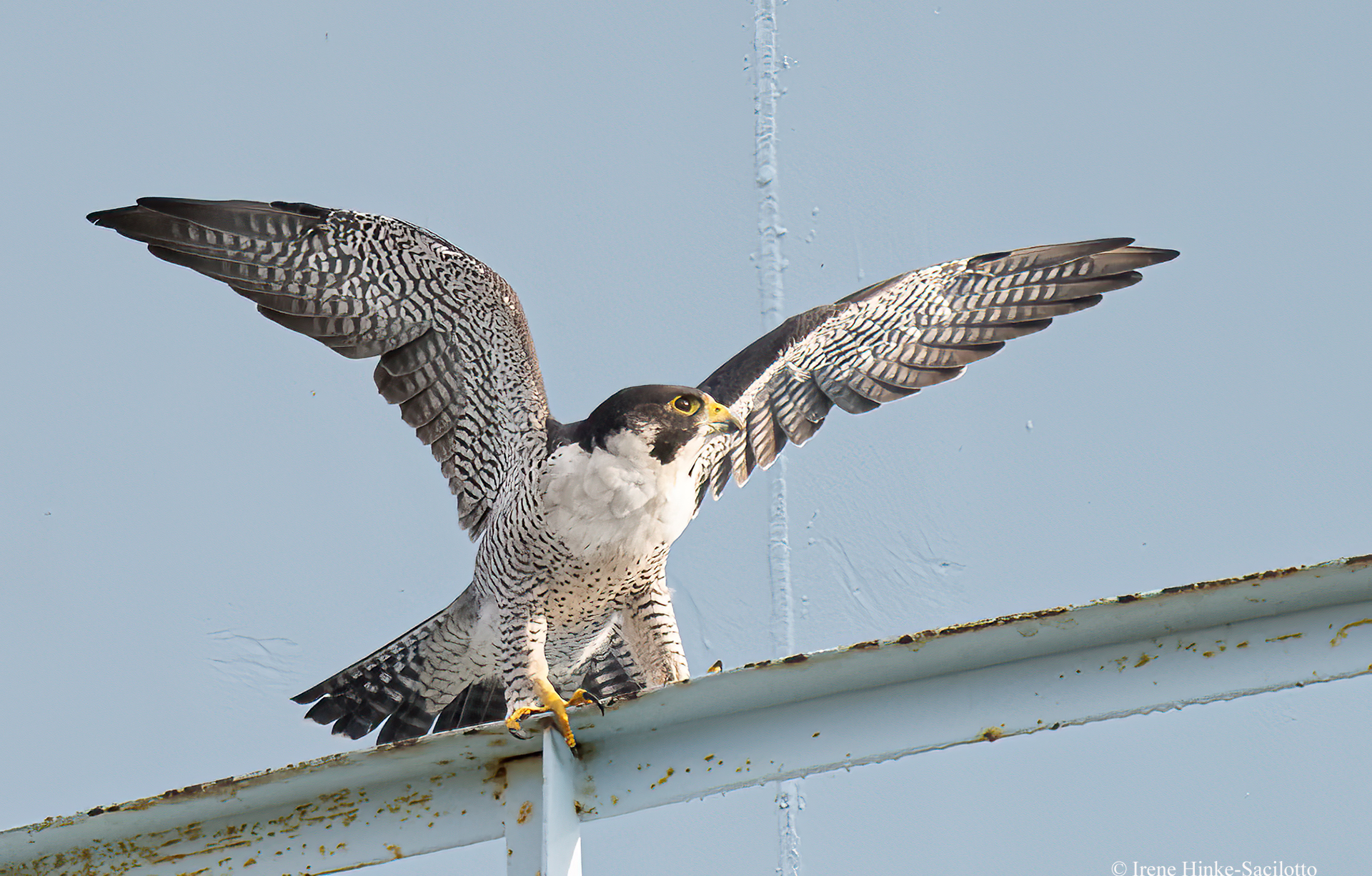
This Peregrin Falcon is stretching wings on top of Tangier’s water tower. For a number of years, a pair of falcons have returned to this high perch. Since the top of the tower was far away, getting. this photo required high magnification. For a sharp image, I needed a windless day, sturdy tripod, and a cable release to fire the camera without touching it.
If your camera system has image stabilization, check what setting should be used if the camera is mounted on a sturdy tripod. This varies with the camera model and lens.
Walking through the marsh and crossing ponds and lagoons can be dangerous. The bottom often consists of soft mud. You can easily sink down to your knees in the mud and lose your balance as well as your equipment.
To photograph flying birds, image stabilization and animal eye tracking on newer mirrorless cameras increases your keeper rate. For a flying bird, it is best to use a shutter speed of 1/2000 of a second or higher if the bird is a fast flier or is close. Start focusing on the bird at a distance using continuous auto focus. Follow it until it is close enough for the image you have in mind. Shoot a burst of shots at a high number of frames/second.
I typically shoot a short burst of shots at a high number of frames per second even if I have a stationary animal to capture the best image with the eye open, best pose and sharp focus.
It is helpful to remember that birds typical take off and land into the wind. Choose your camera position and angle accordingly.
Photograph subjects at eye level for a smooth, blurred, distant background, less distortion, and a more intimate photo. Of course this is not always possible or wise. Always look to avoid distractions behind your subject — bright branches, shiny leaves, a cluttered shoreline, etc. Soft light can minimizes background distractions, with fewer hots spots and dark shadows. Shooting from a low angle is not always good if you are trying to capture reflections. A higher angle may be better.
The more you photograph, the better your images.

Pelicans stacked up on the tip of Tangier’s beach. Most afternoons they are found there.
If you lie on the ground and shoot, look for grasses and other objects that your focus will lock on instead of on your subject. You may have to manually focus. The subjects eye must be sharp or the whole image is compromised. Also if you are shooting at a low angle and there is a rise in the land in front of your subject, it may be out of focus and distracting. Or it may undesirably hide the feet or other critical part of your subject. On the other hand, it can create a soft vignette or frame around your subject.
Refine your images. If the subject is still present, explore alternate camera angles, magnifications, backgrounds, lenses, etc. Look for ways you can improve and vary your approach.
Subjects present, bird behavior, and coloring changes with the season and year. Check field guides and locals for advice.
Get the image right in the camera and don’t depend on post processing to fix it. Many problems are not fixable.
The more you observe wildlife, the more able you are to anticipate what they will do next.
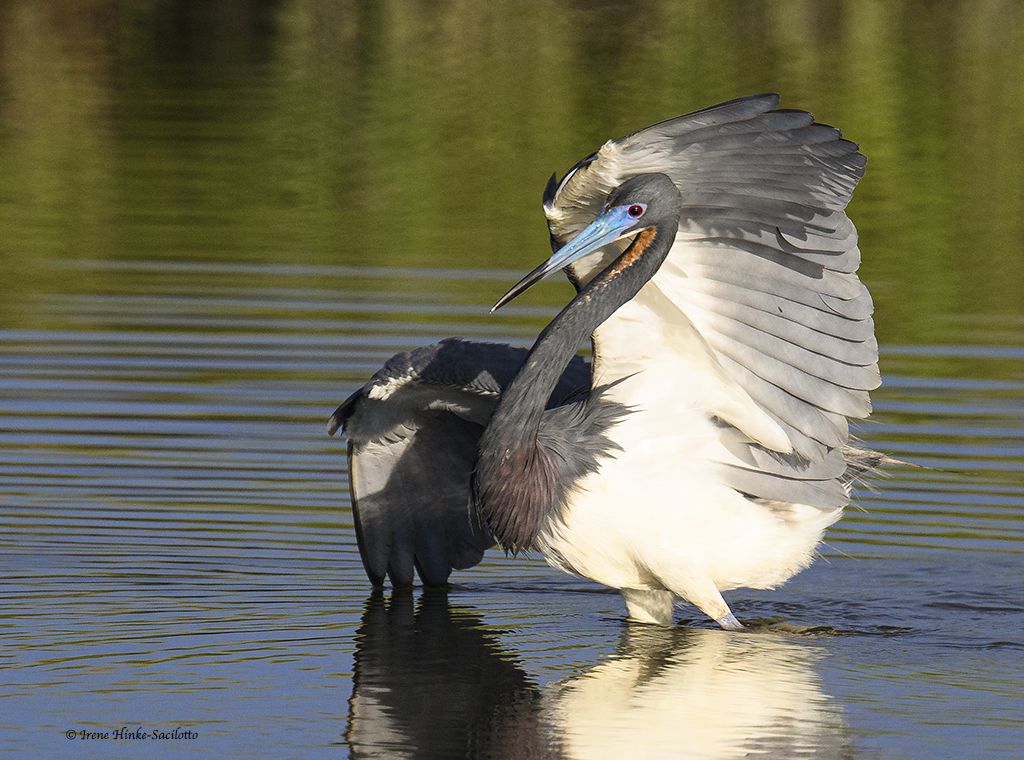
Tri-Color Heron canopy feeding. It creates a shadow that attracts fish. I had to time the shot and choose the camera angle carefully to avoid the heron’s face from being shaded or blocked by the wing.


