by Osprey Photo Workshops & Tours | Aug 9, 2021 | Bird behavior, Bird photography, Chicoteague, Digital Photography, Nature Photography, Photo Tours, Photo Workshops, Rookery, Spring Photography, Spring Photography, Spring Photography, Wetlands, Wildlife Photography
May/June 2021- Heron Rookery Photo Project

From 24 April until 18 June 2021 I was on the road. One of my projects involved documenting the activity in a heron colony populated by a variety of wading birds–Great and Snowy Egrets, Black-Crowned Night Herons, Tri-color & Little Blue Herons, and a few Glossy Ibis. The rookery was in a large marsh on a ridge where low shrubs grow such as Bayberry and Wax Myrtle. Nests were low and among tangled branches that help protect the nests, eggs, and offspring from predators. It was a perfect locations with little chance of flooding and rich waters nearby with abundant food to provide for the growing youngsters.
Photographing colonial birds in a rookery setting requires a very careful approach as to not negatively effect breeding success.
Herring Gulls
Surrounding the heron colony in the tall stands of salt-meadow hay Herring Gulls nested. They chose a perfect location since they could swoop over the rookery harassing the herons and attempting to grab eggs and hatchlings. On several occasions, I saw a gull dive down and hit exposed heron. There was evidence that high water flooded the lower part of the marsh and destroyed some of the nests.


Precautions
I took great care to minimize any disturbance of the nesting birds to avoid interfering with nesting behavior, possibly causing displacement of eggs or the herons abandoning nests. I keep. my visits infrequent, limited in time, and when temperatures were moderate.  Since my intent was to document natural behavior and interactions between individuals, I would have been foolish and unethical to disturb the birds.

My route through the marsh was difficult since I had to avoid soft mud, holes, and tidal guts.   I benefited from past experience reading the marsh and noting what grasses and substrate would support me.

Dressed in camouflage, I approached the colony slowly and indirectly.  I photographed from a  low position, sitting or kneeling on the soggy, water-saturated ground.  Once in place, I  minimized my movement.  It was usually distant noise that would cause the birds to flush from their nests -- the rumble of trucks, planes, boats, and construction projects..  Luckily, the birds quickly returned to their nests and young.

Equipment
Lenses primarily used included my 200-500 mm and 80-400 mm Nikon lenses.with my D500 and D850 Nikon cameras attached. The telephotos were necessary to keep my distance from my subjects and yet isolate them. Zoom lenses provided for flexibility. As the birds moved and interacted, I could adjust my focal length to capture the range of motion. Most shots were taken using a tripod with a sturdy ball head or gimbal mount. I used waterproof sleeves over the base of the tripod legs to protect the joints from damaging grit and corrosive brackish water.


Changes from May into June
During May, many herons displayed breeding plumage and bright colors around the eyes and bill. A few still were engaged in mating, courting and nest building, with some birds carrying sticks. In mid-June, courtship feathers were less obvious and the facial colors had faded a bit. There were eggs in some nests and young birds in others.


Capturing action
One of my goals was to capture arial fighting and aggressive behavior as birds landed in the bushes and jockeyed for position to access their nests. I carefully observed the colony concentrating on areas where there was more activity and less tolerant birds. Aggressive actions included nipping, stabbing, feather pulling, hackle raising, or just landing on the back of an opponent.
I had the best luck capturing the arial fights when using my 80 – 400 mm lens and shorter focal lengths since it was nearly impossible to predict exactly where and when the action would occur.


Focus Difficulties
If the birds were flying with sky in the background, I focused using a small group of focus sensors. When multiple subjects were involved, I selected an f-stop that offered a bit more depth of field than usual such as an F11 or 16.  But to freeze action with high shutter speeds, I had to use higher ISOs than I typically prefer (often 1000 or 1250).  When the birds were perched on branches or were landing,  I often used a single focus point over the bird's eye.

With auto focus, I had problems with the sensor locking on branches and leaves, not the bird.  Sometimes manual focus was required. Because the nest were located deep within shrubs, I struggled to get clear shots of the birds landing and interacting without branches, grass, shadows or the wings blocking their faces.

Final Thoughts
Most folks find marsh foreboding with muck, unpleasant smells, and pesky flies and mosquitoes.  For me, they are marvelous places filled life and new things to discover.  When  involved with projects like this one where I am deep within a marsh, I find solace and a connection with nature.

Marshes are critical ecosystems that need our protection, not destruction  They are highly productive and a haven for wildlife. They trap sediments and remove nutrients and toxins from the water that can clog our waterways, poison wildlife, and deplete life-giving oxygen.

by Osprey Photo Workshops & Tours | Mar 23, 2020 | Bird behavior, Bird photography, Blue Heron Reclamation Wetlands, Florida, Florida's Atlantic Coast, Nature Photography, Orlando Wetlands, Photo Workshops, Waste Water Reclamation, Wetlands, Wildlife, Wildlife Photography

Florida Sandhill Cranes at Orlando Wetlands
This is Part 1 of a report on the photography along Florida’s East Coast.
The last two weeks of February I flew to the East Coast of Florida to scout for a future photo workshop in March of 2021 or 2022. In the past, I have conducted several workshops in Florida but on the west coast and in the Florida Everglades. This time, I spent 12 days visiting 18 locations along the east coast from St. Augustine to Boca Raton. Sites included wildlife refuges, state parks, zoos, gardens, and wastewater reclamation wetlands. I spent the majority of time at locations where wildlife was abundant and accessible. At other sites, I limited my visit to just enough time to evaluate the area for inclusion in a workshop.
Because of my busy lecture schedule, my visit was limited to late February. Even though it is a month earlier than I plan to offer a workshop, wintering birds were present and nesting was beginning. Breeding birds were carrying sticks, constructing nests, fighting over territory, mating, and displaying. Many wading birds displayed nuptial plumes and the color changes that come with breeding. In a few nests, chicks were present. In late March and early April, heron rookeries are much more active with screeching, hungry chicks and parents busy feeding in order to care for their young.

Sandhill Crane Feeding in field. Orlando Wetlands.

Snowy egret photographed at Orlando Wetlands
Two sites covered by this newsletter are Orlando Wetlands and Blue Heron Water Reclamation Facility and Wetland Area. These are natural and man-made wetlands fed by reclaimed wastewater, creating an environment beneficial to wildlife. Both are within a short drive from Titusville. Florida has a number of these sites with some open to visitation by birders and photographers and others are closed to the public. Some encourage visitation with boardwalks for easy access and viewing of wildlife. Several have bird rookeries within their boundaries.

Limpkin with snail at Orlando Wetlands.
What is reclaimed waste water? It is raw wastewater that has passed through a sewage treatment plant to remove solids, toxic contaminants, and some nutrients. To kill pathogens, the waste is treated with chorine which dissipates before entering the wetlands. This “reclaimed,” non-potable water is sometimes discharged into waterways or dedicated to uses like watering lawns and other purposes, but not as drinking water. However, in some cases when discharged to waterways, the nutrient loading may be high enough to create choking algal blooms which can lower oxygen levels as the algae dies and is decomposed by bacteria. Low dissolved oxygen in waterways can produce “dead zones” where aquatic animals cannot live. On the other hand, when discharged into man-made or natural wetlands, the marsh plants take up the phosphorous and nitrogen and flourish, creating environments suitable for wildlife. For sites using wetland treatment of waste, they are proactively managed and the water tested. Their condition is monitored to benefit flora, fauna, and biochemical processes. In simple terms, at both Orlando and Blue Heron Wetlands, sections of natural or man-made marsh populated with native aquatic plants are impounded and surrounded by dikes with provisions for adjusting the water level as needed. Wetland plants support large populations of tiny aquatic organisms that form the basis of a food chain that supports higher organisms. This rich supply of food acts as a magnet attracting wildlife. In addition, wetlands provide shelter and nesting habitat for birds and serve as a nursery for aquatic organisms.
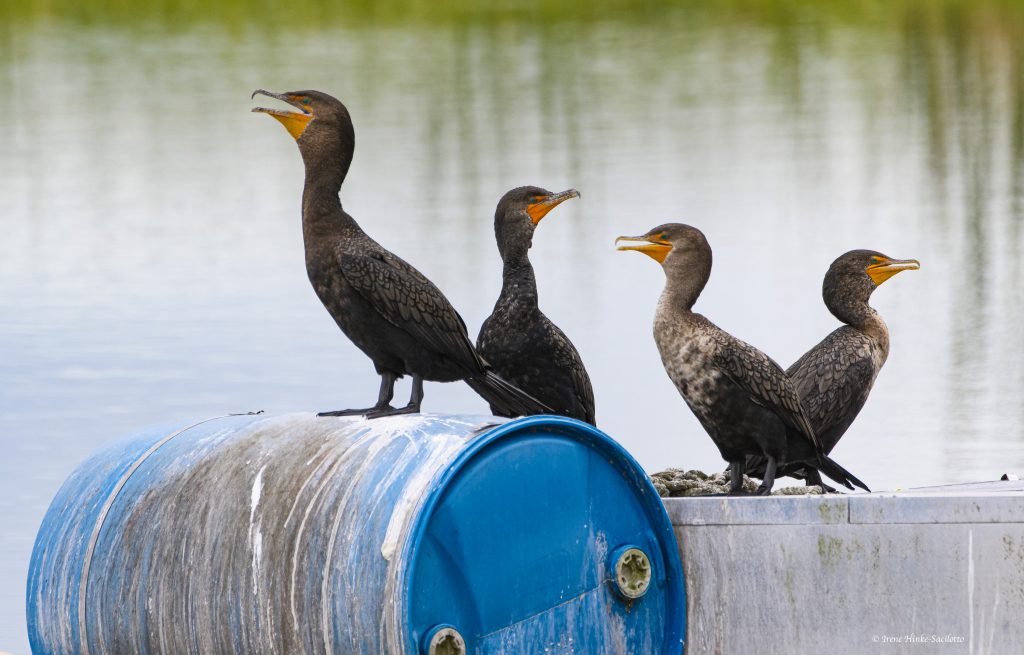
Double-crested Cormorant at Blue Heron Wetlands Facility
In the case of Orlando Wetlands, you can walk along the extensive series of dike roads. At certain times, you can take a tram tour of the facility. In the case of Blue Heron Water Reclamation Wetland Area, you must sign-in & out at their administrative office on site. When I was there, you could drive selected dike roads that provided great opportunities for photography with animals at close range and use to human presence. However, for all locations that I mention in this and the following newsletter, you must check current conditions and regulations.
A number of images in this newsletter are labeled with the location where they were taken. I first visited Orlando Wetlands about a half hour from Titusville. I walked along the dike roads expecting wildlife to be far away and intolerant of my presences. I was pleasantly surprised that many animals just ignored me and went about their normal activities. Alligators, limpkins, ibis, egrets, gallinules, and sandhill cranes were within easy camera range for photography. After conducting several December photo workshops at Bosque del Apache National Wildlife Refuge where thousands of sandhill cranes spend their time from mid-November to mid-February, I was surprised to see several cranes feeding in the first field I encountered. These Florida Sandhill Cranes are resident birds that nest in Florida and don’t migrate. They are omnivorous eating seeds, insects, frogs, mice and other organisms abundant in the marsh. Near Viera Wetlands, I actually saw a crane feeding in someone’s front lawn in the middle of a development. Later I discovered that they can be found on golf courses, parks, and in other public places.

Wood Stork sitting on branch at Orlando Wetland.
To visit Blue Heron Wetlands on weekends, you must make prior arrangements. In general many of the locations I visited were closed on certain days of the week. Those providing early entry for photographers who have purchased photo passes, such as St. Augustine’s Alligator Farm and Gator World’s rookery near Orlando, limit this privilege to certain days of the week or particular months, unfortunate for me February was not included. It is critical to check each location before visiting for rules, open dates, and conditions. For example, a favorite of many photographers, Green Cay Wetlands was closed to visitation due to renovations starting in November 2019. I had visited it several years ago and was impressed with its long boardwalk and large population of nesting birds.

Great Blue Heron at Blue Heron Reclamation Wetlands exposing underside of wings.
In following newsletters, I will cover Merritt Island National Wildlife Refuge and Cape Canaveral National Seashore plus several other areas along Florida’s east coast. The pelican/spoonbill photo at the opening of this newsletter was shot on Merritt Island one morning during my recent visit.

Great Blue Heron resting at Blue Heron Reclamation Facility.

Great Blue Heron at Blue Heron Reclamation Facility.

Red-shouldered Hawk perched in tree on Blue Heron Reclamation Wetland.
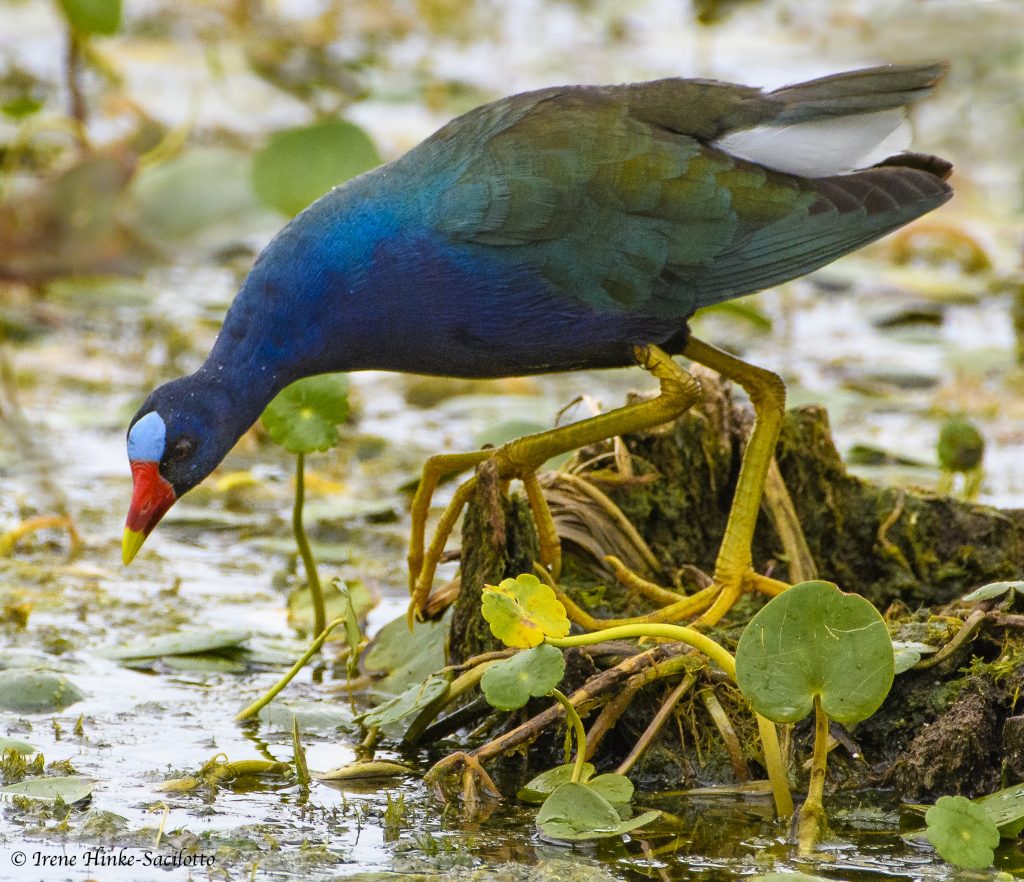
Purple Gallinule Feeding ay Blue Heron Reclamation Wetlands.
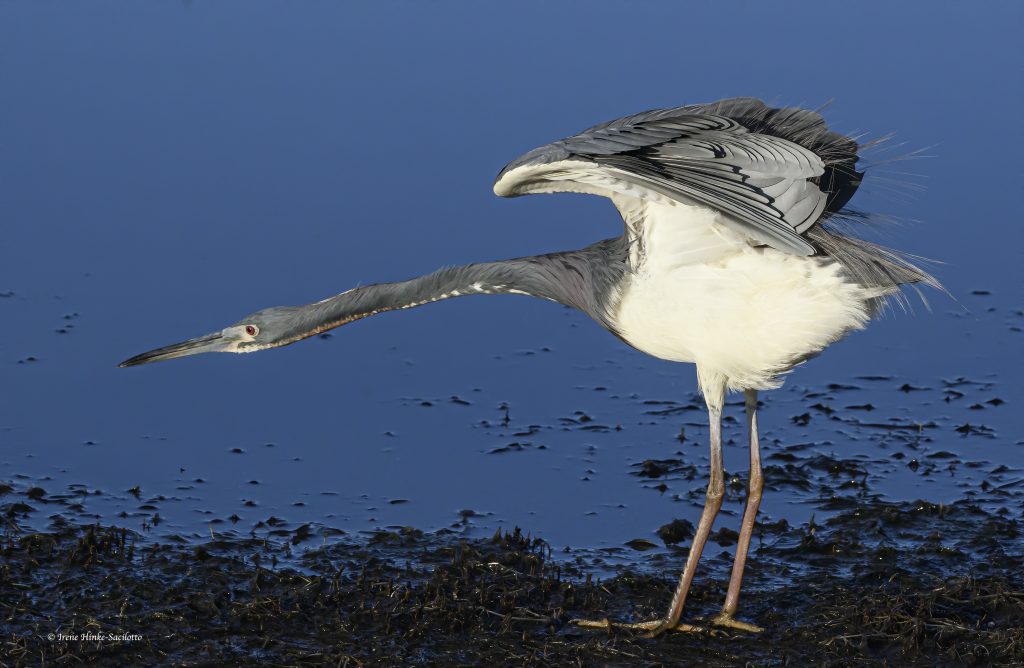
Tricolor Heron stretching on Merritt Island NWR Subject of next blog.

White Pelicans and Spoonbills at Merritt Island NWR.

by Osprey Photo Workshops & Tours | Oct 27, 2019 | Mc Neil River State Game Sanctuary, Nature, Nature Photography, Uncategorized, Wetlands, Wildlife, Wildlife Photography
Passion for Wildlife Photography

Inspiration
Why is wildlife my favorite subject to photograph? To begin, I inherited love of animals from my father. He lived in the Baltimore’s inner city in a row home with 12 siblings, but escaped whenever possible, walking great distances beyond city limit into the woods with his dog by his side. I am grateful for the knowledge he shared and reserving free time to take me for walks in the woods turning over logs looking for salamanders and in treetops for squirrels. He instilled in me an appreciation for nature and love of animals, no matter how common or unusual.
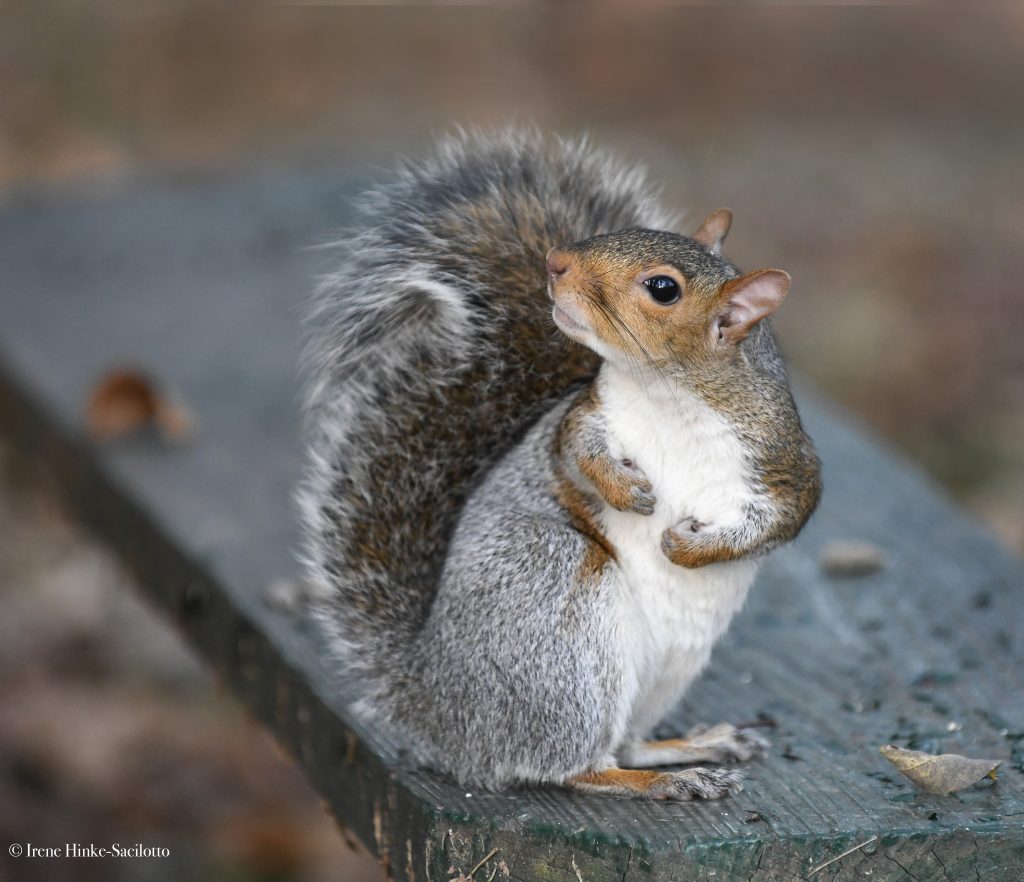
The Eastern Gray Squirrel is commonly found on the east coast of the U.S. They are known for their acrobatic skills. With specialized feet that you can see here, they can hang upside-down on trees trunks, run along the top of a fence, and gain access to the most sophisticate bird feeders.
Engagement & Mindset
I am curious by nature and love the challenges that wildlife photography presents to include locating animals and anticipating behavior. For me, the pursuit of wildlife photography has a calming influence in my life. I call it “Photo Yoga”. When observing animals, my attention is totally focused on the subject. Negative thoughts, worries, and concerns disappear. Immersed in moment, I often instinctively sense what is going to happen next as my subconscious recalls past encounters and visual cues. Even if I never take a shot, each encounter provides me with a mental database that helps me take better images in the future and with stories to share. The observations are often interjected in my presentations for camera clubs and entertain friends. For some photographers, post processing is the favorite part of rendering an image. For me, my greatest joy is capturing images in the field.
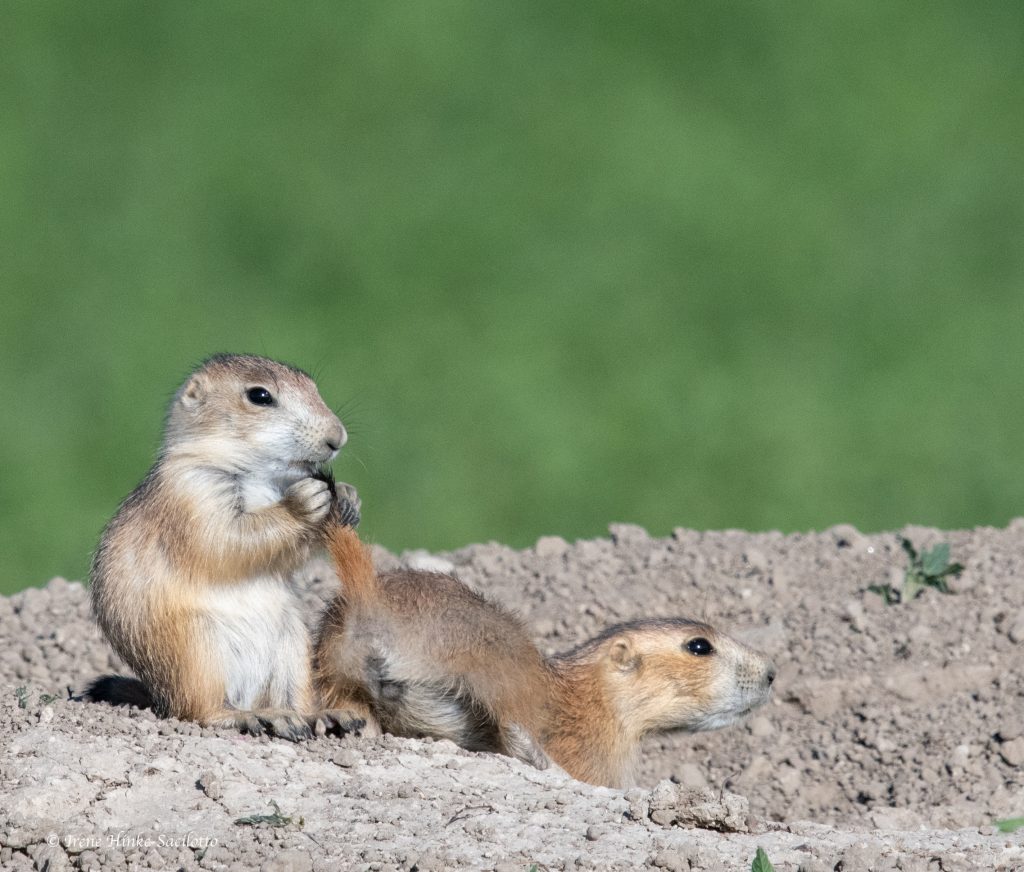
Humor is infectious. I had to laugh when watching this young Black-tailed Prairie Dog playing with the tail of its sibling.
Patience & Perseverance
Patience and perseverance are critical for capturing great images of wildlife behavior. Maybe nothing is happening at the moment. But if you wait, conditions may change. Stay focused but be open to other possible images, different than those you originally had in mind.

This wallaby mom and her joey hung out near my room at O’Reily’s Guest House in Australia. I looked for the pair each day when I walked passed the area. One day, both were in the open and allowed me to capture this and other images.

I spent a long time with this pair of wallabies and took a number of photos of them. This one shows the size of the joey. I suspect junior may shortly be too large to be fit in mom’s pouch.
Knowledge, the Key to Success
The more you know about your subject, the better your photography. Careful observation of animal behavior and research are crucial. Now web searches make gathering information much easier than years ago. Talking to researchers, hunters, fellow photographers, and birders can be quite helpful understanding what you are observing and making it easier to anticipate action.
I saw this Great Egret beginning to stretch after sitting on this branch for a long time. It extended its wing and then stretched its leg. I was lucky to capture this image at the exact moment that the bird’s leg was extended with the wing behind.
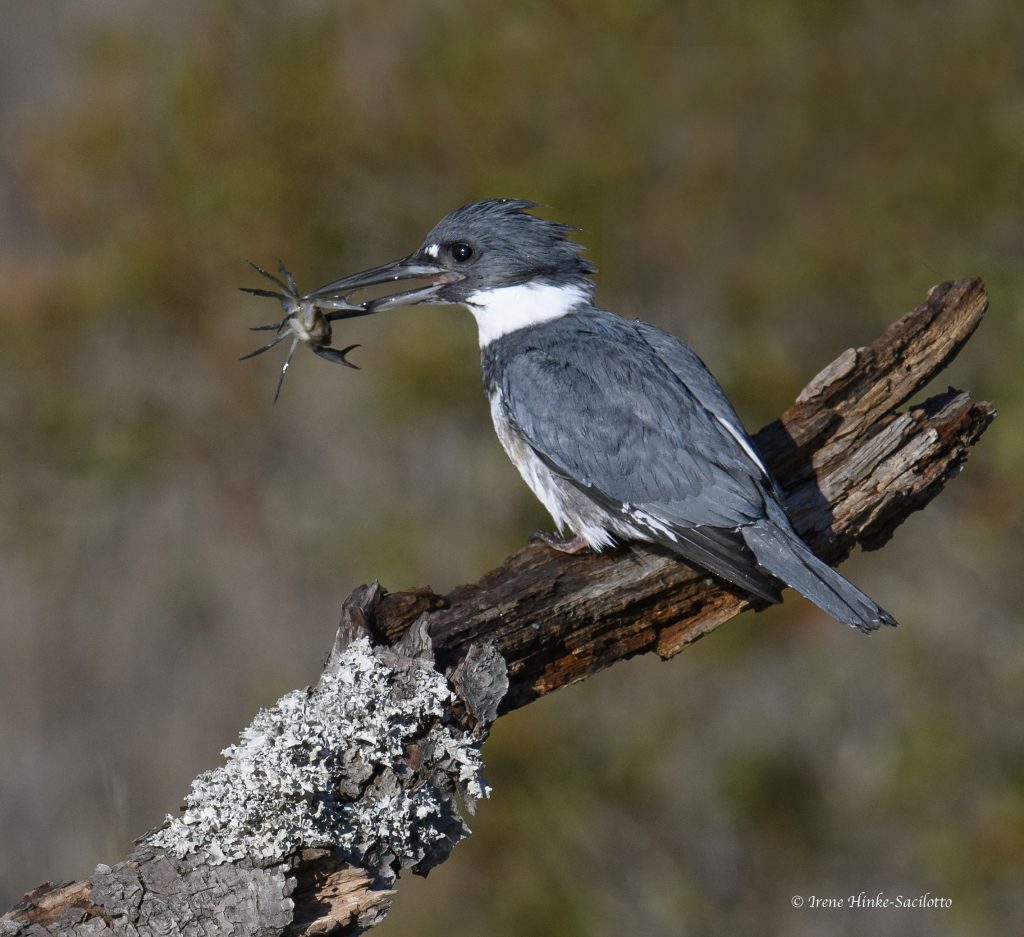
After this Belted Kingfisher caught a crab, it shifted the position of the crab in its bill a number of times trying to eat it. By taking a series of photos in rapid succession, captured this shot at the exact moment that the crab’s claw showed against the background.
Relax and Let your Imagination Soar
Give up preconceptions or labels. Keep an open mind with child-like curiosity and enthusiasm. Be flexible and experiment. Move and change your camera angle. I might lie on my back for an interesting point of view or shoot while lying on my belly. Zoom out for wider views of the surrounding or increase magnification to capture detail. Sometimes I give myself assignments designed to stretch my imagination. I go into the field with a single lens or shoot only with slow shutter speeds.

Ribbon Snake photographed while lying on my belly for a unique point of view.
Identify the Attraction
When photographing, it is important to identify what initially attracted you to the subject. Is it rim-light, texture, patterns, repeating elements, reflections, detail, surprising behavior, unique appearance, etc.? Once you realize what attracted you, then select the lens, approach, and lighting that best captures that feature. Look for shots that tell a story and unique behavior.
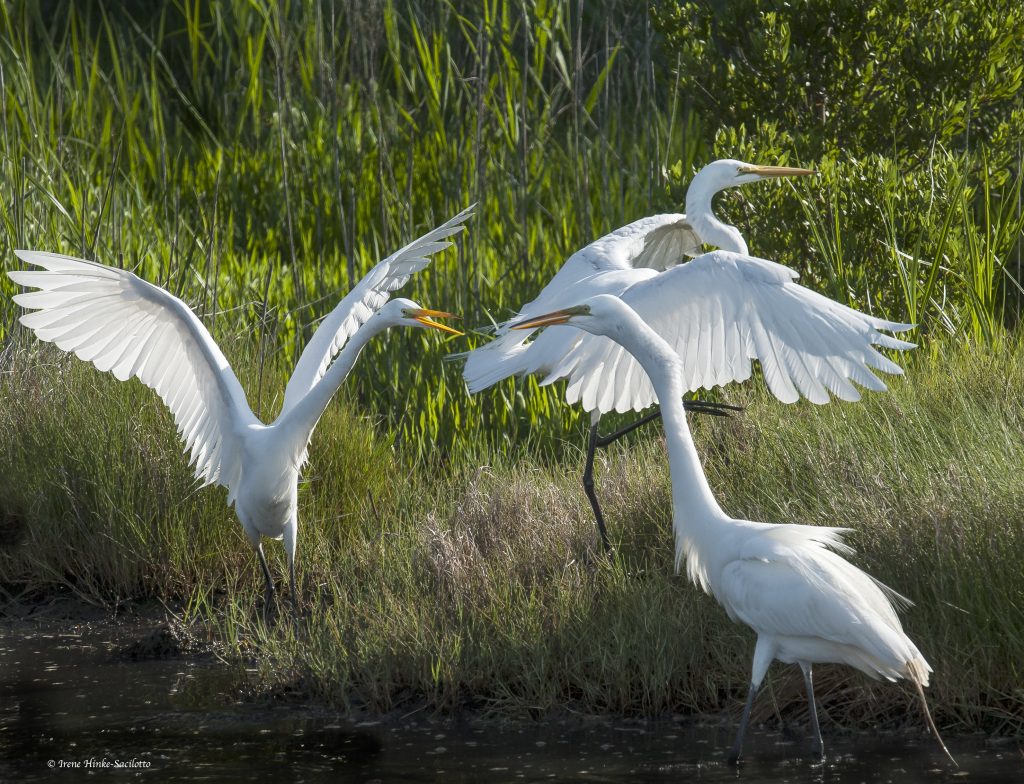
This image shows Great Egret fighting over something. In this case, the squabble was over a pool of water filled with small fish. Apparently, the third bird wanted no part of the disagreement.

Sanderlings are small shorebirds that feed along the shoreline. When waves retreat, the birds follow and feed on mole crabs and other organisms as wet sand is exposed. With incoming surf, they run ahead of it to avoid being swamped.
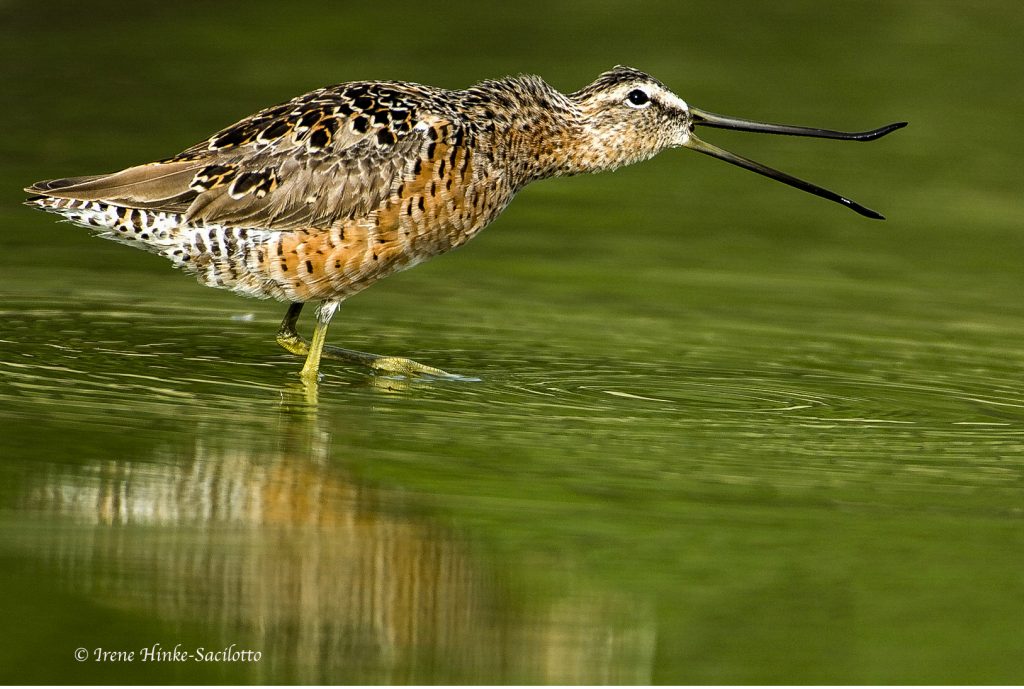
This photo of this Long-billed Dowitcher yawning, shows that the bill is not rigid. The tip with tactile receptors can be manipulated as it feeds making it possible for it to locate prey by touch.
Refining your Images
In the field, I continuously refine my images. Typically if there is time, I take a series of photographs attempting to make each one better than the last. I examine the composition, carefully scan the edges of the frame, and look for potential flaws and distractions. I also consider alternative points of view so I can take full advantage of each situation. I look for lines, contrast, color, etc. that can lead to the subject and keep the viewer’s eye engaged and within the frame. I may spend hours with one subject or return day after day.
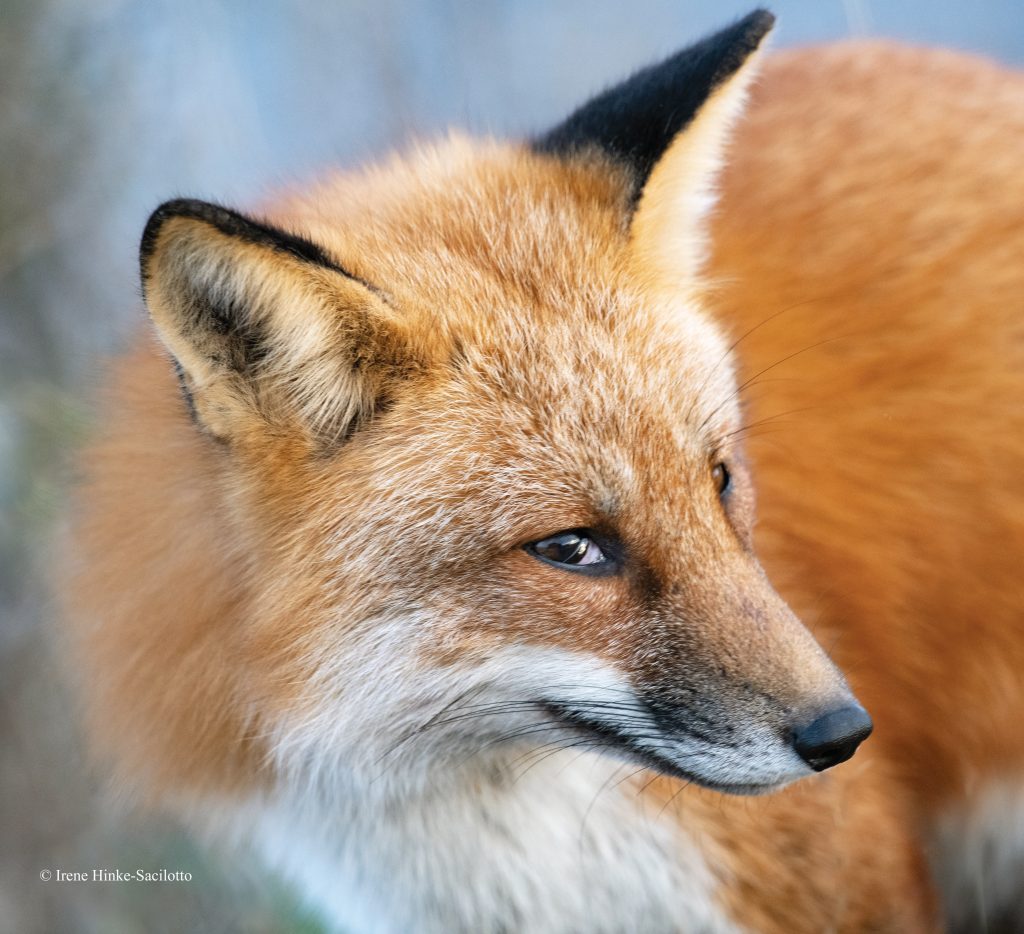
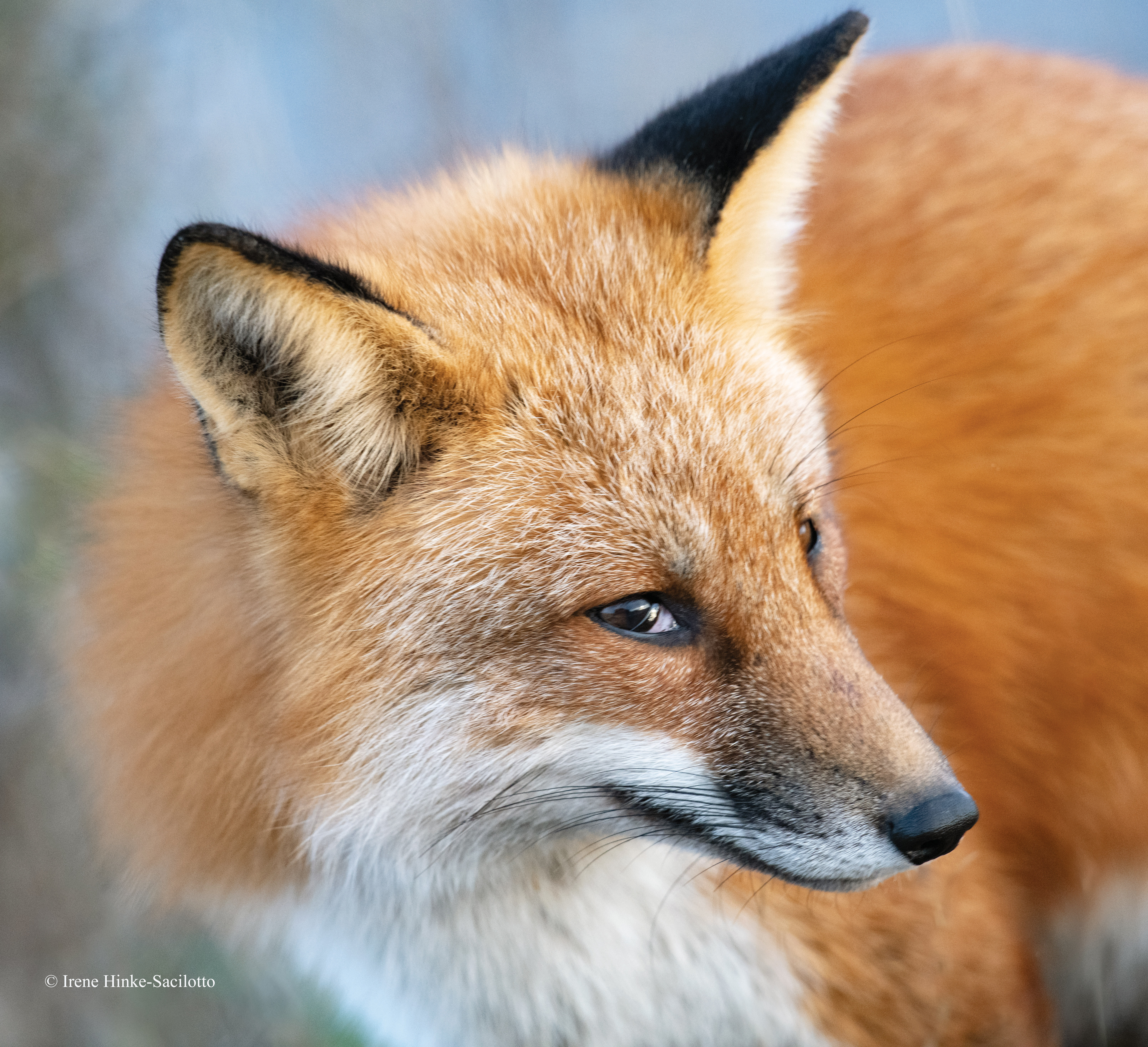
Red Fox image captured with an expression that suggests the saying “sly as a fox”. I took several shots of the fox at the time but this was the only one with this look.
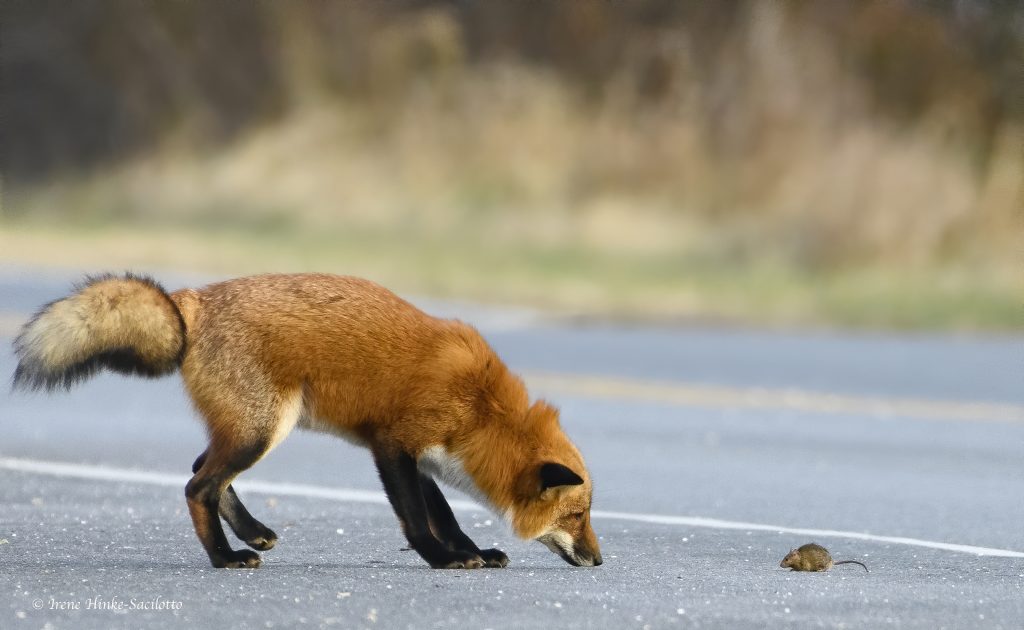
Red Fox standoff with mouse at Chincoteague, NWR. Every day during this trip I looked for fox in same area where I first saw it. Eventually I spotted it toying with a mouse and moved in to take this photo.
Background Control
Sometimes I squint my eyes when looking at a scene to exclude less important details and see what stands out (including lines, forms, etc.) or could present a problem. For example, I use this technique when photographing a subject as a silhouette to be sure its shape does not blend with other unlit portions of the scene and that the animal is recognizable by outline alone.

Silhouette of heron with fish in bill.
For close-up photography, I sometimes shift my camera’s focus off the subject and focus on the background for an instant. This technique allows me to more easily see if strong forms, bright highlights, or other distractions are in the background and may be a problem. Then I refocus on the subject with this information in mind.
The longer the focal length of the lens, the narrower angle of view. So, these telephoto lenses can help you exclude a something distracting in the background. Small shifts in the camera position can dramatically control what appears behind your subject. In some situations where the subject is in sunlight but the background is distracting, I position camera so that a shadowed area falls behind my subject. This approach creates a dramatic image, as is if the animal is lit by a spotlight.

Yellow-Crowned Night Heron after catching soft crab. The bird was in sunlight but the background was in shadow. I made the image a bit more dramatic by darkened the backgound even more during post-processing .
Shooting from a position level with your subject is often desirable, producing less distortion of the image and suggesting a more intimate relationship between you and your wildlife subject. The lower angle can also help isolate the subject if the background is distant and well out of the depth of field.

Black-Tailed Prairie Dog family

Black-Tailed Prairie Dogs nose to nose.
Capturing the Unusual
I love capturing the unique aspects of an animal’s morphology and behavior. I look for the unexpected, humor, or the emotion evoked by the scene. Every situation is unique, for the behavior, environment, and lighting is never the same. Don’t pass up on an opportunity expecting it to be there tomorrow. It won’t!
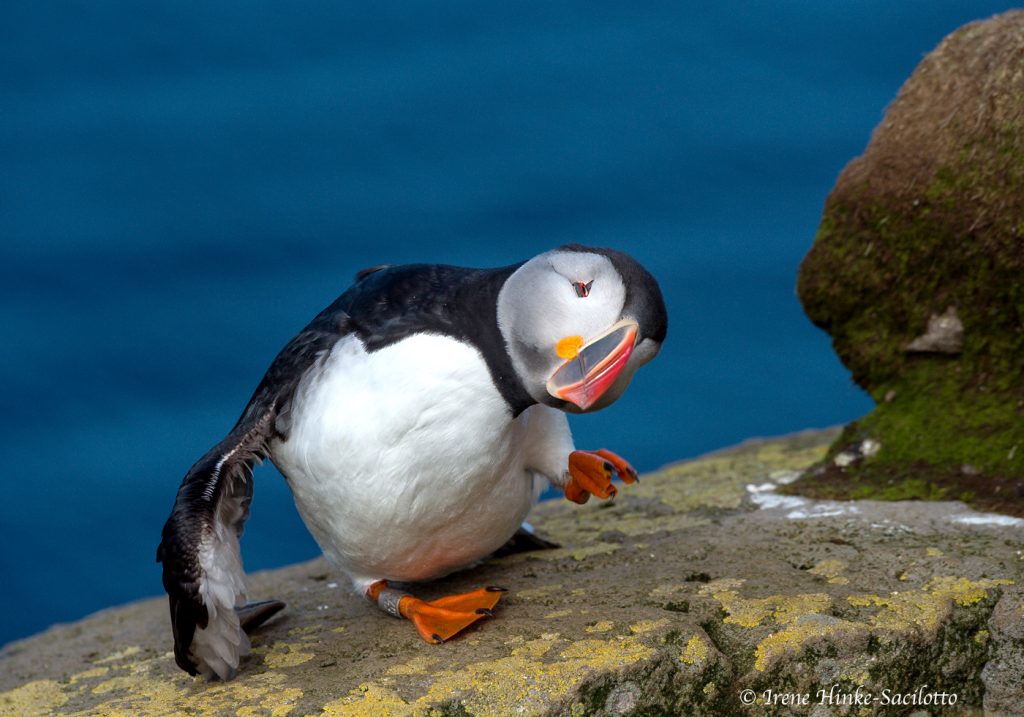
Unique photo of Atlantic Puffin using wing for balance while scratching.
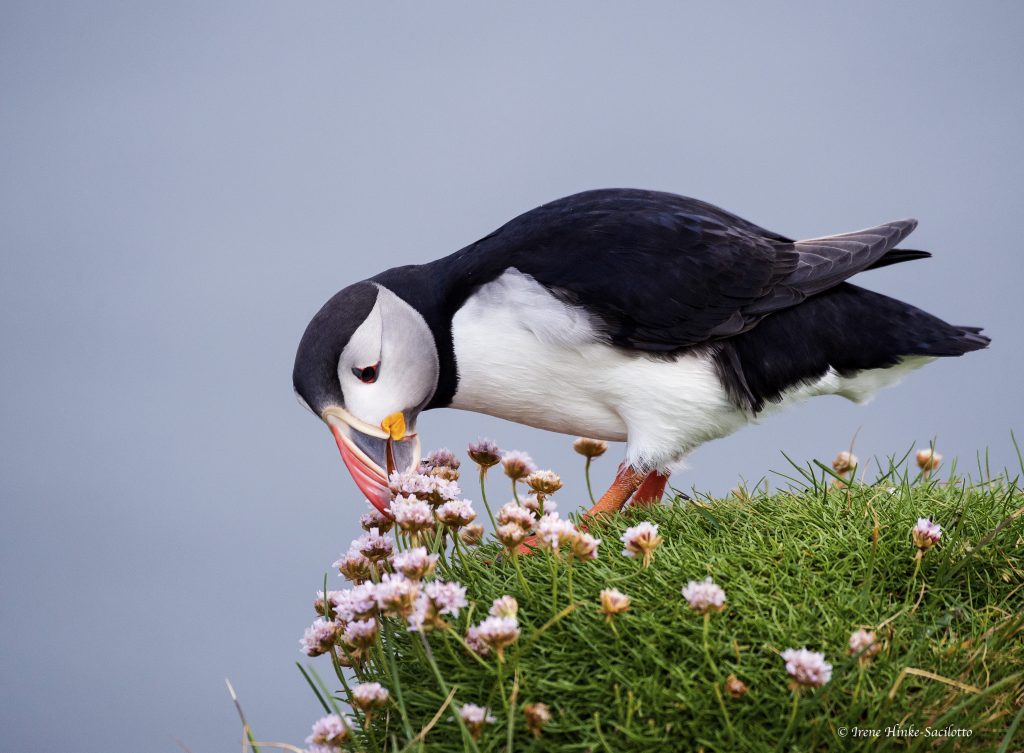
Atlantic Puffin eating flowers. This was so unexpected, that I took a number of photos at the time but only one best showed what the puffin was doing. The distant background and relatively shallow depth of field helped make the bird bird and flowers standout.
Imaginary Gallery
To judge the impact of a photograph, I sometimes imagine it hanging on the wall in a gallery. I examine the photo as if seeing it for the first time. Then I ask myself, have I conveyed the thoughts and feelings I experienced while taking the photo? Is the composition static – perhaps with the subject centered or with the horizon in the middle of the frame? Is the viewers eye drawn into the scene? Does it convey a story?

This is a humorous shot of a young Brown Bear struggling to hold onto a slippery salmon at McNeil State Game Sanctuary in Alaska. I love the story.
I always am learning something new from magazine articles, youtube, experiences in the field, and from other photographers. I keep my workshops small so I can provide individual attention to each person, no matter their skill level. No one should ever be embarrassed to ask questions. I typically learn something each time I conduct a program. If you have an open mind and see disappointments as opportunities, you will gain from your experiences. Everyone has his own unique vision. This becomes very obvious during my workshop image reviews. Even though the photographers are at the same location at the same time, the resulting mages are normally quite different.

by Osprey Photo Workshops & Tours | Mar 13, 2019 | Alaska, Bald Eagle, Bristol Bay, Brown Bears, Environmental Impact, Mc Neil River State Game Sanctuary, Nature, Wetlands, Wildlife
Pebble Mine and Its Negative Environmental Impact
The following expresses my feelings and concerns about construction and operation of the Pebble Mine in Southeast Alaska and it negative impact on the environment and Bristol Bay ecosystem, spawning sockeye salmon, and the bears of Southeast Alaska.

Bald Eagle in Homer.
The construction of one of the world’s largest open-pit mines will require the building of significant amounts of supporting infrastructure, including roads, a power plant, pipelines, and a port, and the resulting development would have destructive environmental impacts for hundreds of square miles. The disturbance of this pristine area including Mc Neil River State Game Sanctuary and Katmai National Park where coastal brown bears gather each year to feed on salmon is distressing. The application submitted to the Army Corps of Engineers includes a deep-water port at Amakdedori beach and road that stretches across prime bear habitat from near Kokhanok, AK to the shoreline. This proposed road comes within a mile of the McNeil River State Game Refuge boundary and the port facility is within sight of a world class bear viewing destination.
The activity along the road and associated construction and operation of a deep-water port nearby and mine is bound to have a highly detrimental effect on the bears and other wildlife that live in the area. For years the government has exercised great care to protect the bears and provide safe bear-viewing for the public. This includes minimizing negative interactions between the bears and humans by enforcing rules to avoid harmful encounters. Activities around the mine and port will certainly undo these efforts.
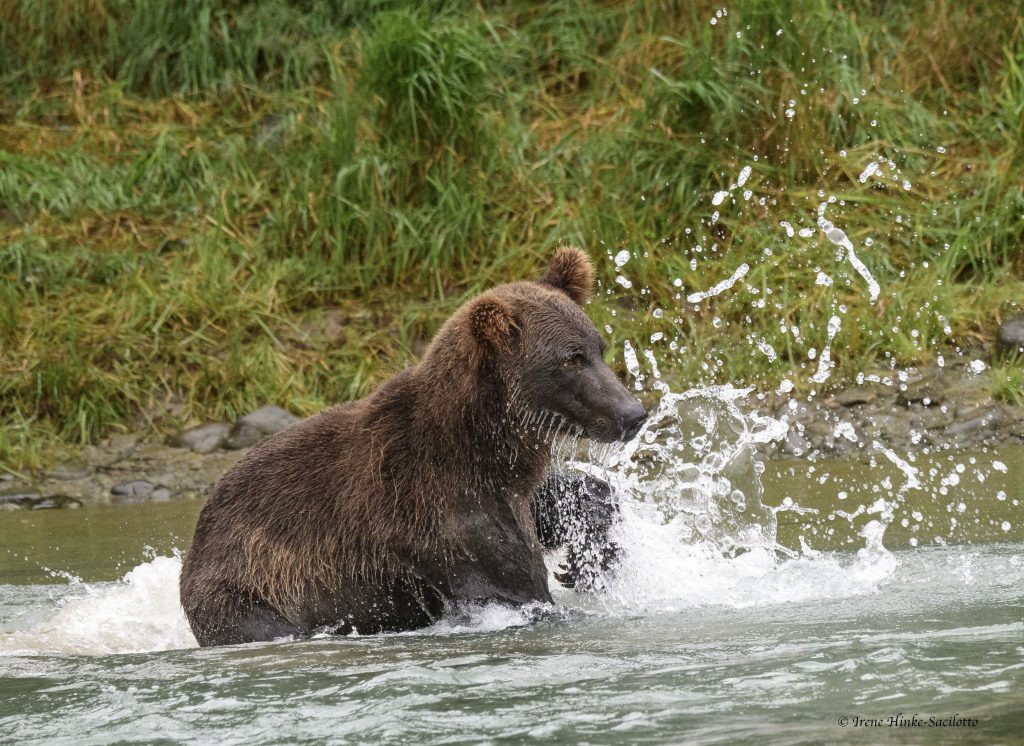
Brown bear chasing salmon.
People from all over the world are attracted to Alaska for the possibility of seeing bears and other wildlife roaming free. They spend millions of dollars in Alaska for the opportunity and contribute billions to the economy of Alaska – food, transportation, lodging, tour guides, park fees, etc.
Regarding Mc Neil River, there is no place like it anywhere in the world. I am now 70 and last year I had the privilege of visiting Mc Neil River, after a number of years trying to win the state lottery for the privilege. It was one of the most incredible experiences I have had in my life. I am a professional wildlife photographer and nature photo tour leader. I have been to Africa, Argentina, Iceland, Chile, Newfoundland, the Falkland Islands, Northwest Territory, Churchill Manitoba, Nome, Australia, and New Zealand, so I have been to many premiere natural areas around the world. But I never experienced a thrill like that of sitting quietly photographing and watching the bears feeding on salmon at the lower falls at Mc Neil, feeling unthreatened with some bears walked by only 12 feet away.

Brown Bear Standing in grasses near lower falls of Mc Neil River.
I was horrified when I found out that the Pebble Mine project may be approved. The largest sockeye salmon run in the world will be disrupted along with the fishery industry in Southeast Alaska. Equally important, bears and other wildlife (bald eagles, killer whales, other marine animals, etc.) will be adversely effected since they depend on the salmon for survival. Removal of groundwater in order to operate the mine will dry up streams, lakes, and wetlands necessary for salmon eggs, young salmon, and their food source to survive. No amount of recycling the water supply after waste water cleanup will return the water and waterways to their original state. The mine with its associated structures is located near a fault, in an area where earth quakes and severe storms with heavy rainfall are possible. Not only will the blasting involved in the mining process disturb wildlife but I question whether it could actually trigger earthquakes. The acid waste from extracting copper and gold from pulverized ore contains cyanide, toxic metals such as lead, selenium, cadmium, and arsenic, and other contaminants can potentially leach into nearby waterways and lakes. Efforts to permanently contain this poisonous waste are destined to fail.
It is not worth damaging Alaska’s natural resources including the fragile Bristol Bay ecosystem and wildlife populations just to benefit developers and foreign investors. Any perceived economic benefit will be offset by the cost of restoration if there is a mishap during the construction or operation of the mine, deep water port, and any associated activities. Remember the Exxon Valdes oil spill, a tragedy thought to be unimaginable. The damage to the environment was catastrophic and the cost of clean-up was in the billions of dollars. The benefit from the construction of the Pebble Mine is not worth the threat to human population nearby and the incredible ecosystem where salmon spawn and bears roam free. This pristine region of Southeast Alaska is unique in the world. In addition, Issuing a permit for the construction of the Pebble Mine will open up other areas in the Bristol Bay region and southeast Alaska to mining which will result in farther degradation of the environment and more threats to wildlife.
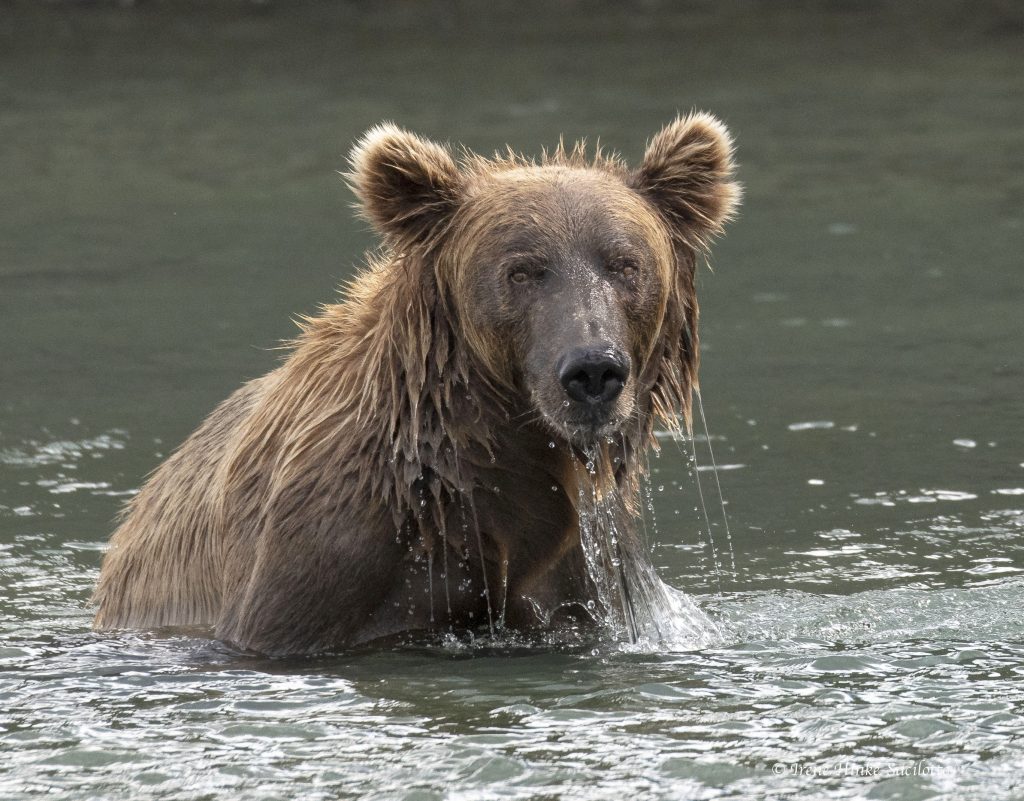
Coastal Brown Bear feeding in the waters at the lower falls of Mc Neil River.
What kind of world to you want to leave for your grandchildren?
What Makes America Great are places like Mc Neil River State Game Sanctuary where in July as many as 80 brown bears gather to feed on salmon, where millions of sockeye salmon spawn, and where wildlife thrives on the land and in the waters of Bristol Bay.
I believe that the Pebble Mine Draft Environmental Impact Statement should be resubmitted and replaced with one that is more comprehensive and backed by data that can validated. This project is huge with many ramifications and the potential of having far-reaching negative on the environmental and the delicate ecosystem of Bristol Bay. That which it will destroy, cannot be replaced.
See my previous blog on Mc Neil River State Game Sanctuary and Coastal Brown Bears.
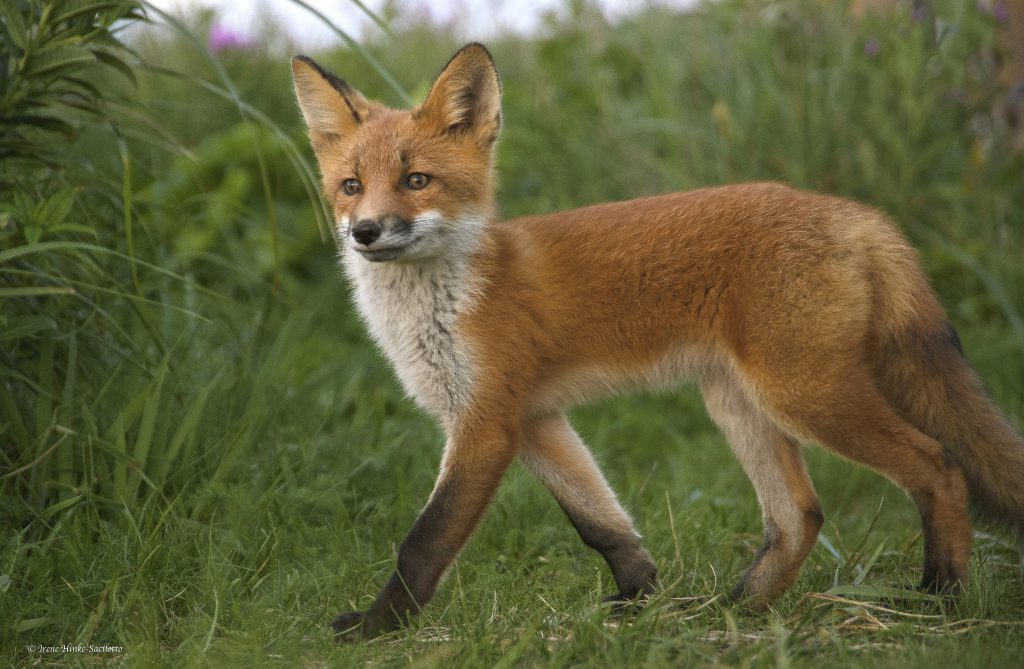
Young Red Fox in South East Alaska.
***********
For more info and links on the Pebble Mine and where you can comment to the Corp of Engineers regarding the project.
Orvis.com/nopebblemine
Regarding the Army Corp of Engineers approval of the Draft Environmental Impact Statement on the Pebble Mine you can go to their website. https://www.pebbleprojecteis.com/ A quote from their web page reads as follows: “The public comment period will run from March 1, 2019 through May 30, 2019. You can submit comments through testimony at public meetings, email to drafteis@comments.pebbleprojecteis.com or mail them to:
Program Manager
US Army Corps of Engineers
645 G St.
Suite 100-921
Anchorage, AK 99501
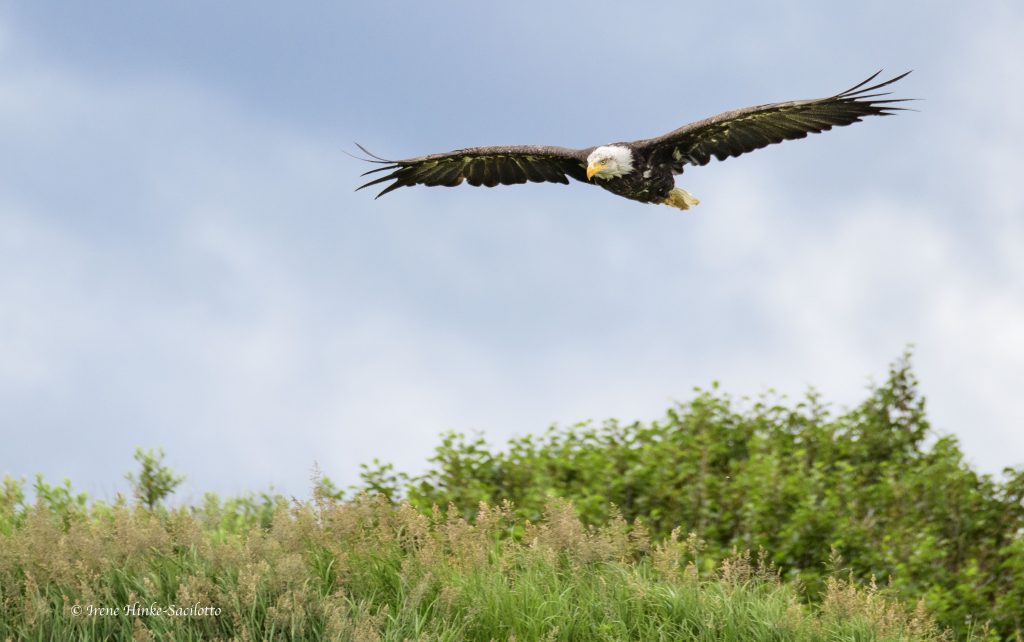
Bald Eagle flying over cliff at Mc Neil River State Game Sanctuary.