by Osprey Photo Workshops & Tours | Oct 27, 2019 | Mc Neil River State Game Sanctuary, Nature, Nature Photography, Uncategorized, Wetlands, Wildlife, Wildlife Photography
Passion for Wildlife Photography

Inspiration
Why is wildlife my favorite subject to photograph? To begin, I inherited love of animals from my father. He lived in the Baltimore’s inner city in a row home with 12 siblings, but escaped whenever possible, walking great distances beyond city limit into the woods with his dog by his side. I am grateful for the knowledge he shared and reserving free time to take me for walks in the woods turning over logs looking for salamanders and in treetops for squirrels. He instilled in me an appreciation for nature and love of animals, no matter how common or unusual.
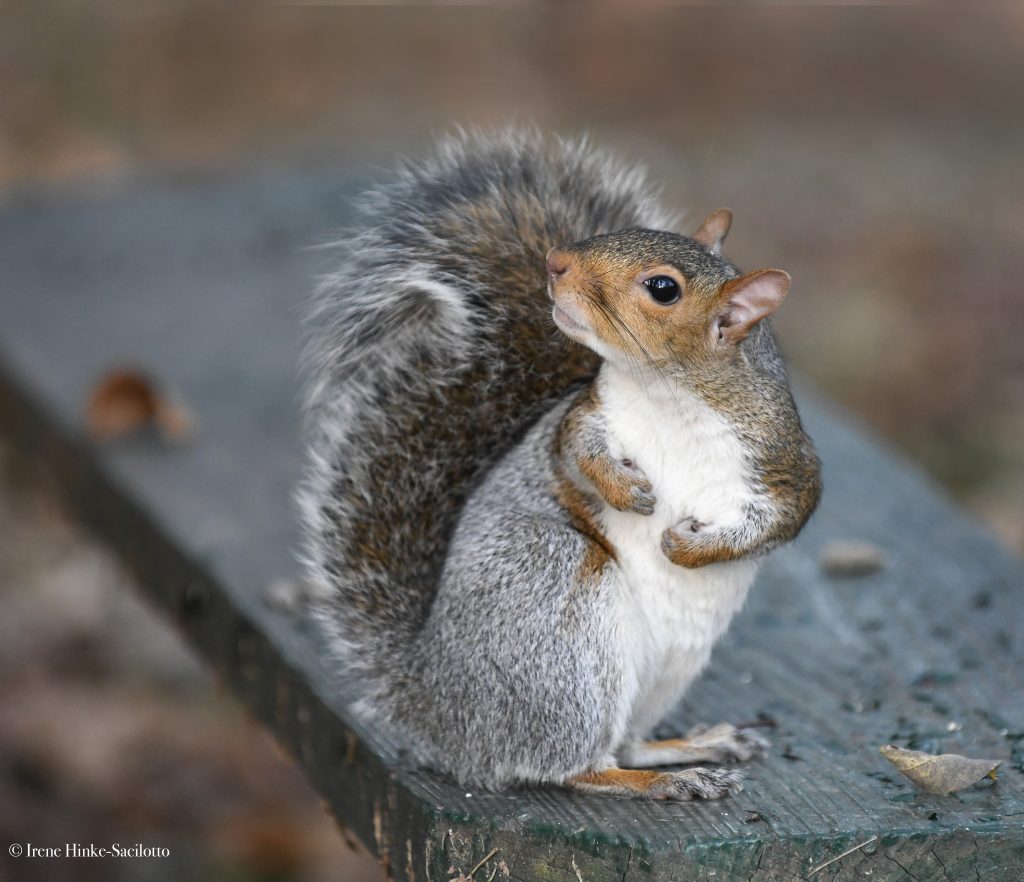
The Eastern Gray Squirrel is commonly found on the east coast of the U.S. They are known for their acrobatic skills. With specialized feet that you can see here, they can hang upside-down on trees trunks, run along the top of a fence, and gain access to the most sophisticate bird feeders.
Engagement & Mindset
I am curious by nature and love the challenges that wildlife photography presents to include locating animals and anticipating behavior. For me, the pursuit of wildlife photography has a calming influence in my life. I call it “Photo Yoga”. When observing animals, my attention is totally focused on the subject. Negative thoughts, worries, and concerns disappear. Immersed in moment, I often instinctively sense what is going to happen next as my subconscious recalls past encounters and visual cues. Even if I never take a shot, each encounter provides me with a mental database that helps me take better images in the future and with stories to share. The observations are often interjected in my presentations for camera clubs and entertain friends. For some photographers, post processing is the favorite part of rendering an image. For me, my greatest joy is capturing images in the field.
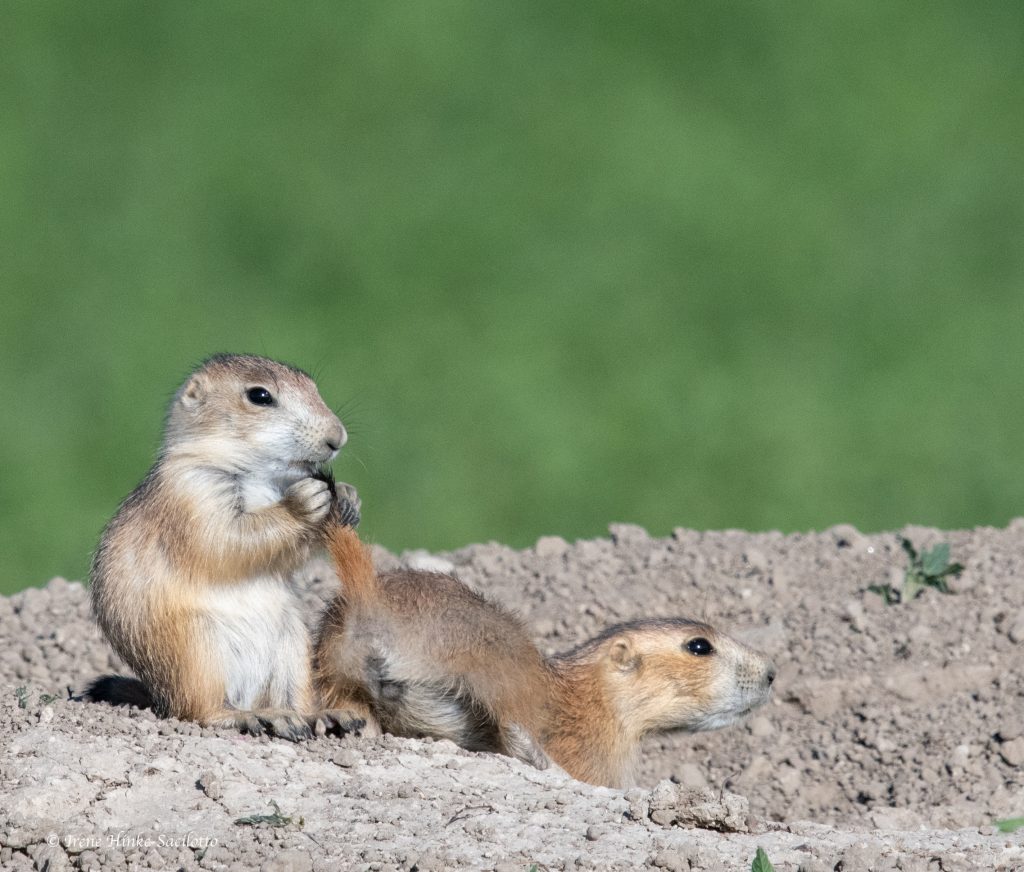
Humor is infectious. I had to laugh when watching this young Black-tailed Prairie Dog playing with the tail of its sibling.
Patience & Perseverance
Patience and perseverance are critical for capturing great images of wildlife behavior. Maybe nothing is happening at the moment. But if you wait, conditions may change. Stay focused but be open to other possible images, different than those you originally had in mind.

This wallaby mom and her joey hung out near my room at O’Reily’s Guest House in Australia. I looked for the pair each day when I walked passed the area. One day, both were in the open and allowed me to capture this and other images.

I spent a long time with this pair of wallabies and took a number of photos of them. This one shows the size of the joey. I suspect junior may shortly be too large to be fit in mom’s pouch.
Knowledge, the Key to Success
The more you know about your subject, the better your photography. Careful observation of animal behavior and research are crucial. Now web searches make gathering information much easier than years ago. Talking to researchers, hunters, fellow photographers, and birders can be quite helpful understanding what you are observing and making it easier to anticipate action.
I saw this Great Egret beginning to stretch after sitting on this branch for a long time. It extended its wing and then stretched its leg. I was lucky to capture this image at the exact moment that the bird’s leg was extended with the wing behind.
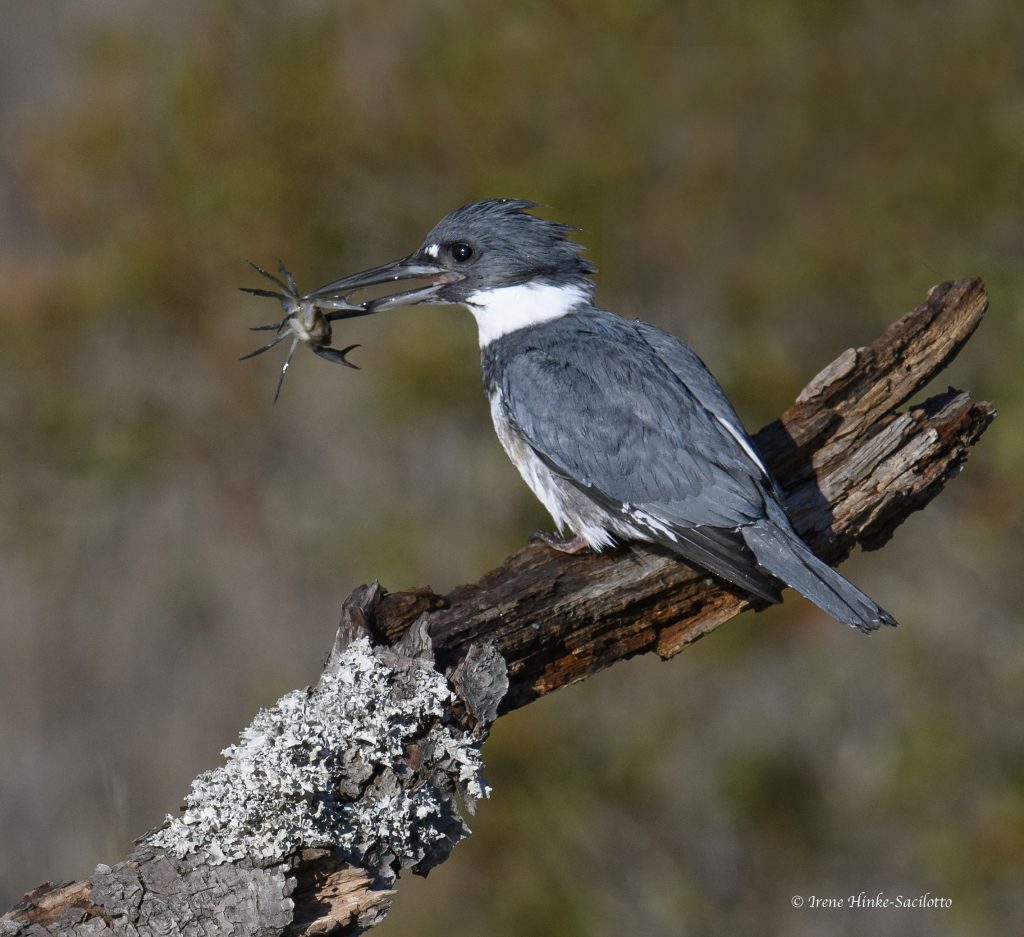
After this Belted Kingfisher caught a crab, it shifted the position of the crab in its bill a number of times trying to eat it. By taking a series of photos in rapid succession, captured this shot at the exact moment that the crab’s claw showed against the background.
Relax and Let your Imagination Soar
Give up preconceptions or labels. Keep an open mind with child-like curiosity and enthusiasm. Be flexible and experiment. Move and change your camera angle. I might lie on my back for an interesting point of view or shoot while lying on my belly. Zoom out for wider views of the surrounding or increase magnification to capture detail. Sometimes I give myself assignments designed to stretch my imagination. I go into the field with a single lens or shoot only with slow shutter speeds.

Ribbon Snake photographed while lying on my belly for a unique point of view.
Identify the Attraction
When photographing, it is important to identify what initially attracted you to the subject. Is it rim-light, texture, patterns, repeating elements, reflections, detail, surprising behavior, unique appearance, etc.? Once you realize what attracted you, then select the lens, approach, and lighting that best captures that feature. Look for shots that tell a story and unique behavior.
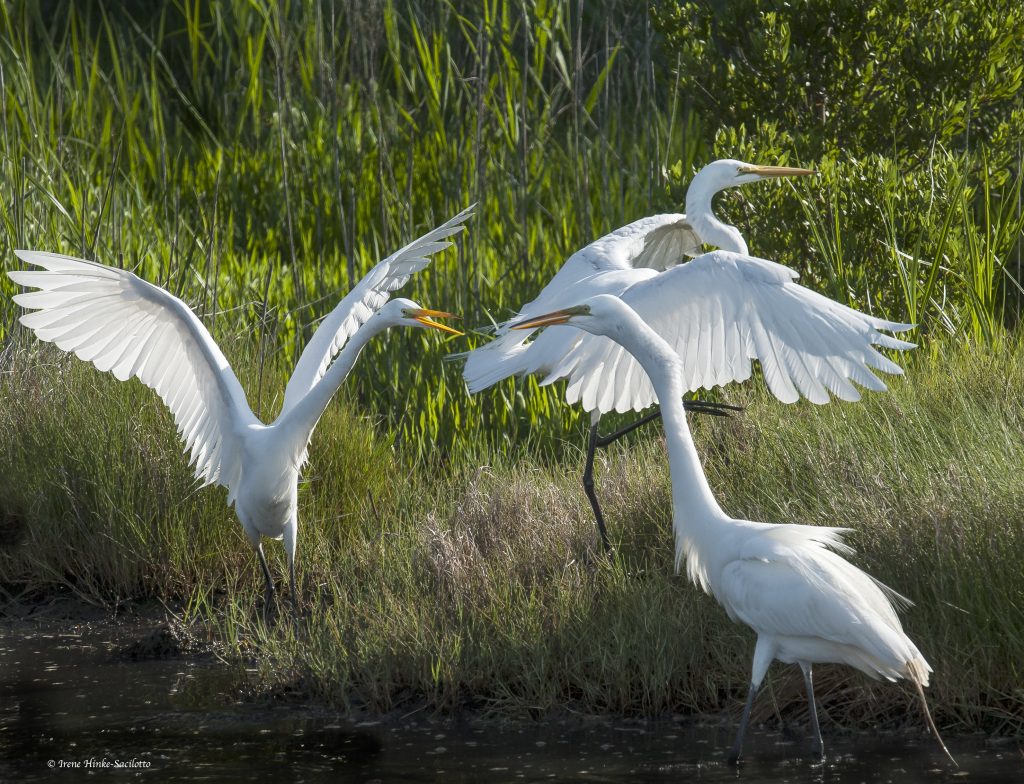
This image shows Great Egret fighting over something. In this case, the squabble was over a pool of water filled with small fish. Apparently, the third bird wanted no part of the disagreement.

Sanderlings are small shorebirds that feed along the shoreline. When waves retreat, the birds follow and feed on mole crabs and other organisms as wet sand is exposed. With incoming surf, they run ahead of it to avoid being swamped.
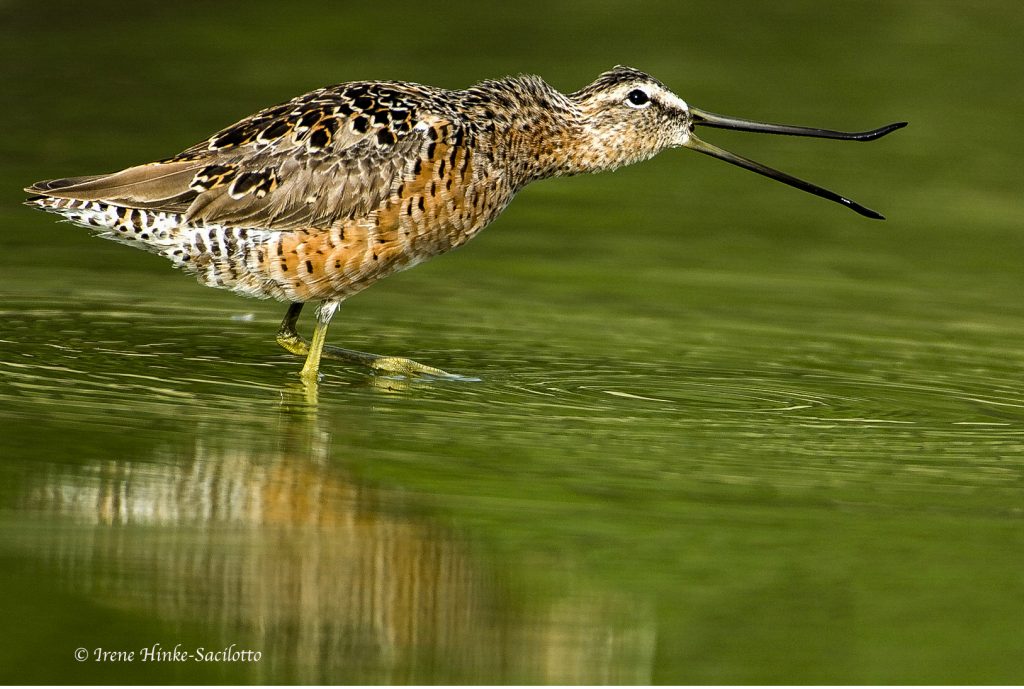
This photo of this Long-billed Dowitcher yawning, shows that the bill is not rigid. The tip with tactile receptors can be manipulated as it feeds making it possible for it to locate prey by touch.
Refining your Images
In the field, I continuously refine my images. Typically if there is time, I take a series of photographs attempting to make each one better than the last. I examine the composition, carefully scan the edges of the frame, and look for potential flaws and distractions. I also consider alternative points of view so I can take full advantage of each situation. I look for lines, contrast, color, etc. that can lead to the subject and keep the viewer’s eye engaged and within the frame. I may spend hours with one subject or return day after day.
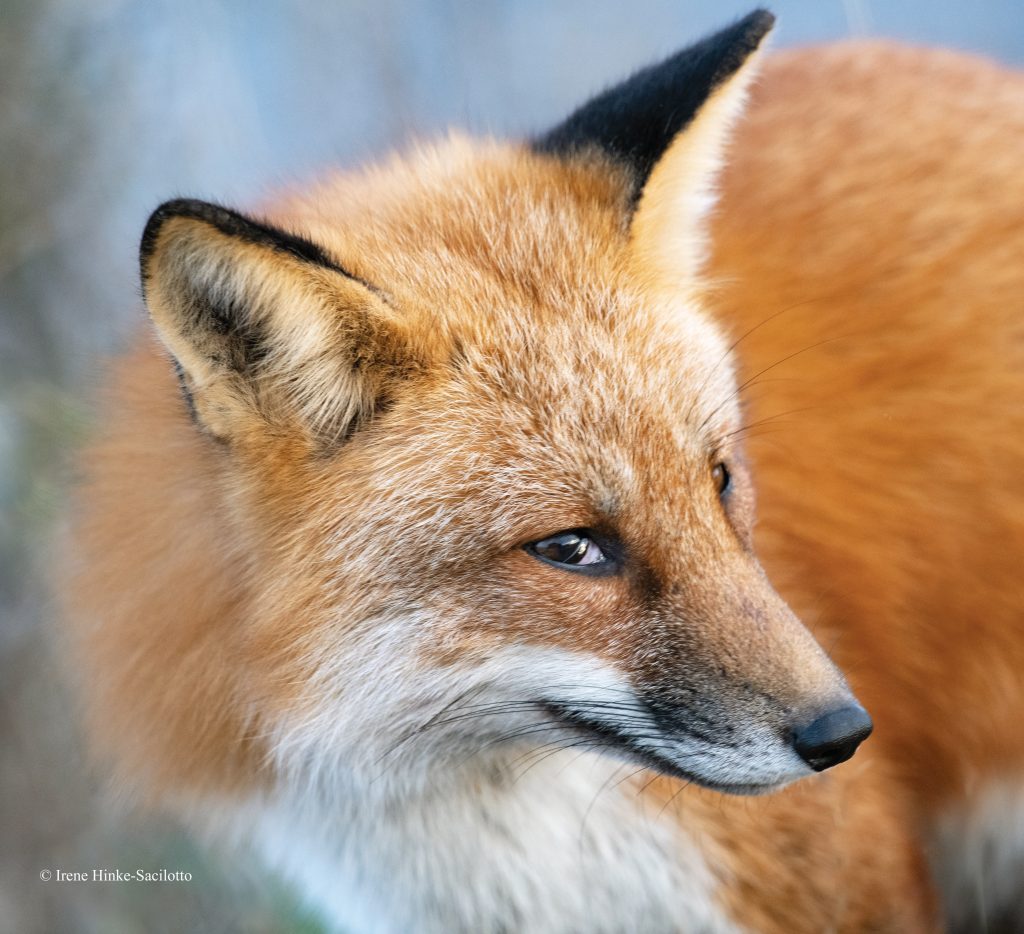
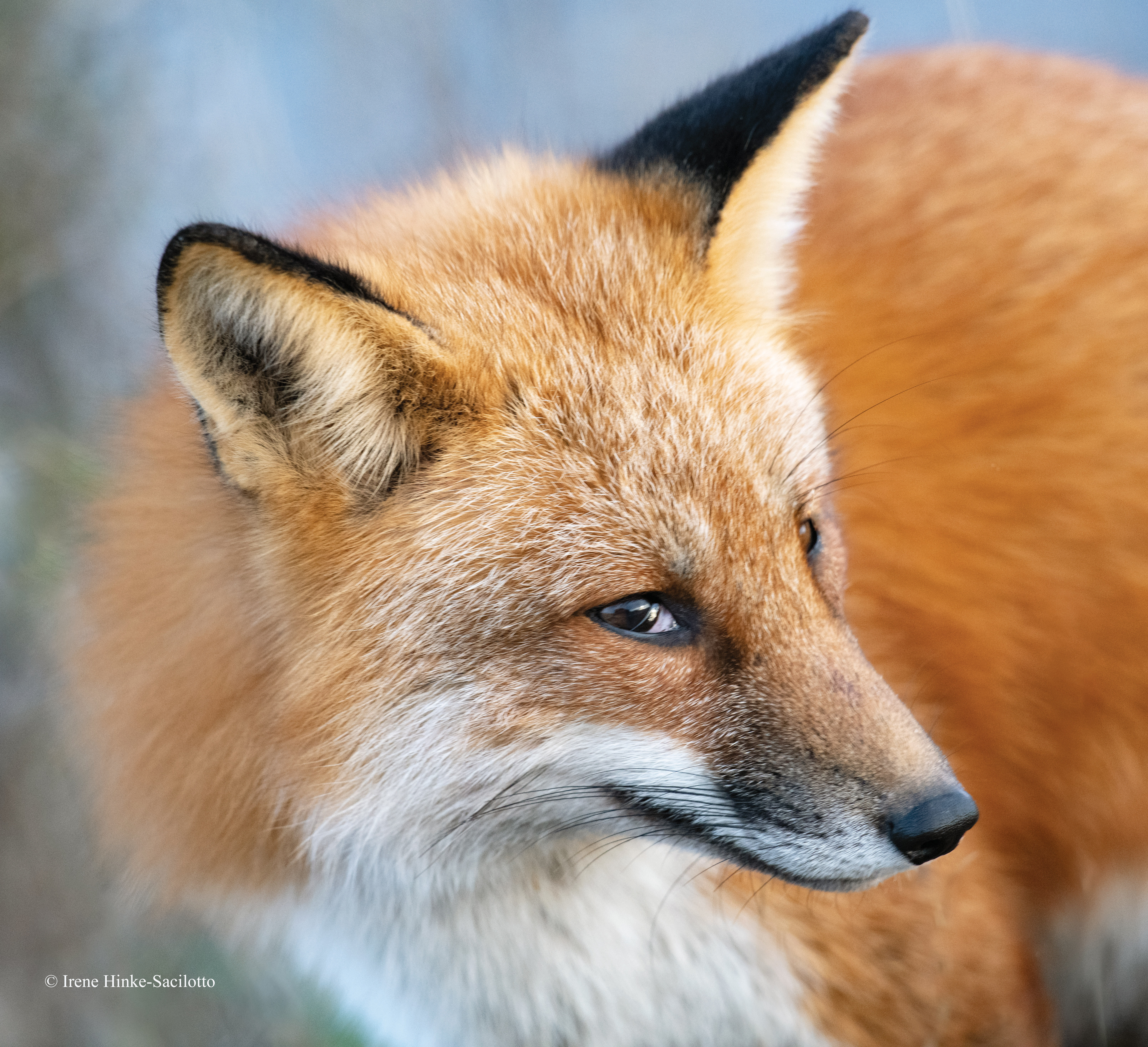
Red Fox image captured with an expression that suggests the saying “sly as a fox”. I took several shots of the fox at the time but this was the only one with this look.
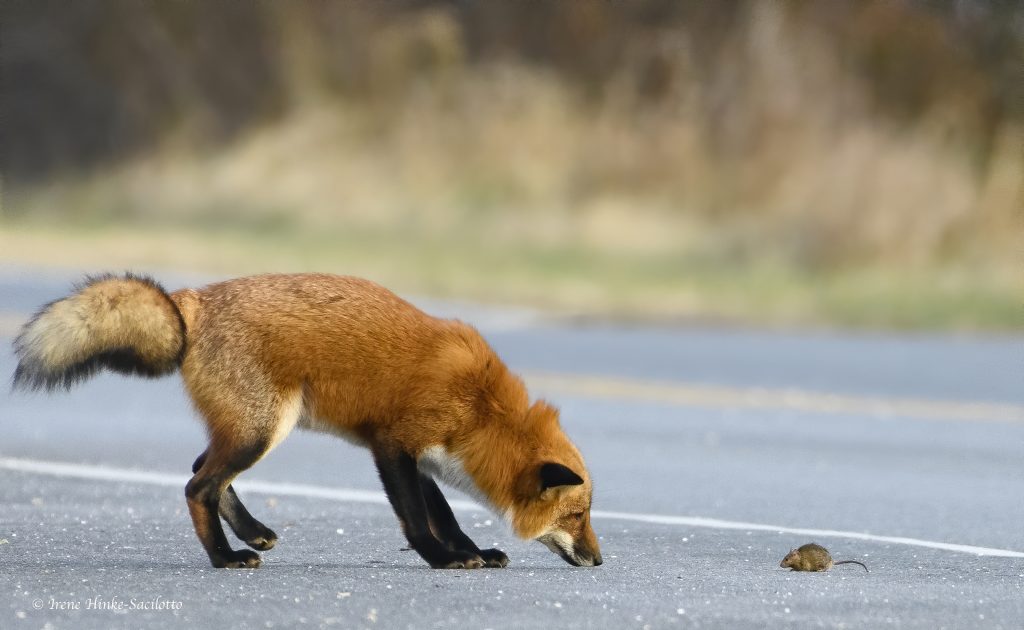
Red Fox standoff with mouse at Chincoteague, NWR. Every day during this trip I looked for fox in same area where I first saw it. Eventually I spotted it toying with a mouse and moved in to take this photo.
Background Control
Sometimes I squint my eyes when looking at a scene to exclude less important details and see what stands out (including lines, forms, etc.) or could present a problem. For example, I use this technique when photographing a subject as a silhouette to be sure its shape does not blend with other unlit portions of the scene and that the animal is recognizable by outline alone.

Silhouette of heron with fish in bill.
For close-up photography, I sometimes shift my camera’s focus off the subject and focus on the background for an instant. This technique allows me to more easily see if strong forms, bright highlights, or other distractions are in the background and may be a problem. Then I refocus on the subject with this information in mind.
The longer the focal length of the lens, the narrower angle of view. So, these telephoto lenses can help you exclude a something distracting in the background. Small shifts in the camera position can dramatically control what appears behind your subject. In some situations where the subject is in sunlight but the background is distracting, I position camera so that a shadowed area falls behind my subject. This approach creates a dramatic image, as is if the animal is lit by a spotlight.

Yellow-Crowned Night Heron after catching soft crab. The bird was in sunlight but the background was in shadow. I made the image a bit more dramatic by darkened the backgound even more during post-processing .
Shooting from a position level with your subject is often desirable, producing less distortion of the image and suggesting a more intimate relationship between you and your wildlife subject. The lower angle can also help isolate the subject if the background is distant and well out of the depth of field.

Black-Tailed Prairie Dog family

Black-Tailed Prairie Dogs nose to nose.
Capturing the Unusual
I love capturing the unique aspects of an animal’s morphology and behavior. I look for the unexpected, humor, or the emotion evoked by the scene. Every situation is unique, for the behavior, environment, and lighting is never the same. Don’t pass up on an opportunity expecting it to be there tomorrow. It won’t!
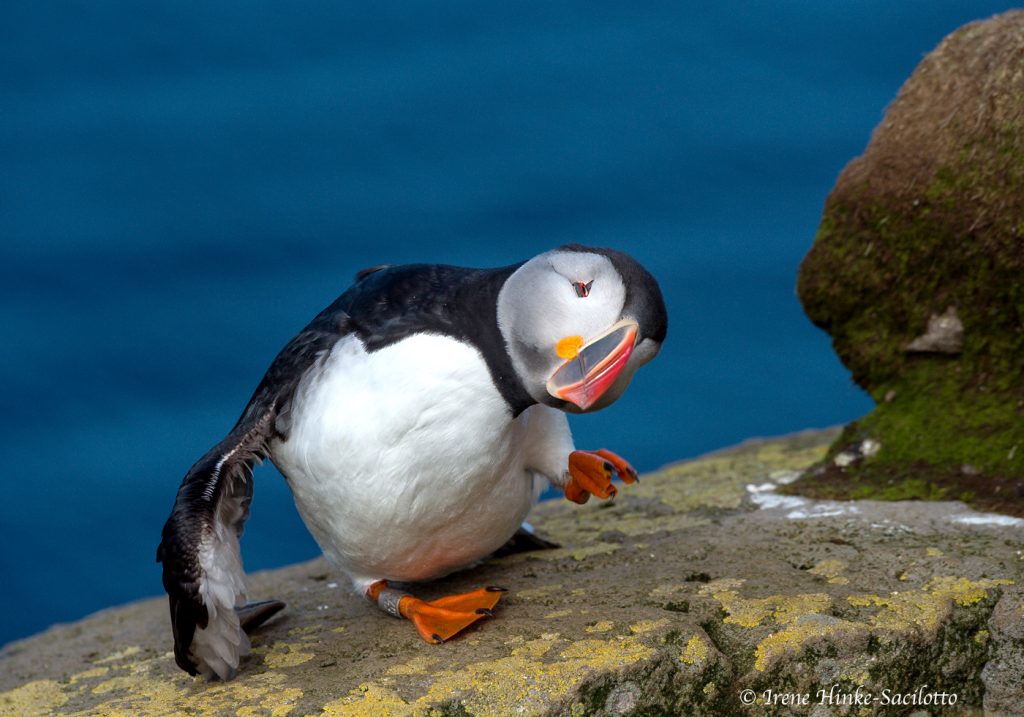
Unique photo of Atlantic Puffin using wing for balance while scratching.
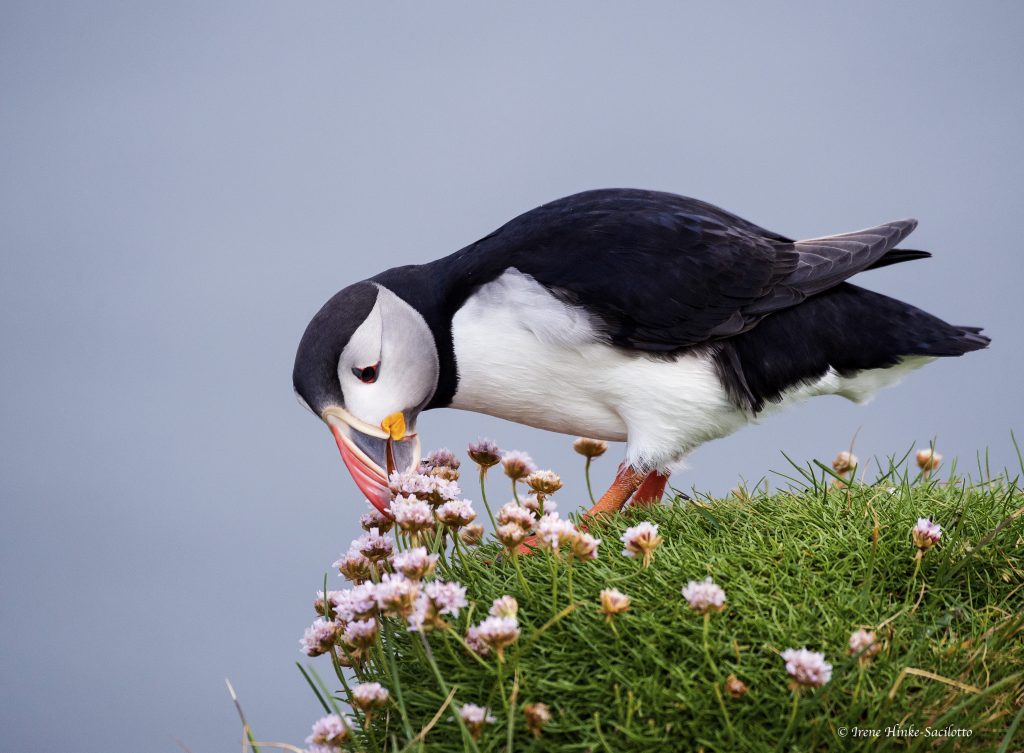
Atlantic Puffin eating flowers. This was so unexpected, that I took a number of photos at the time but only one best showed what the puffin was doing. The distant background and relatively shallow depth of field helped make the bird bird and flowers standout.
Imaginary Gallery
To judge the impact of a photograph, I sometimes imagine it hanging on the wall in a gallery. I examine the photo as if seeing it for the first time. Then I ask myself, have I conveyed the thoughts and feelings I experienced while taking the photo? Is the composition static – perhaps with the subject centered or with the horizon in the middle of the frame? Is the viewers eye drawn into the scene? Does it convey a story?

This is a humorous shot of a young Brown Bear struggling to hold onto a slippery salmon at McNeil State Game Sanctuary in Alaska. I love the story.
I always am learning something new from magazine articles, youtube, experiences in the field, and from other photographers. I keep my workshops small so I can provide individual attention to each person, no matter their skill level. No one should ever be embarrassed to ask questions. I typically learn something each time I conduct a program. If you have an open mind and see disappointments as opportunities, you will gain from your experiences. Everyone has his own unique vision. This becomes very obvious during my workshop image reviews. Even though the photographers are at the same location at the same time, the resulting mages are normally quite different.

by Osprey Photo Workshops & Tours | Aug 26, 2019 | Uncategorized
Svalbard Norway Visual Journey
Svalbard Norway is an archipelago in the Arctic Ocean above the Arctic Circle. It is home to polar bears, walrus, seals, reindeer, arctic fox, and pelagic seabirds. At the beginning of June 2019, I boarded the M/V Stockholm ship (130 ft boat, limited t 12 passengers) for 7 days cruise around the islands planning to photograph the spectacular scenery, ice flows, and wildlife with Joe and Mary Ann McDonald. We met the ship in Loongyearbyen on 31 May. While in town, we explored the surrounding from rented vehicles where we photographed Skua, Common Eider, Barnacle Geese, Fulmars and other birds. While on the ship and in zodiacs, we had great opportunities to photograph polar bears and walrus at close distances. The surrounding landscape was amazing with beautiful ice flows and snow capped mountains. Here are some images from the trip. Included are a few images from the Senja Peninsula.

Polar bear on ice flow

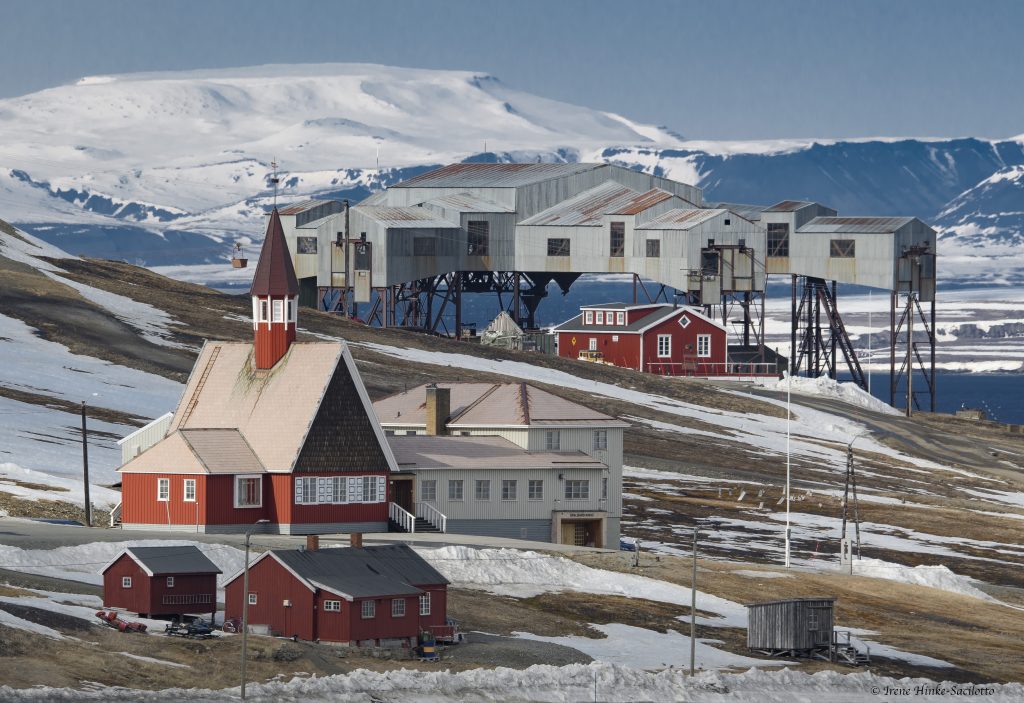
Longyearbyen town
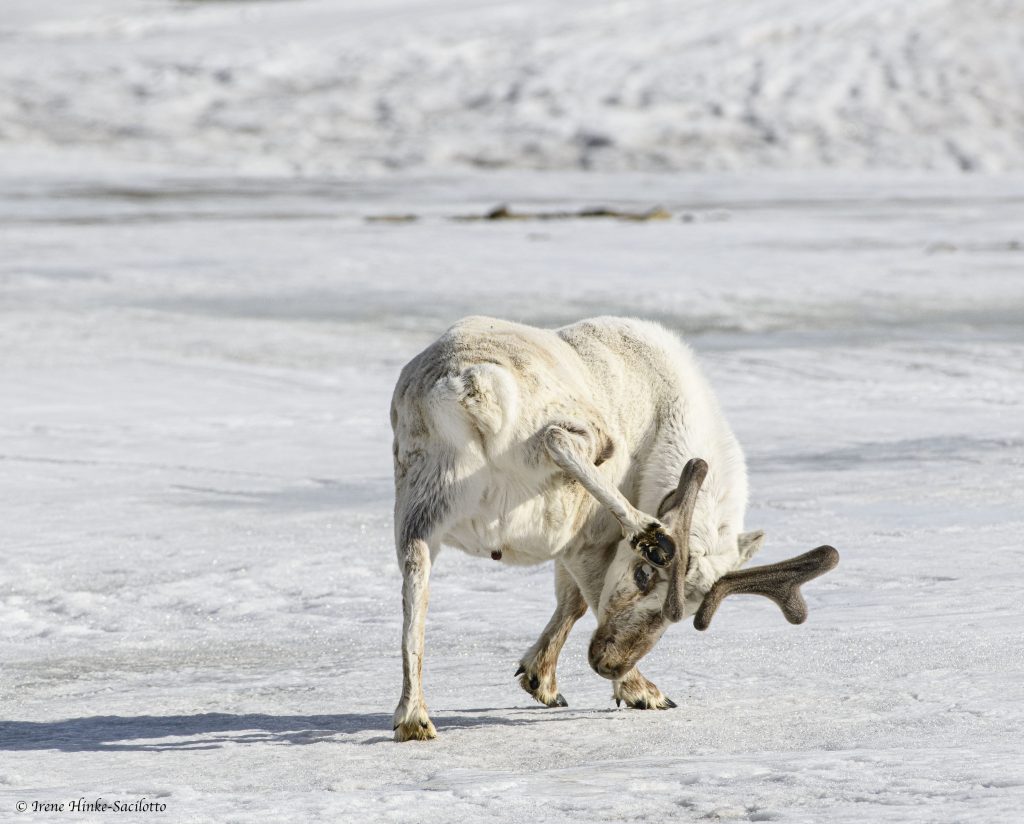
Reindeer scratching

Young Ringed Seal resting on ice
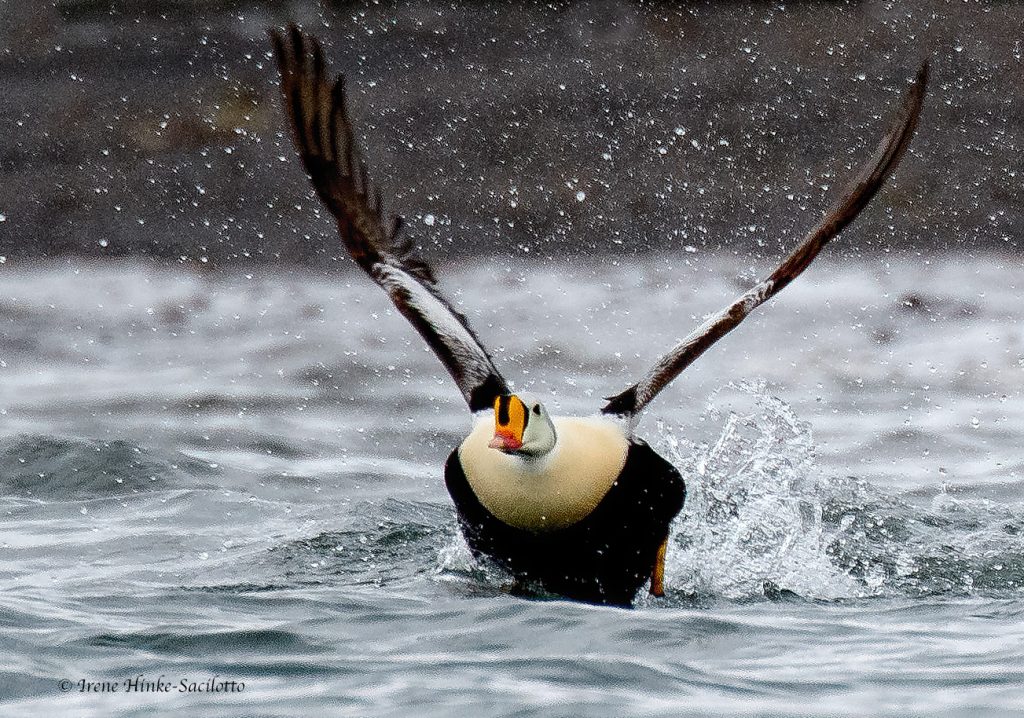
King eider lifting off from water.
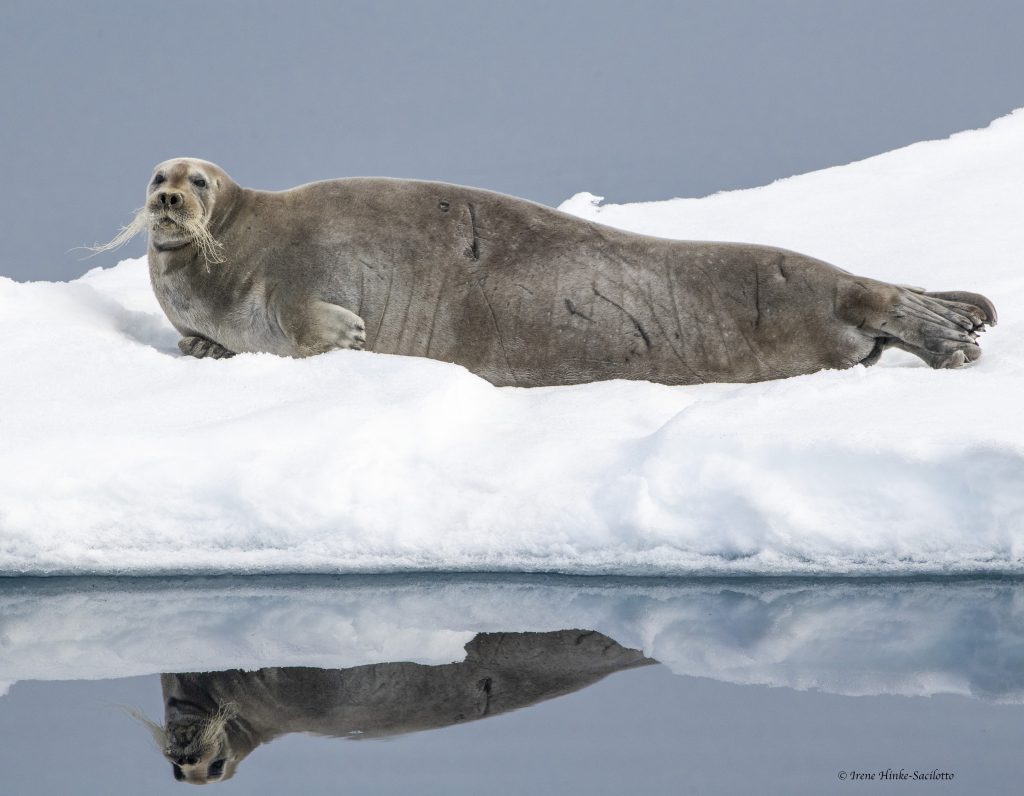
Bearded Seal resting

Ice breaking up
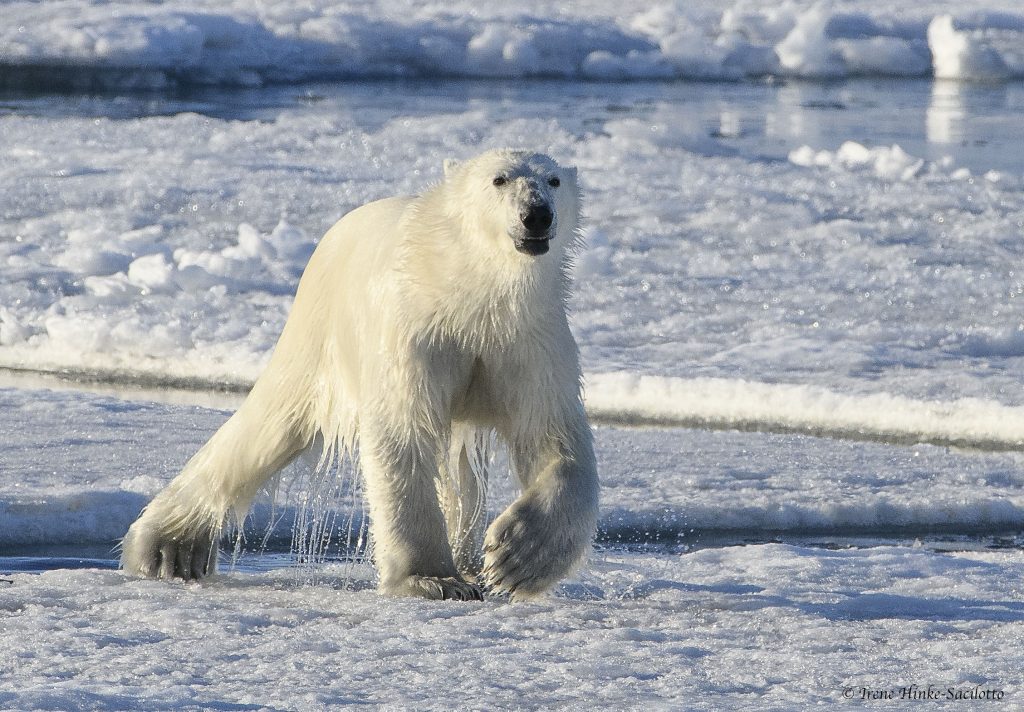
Polar bear after swimming

Fulmar flying past boat

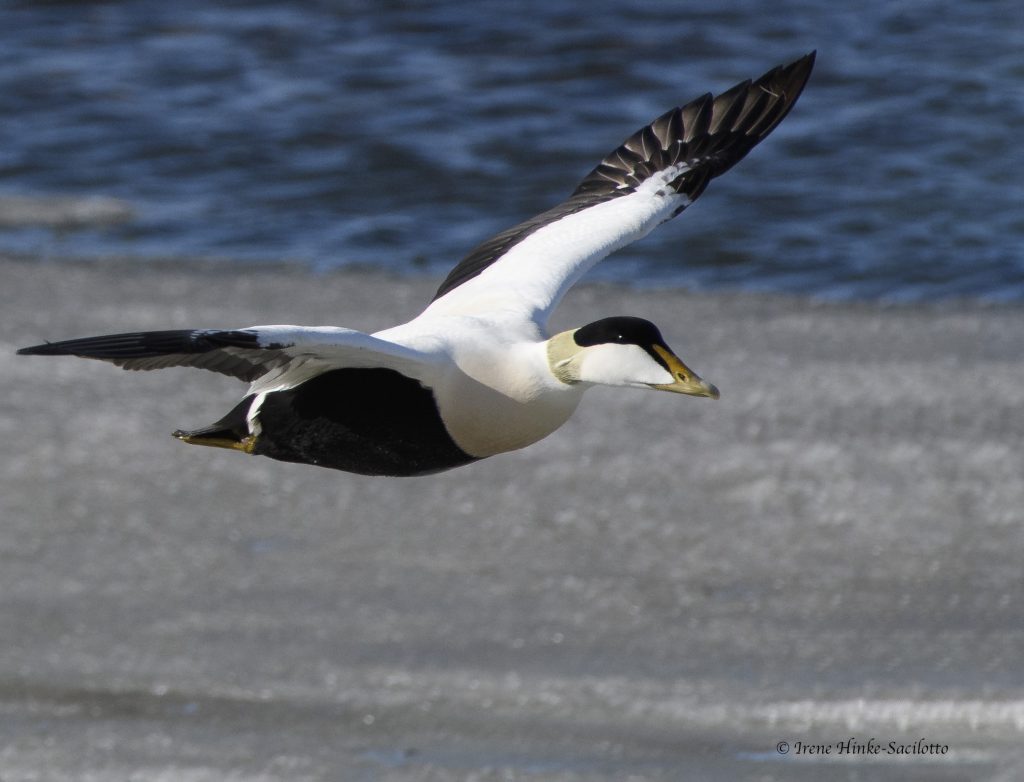
Common Eider landing

Iceberg

Icebergs floating in front of mountains.
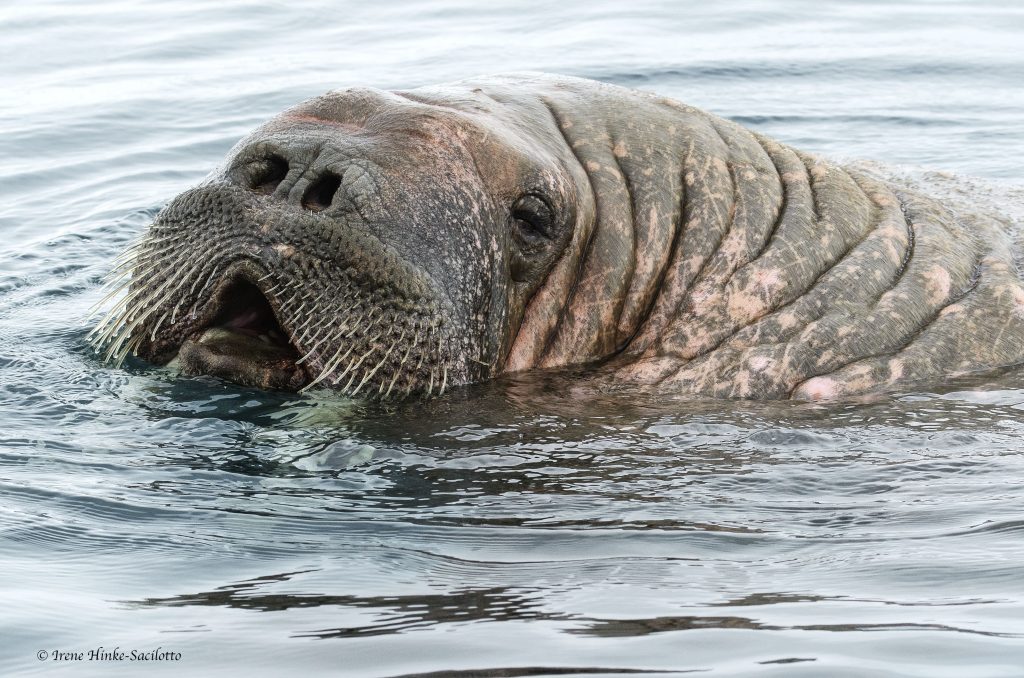
Walrus near zodiac
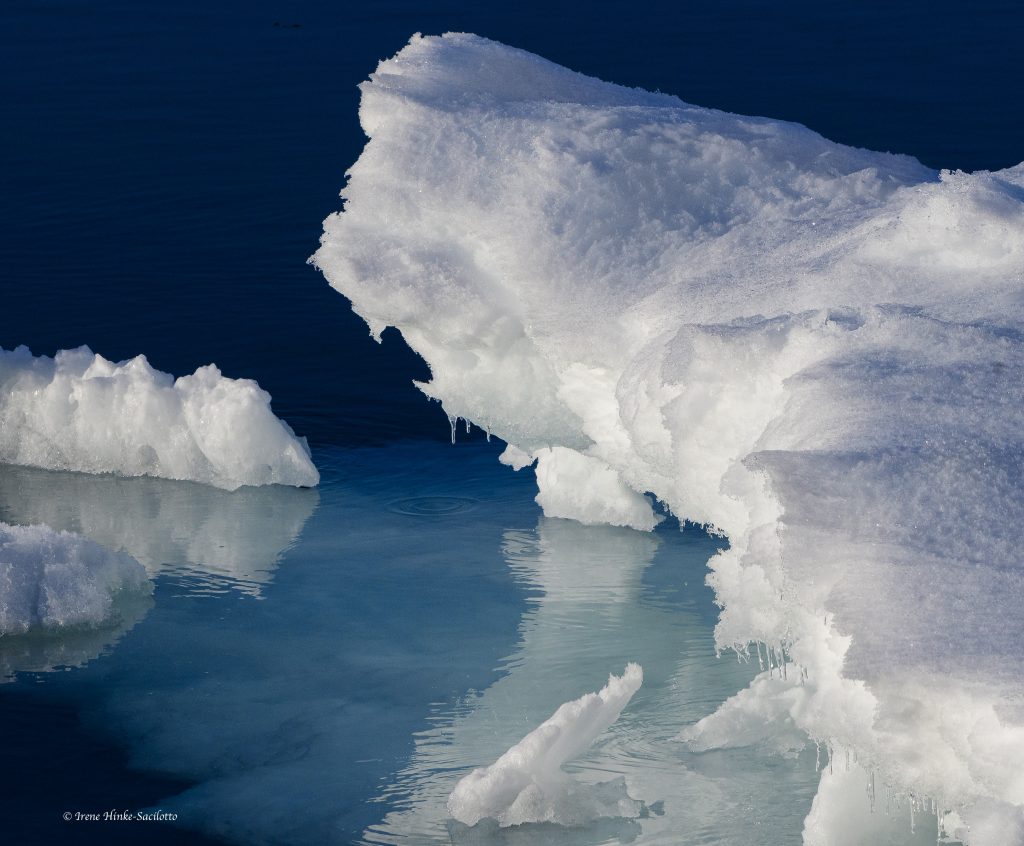
Ice cycles
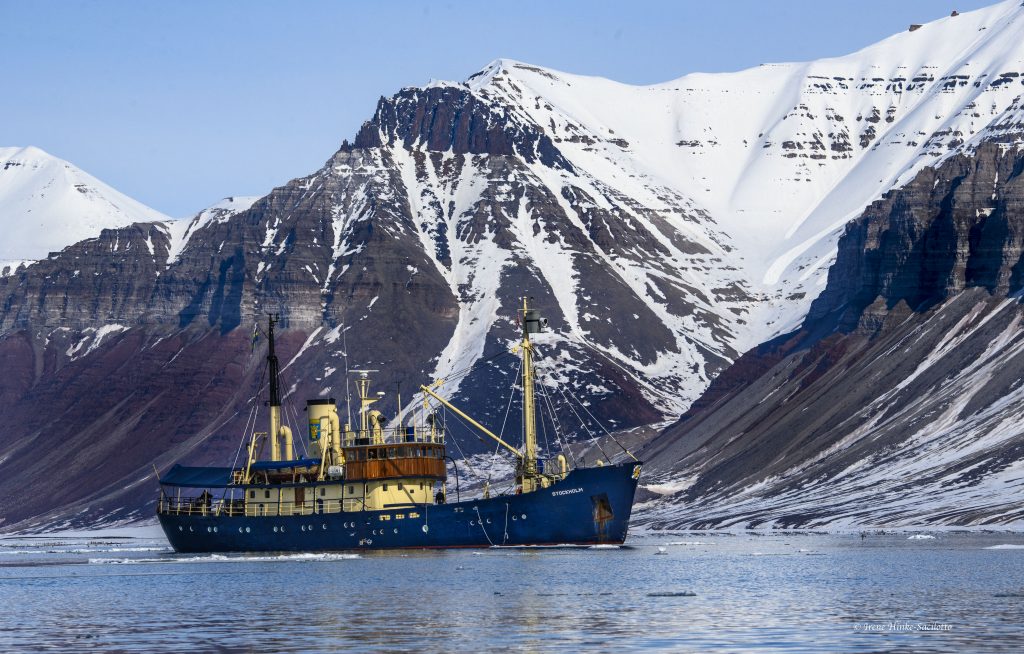
M/V Stokholm

Curious polar bear

Polar bear looking as if praying

Common gull wings

Stockholm ship in ice

Glaucous full nesting on roof

Eurasian oystercatcher jumping from rock to rock

by Osprey Photo Workshops & Tours | Apr 21, 2019 | Assateague, Chicoteague, Nature Photography, Photo classes, Photo instruction, Virginia, Wildlife Photography
Photo Opportunities
Chincoteague National Wildlife Refuge & Assateague Island National Seashore

Ospreys can dive to catch fish. Their feathers shed water easily and their talons specifically designed to be able to grab and fly with their catch.
Chincoteague National Wildlife Refuge and Assateague Island National Seashore
Location & Management:
Managed by the US Fish and Wildlife Service, Chincoteague National Wildlife Refuge covers 14,000 acres of beach, dune, marsh, shrub and forest habitats. The majority of the refuge is located on the Virginia end of the narrow, 37-mile-long barrier island of Assateague (Assateague Island National Seashore) just south of Ocean City Maryland. The refuge is managed to benefit wildlife and to protect critical habitat for both resident and migrating species. Birds found on the refuge include ducks, geese, heron, raptors, warblers, and shorebirds plus deer, raccoons, Delmarva Peninsula Fox Squirrels, muskrats, foxes, and otters.

In recent years, there has been a significant drop in the number of migrating snow geese visiting the refuge in the fall. Once reaching nearly 40,000, but today the numbers are much lower. Grabbed this shot several years ago as they landed on the beach. This fall, they were there again this year.
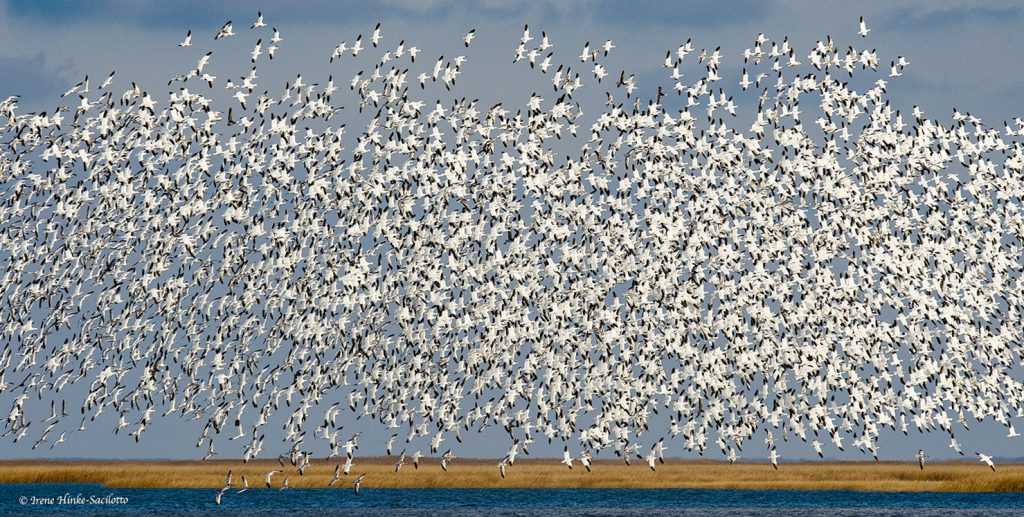
Large numbers of snow geese sometimes stop at Bombay Hook National Wildlife refuge, DE instead of proceeding south to Chincoteague in the fall. This flock circled several times before landing.
A number of impoundments have been created by refuge staff where water levels are managed to provide resting and feeding areas for waterfowl and other species. Some dikes bordering the enclosures are topped with roads adjacent to water-filled borrow ditches where birds congregate. This arrangement offers excellent opportunities to photograph wildlife from your car, steadying your camera on a bean bag or using another means of support. Because the animals are protected on the refuge and are used to seeing people and vehicles, they are less timid than elsewhere and more easily photographed.
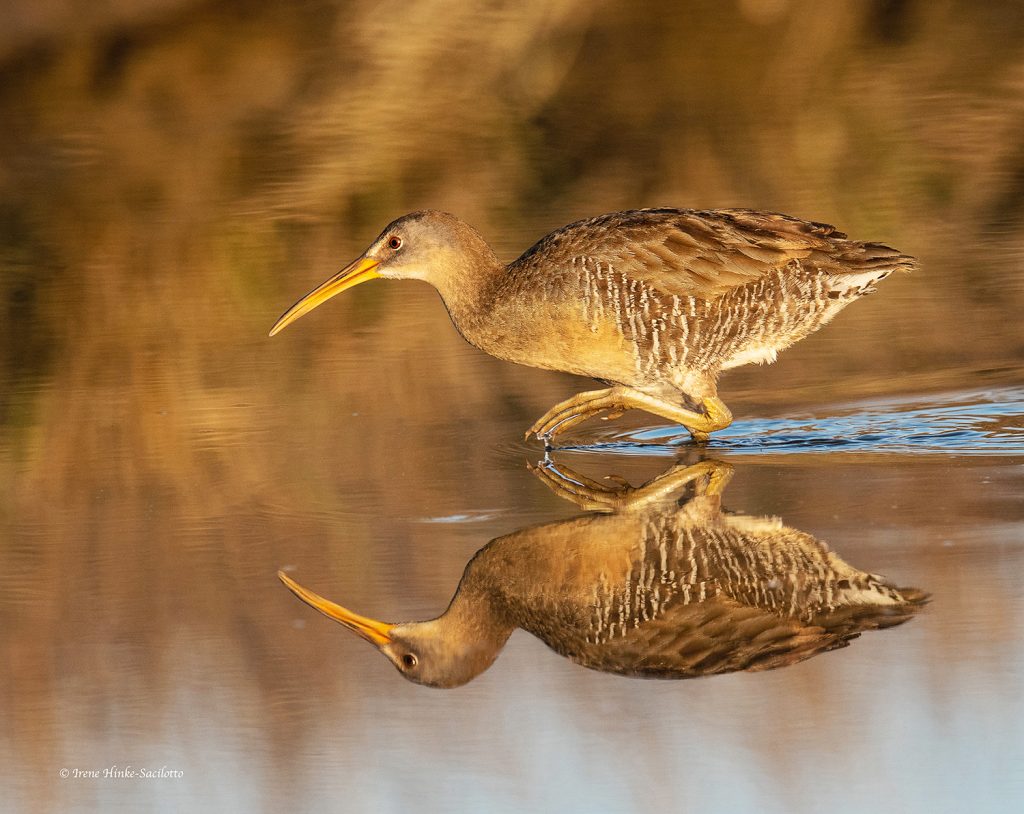
Clapper Rails are secretive birds found in the marshes. They feed at low tide on the exposed mud flats. Rails are often heard before seen.
Wild ponies are a favorite photo subject among visitors. Smaller than standard horses with heavy coats to protect them in this harsh environment. They appear perpetually pregnant with bloated bellies from their diet high in bulk and salt.

New born. Wild pony family.
Constant Change:
As with all barrier islands, the sand shifts with the season and strong storms. The ocean cuts through the dunes sometimes forming temporary inlets. Water-laden sand rolls over the land creating new marsh. With the landscape constantly changing, there are always new and exciting opportunities for photography. No matter when you visit, you will always find something to photograph. Even in the summer when the public beach is packed with people, you can still find photo subjects by venturing out in the early morning and late afternoon when there are fewer people to interfere with your activities.

Once endangered, Delmarva Peninsula Fox Squirrels were transplanted on Chincoteague and now they are often seen at the edge of the maritime forest.
Locating and approaching wildlife:
Spotting animals requires careful scanning of the environment for shapes, tones or colors out of place, and movement. By studying animals, whether photographing or not, you gain insight into their behavior and are better able to capture action shots. Creatures of habit, animals often visit the same locations repeatedly so check these spots on a regular basis. Know your equipment well and be prepared to photograph at any time. Have a suitable camera/lens combination ready with exposure settings pre-set for conditions you are likely to encounter. Once a potential subject is spotted, plan your approach. Consider the lighting, background, subject temperament, and the animals direction of movement. If it is following a predictable path, move slowly and indirectly to position yourself where it is heading. Be careful not to cause it to alter its behavior. Rapidly moving directly towards the animal will normally causes it to flee.

I watched the direction the fox was moving and carefully position my vehicle on the shoulder of the road at a distance in front of where I thought it was going. I made sure the warm afternoon light was illuminating its beautiful red coat

After hearing its distinctive call, I spotted this Belted Kingfisher on one of its favorite branches. As I positioned my camera, it plunged into the water and emerged with a small crab in its bill before returning to its perch. To capture various poses of the bird as the bird struggled to consume the crustacean, I held down the shutter release button and repeatedly fired a series of shots using a high number of frames/second.
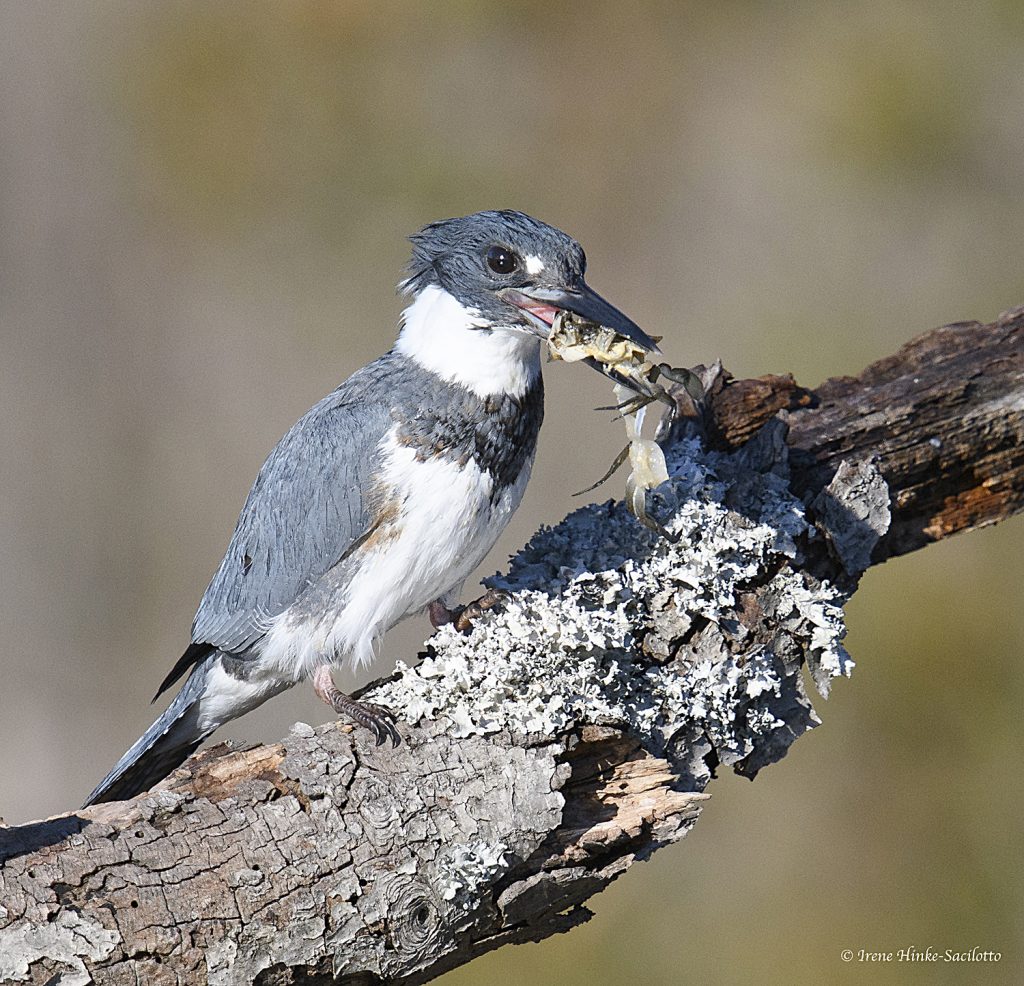
Shot from my car with my Nikon D850 camera and 600 mm lens resting on a bean bag. Settings: ISO 800, F10, and shutter speeds approximately 1/2000 second.
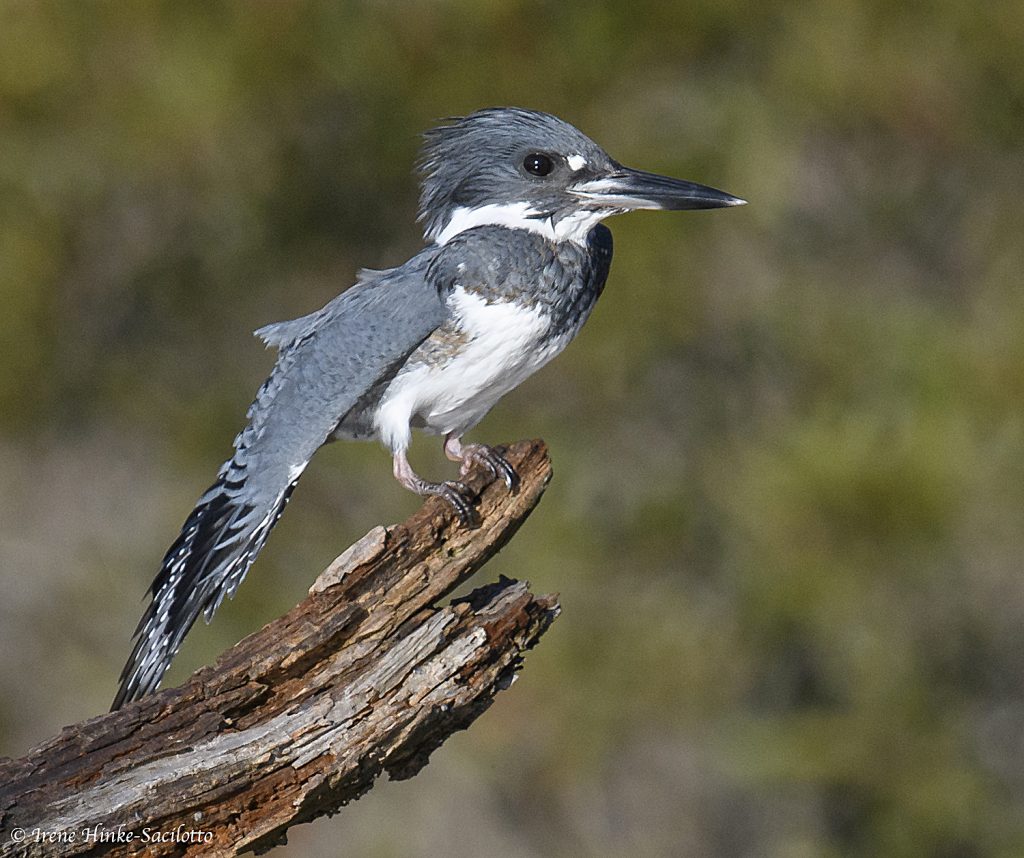
Belted Kingfisher stretched wing just before it dove after fish.
Suggested lenses and other gear:
- A wide-angle for beach scenes, flocks of birds, and sunrise/sunsets and perhaps a 80 to 200 mm zoom lens to isolate portions of the scene.
- A 300, 400 or 600 mm telephoto for small or timid subjects such as shorebirds. It is preferable to buy long lenses that have collars for mounting on a tripod. This makes it easier to handle the camera/lens combination and it allows for quick adjustment of orientation from horizontal to vertical or in-between.

To spot animals, I look for movement. This Cedar Waxwing was part of a flock attracted to the berries. Shot with my 600-mm lens.
- A 1.4 tele-converter to extend the effective focal length of your primary lens for photographing small subjects. Note: The tele-converter reduces the amount of light reaching the sensor, cutting shutter speeds in half. For best image quality, buy one matched to your prime lens.
- A 200-mm macro lens for close focusing and high magnification when photographing a shell, insect, or flower. Compared to shorter macro lenses, with the 200-mm lens, you can obtain the same magnification at a greater working distance from your subject–a benefit if photographing something timid such as a ghost crab.
- Other gear: An electronic shutter release to prevent camera shake when using long exposures or high magnification. A polarizing filter to remove unwanted reflections and shine on surfaces of vegetation intensifying colors. Depending on the angle of the sun, it can also make the sky appear bluer. You might want to include a neutral density filter that reduces the amount of light entering the lens in order to create special effects by using slow shutter speeds to suggest motion of moving objects – the surf, the wings of birds, etc.

The lighting and pose made this photo of a Great Blue Heron special. Shot in the early AM.
- A sturdy tripod, preferably without a center post for maximum stability when using long telephoto lenses. The tripod should be topped with a professional ball head that can easily support the weight of your camera/lens combination or with a Wimberley Head (gimbal) which is preferred by many photographers for manipulating large lenses and tracking animals and birds.
- If shooting on the beach, the wind off the ocean can be fierce and unpredictable, so never walk away from the tripod. Also, watch where you place your camera gear since an incoming wave can swamp your equipment or worse, wash it away. When around blowing sand or dust, shield your camera when changing lenses to avoid particles entering the throat of the camera and making their way to the sensor resulting in dark spots on your images.
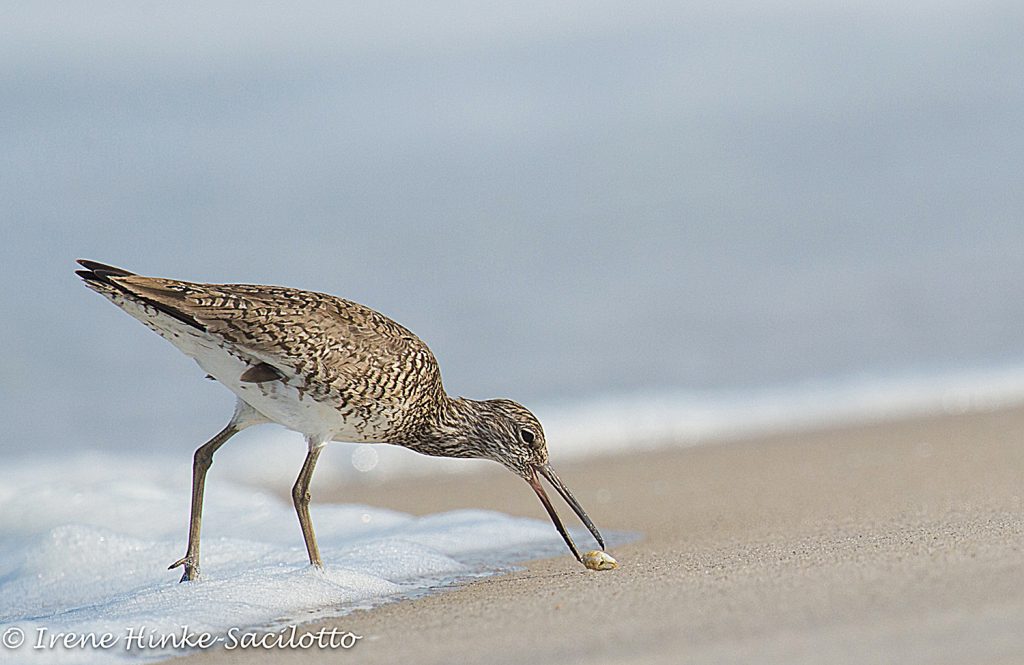
Willet picking up mole crab. Shorebird behavior is often predictable. They follow the edge of the surf, probing for organisms as waves retreat.
Useful tips:
- By having with you two cameras mounted with different lenses when in the field, you can avoid changing lenses in the open and can more quickly switch from one focal length to another.
- When on the beach, wipe or brush the sand off your tripod legs with a damp cloth to prevent particles and salt from entering the joints between tripod segments and making it difficult to adjust the tripod’s height. You can buy or create water-proof tube covers for the lower legs to minimize sand-related problems and to allow you to submerge the legs in the surf.
- If visiting in the spring, summer or early fall, bring insect repellant to guard against mosquitoes, biting flies, and ticks potentially carrying Lyme disease. Reads more on CDC’s website. https://www.cdc.gov/lyme/prev/on_people.html
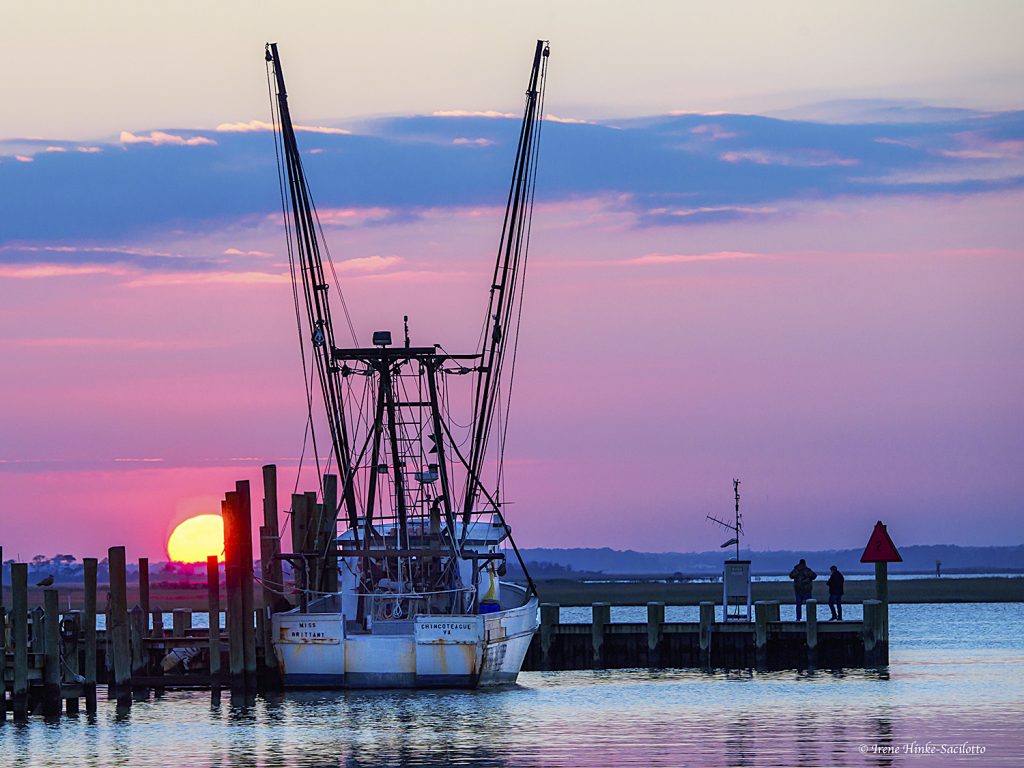
Adjacent to the refuge is the town of Chincoteague with a small boat harbor. Sometimes loons are found here. It is also a good place to photograph sunset.

by Osprey Photo Workshops & Tours | Mar 13, 2019 | Alaska, Bald Eagle, Bristol Bay, Brown Bears, Environmental Impact, Mc Neil River State Game Sanctuary, Nature, Wetlands, Wildlife
Pebble Mine and Its Negative Environmental Impact
The following expresses my feelings and concerns about construction and operation of the Pebble Mine in Southeast Alaska and it negative impact on the environment and Bristol Bay ecosystem, spawning sockeye salmon, and the bears of Southeast Alaska.

Bald Eagle in Homer.
The construction of one of the world’s largest open-pit mines will require the building of significant amounts of supporting infrastructure, including roads, a power plant, pipelines, and a port, and the resulting development would have destructive environmental impacts for hundreds of square miles. The disturbance of this pristine area including Mc Neil River State Game Sanctuary and Katmai National Park where coastal brown bears gather each year to feed on salmon is distressing. The application submitted to the Army Corps of Engineers includes a deep-water port at Amakdedori beach and road that stretches across prime bear habitat from near Kokhanok, AK to the shoreline. This proposed road comes within a mile of the McNeil River State Game Refuge boundary and the port facility is within sight of a world class bear viewing destination.
The activity along the road and associated construction and operation of a deep-water port nearby and mine is bound to have a highly detrimental effect on the bears and other wildlife that live in the area. For years the government has exercised great care to protect the bears and provide safe bear-viewing for the public. This includes minimizing negative interactions between the bears and humans by enforcing rules to avoid harmful encounters. Activities around the mine and port will certainly undo these efforts.
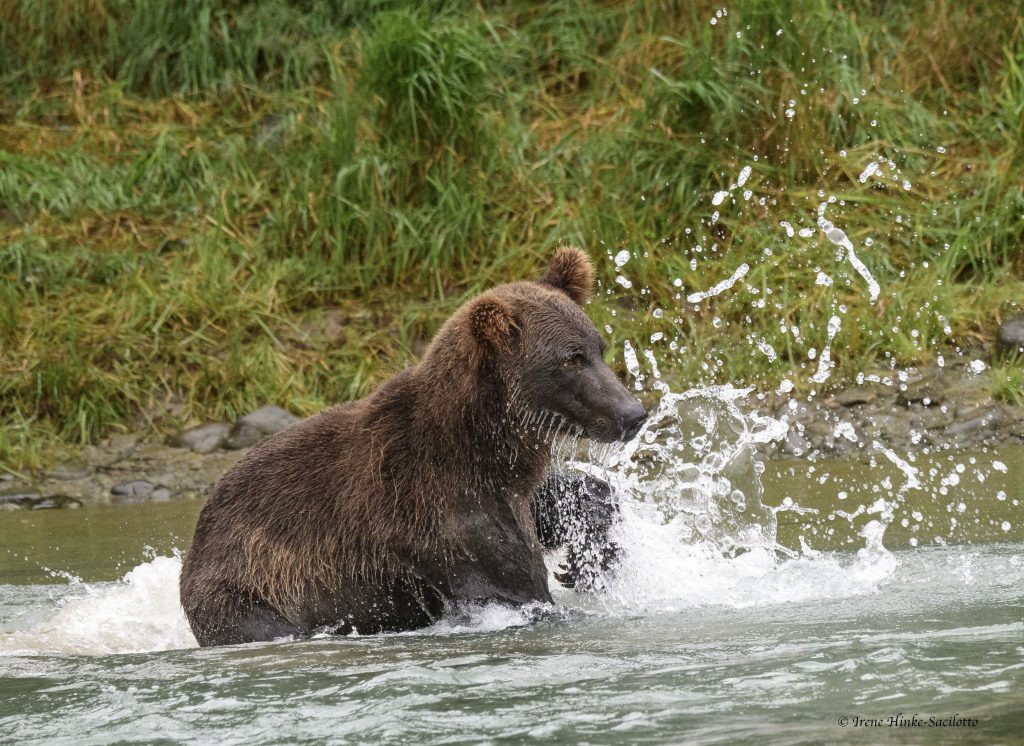
Brown bear chasing salmon.
People from all over the world are attracted to Alaska for the possibility of seeing bears and other wildlife roaming free. They spend millions of dollars in Alaska for the opportunity and contribute billions to the economy of Alaska – food, transportation, lodging, tour guides, park fees, etc.
Regarding Mc Neil River, there is no place like it anywhere in the world. I am now 70 and last year I had the privilege of visiting Mc Neil River, after a number of years trying to win the state lottery for the privilege. It was one of the most incredible experiences I have had in my life. I am a professional wildlife photographer and nature photo tour leader. I have been to Africa, Argentina, Iceland, Chile, Newfoundland, the Falkland Islands, Northwest Territory, Churchill Manitoba, Nome, Australia, and New Zealand, so I have been to many premiere natural areas around the world. But I never experienced a thrill like that of sitting quietly photographing and watching the bears feeding on salmon at the lower falls at Mc Neil, feeling unthreatened with some bears walked by only 12 feet away.

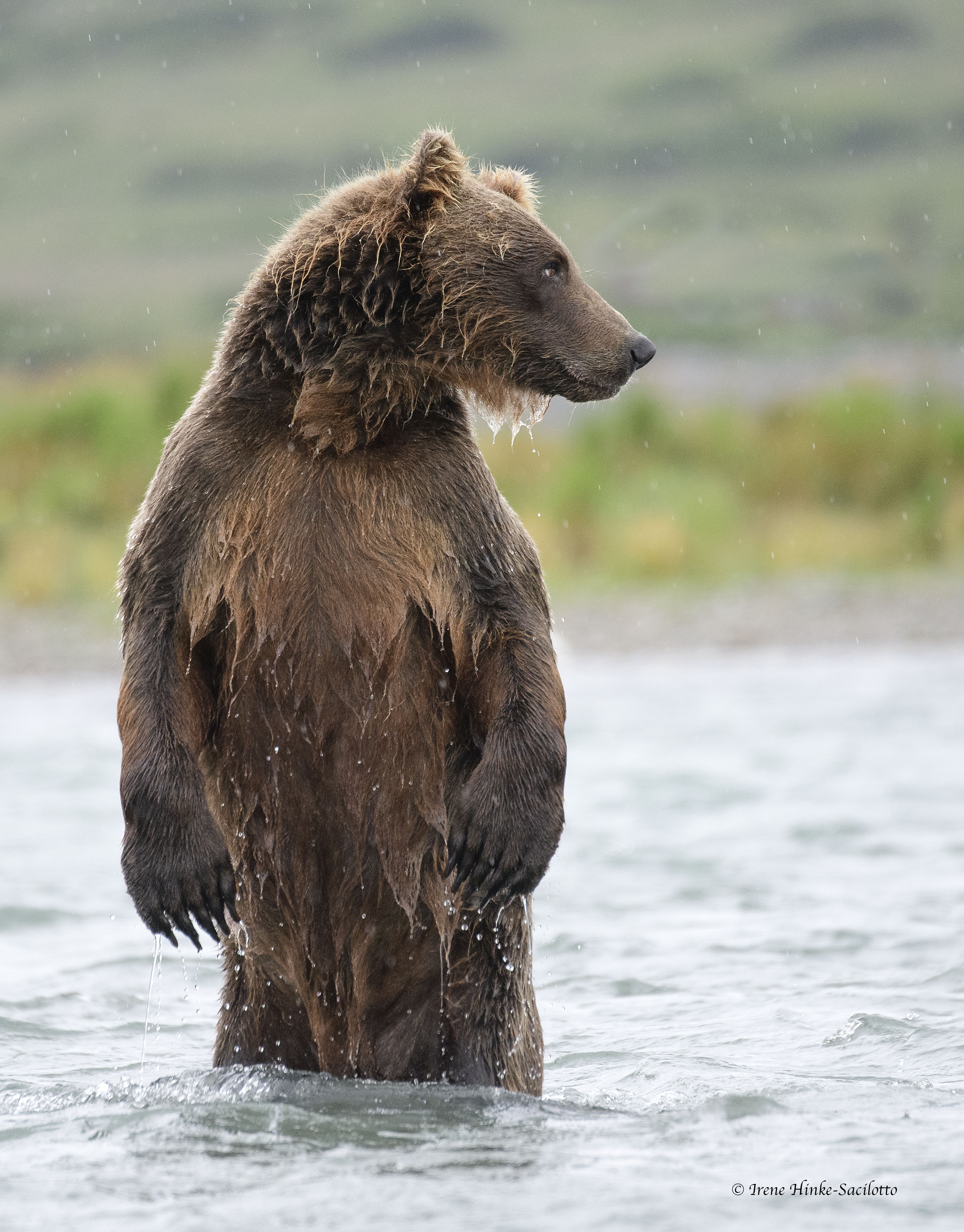
Brown Bear Standing in grasses near lower falls of Mc Neil River.
I was horrified when I found out that the Pebble Mine project may be approved. The largest sockeye salmon run in the world will be disrupted along with the fishery industry in Southeast Alaska. Equally important, bears and other wildlife (bald eagles, killer whales, other marine animals, etc.) will be adversely effected since they depend on the salmon for survival. Removal of groundwater in order to operate the mine will dry up streams, lakes, and wetlands necessary for salmon eggs, young salmon, and their food source to survive. No amount of recycling the water supply after waste water cleanup will return the water and waterways to their original state. The mine with its associated structures is located near a fault, in an area where earth quakes and severe storms with heavy rainfall are possible. Not only will the blasting involved in the mining process disturb wildlife but I question whether it could actually trigger earthquakes. The acid waste from extracting copper and gold from pulverized ore contains cyanide, toxic metals such as lead, selenium, cadmium, and arsenic, and other contaminants can potentially leach into nearby waterways and lakes. Efforts to permanently contain this poisonous waste are destined to fail.
It is not worth damaging Alaska’s natural resources including the fragile Bristol Bay ecosystem and wildlife populations just to benefit developers and foreign investors. Any perceived economic benefit will be offset by the cost of restoration if there is a mishap during the construction or operation of the mine, deep water port, and any associated activities. Remember the Exxon Valdes oil spill, a tragedy thought to be unimaginable. The damage to the environment was catastrophic and the cost of clean-up was in the billions of dollars. The benefit from the construction of the Pebble Mine is not worth the threat to human population nearby and the incredible ecosystem where salmon spawn and bears roam free. This pristine region of Southeast Alaska is unique in the world. In addition, Issuing a permit for the construction of the Pebble Mine will open up other areas in the Bristol Bay region and southeast Alaska to mining which will result in farther degradation of the environment and more threats to wildlife.
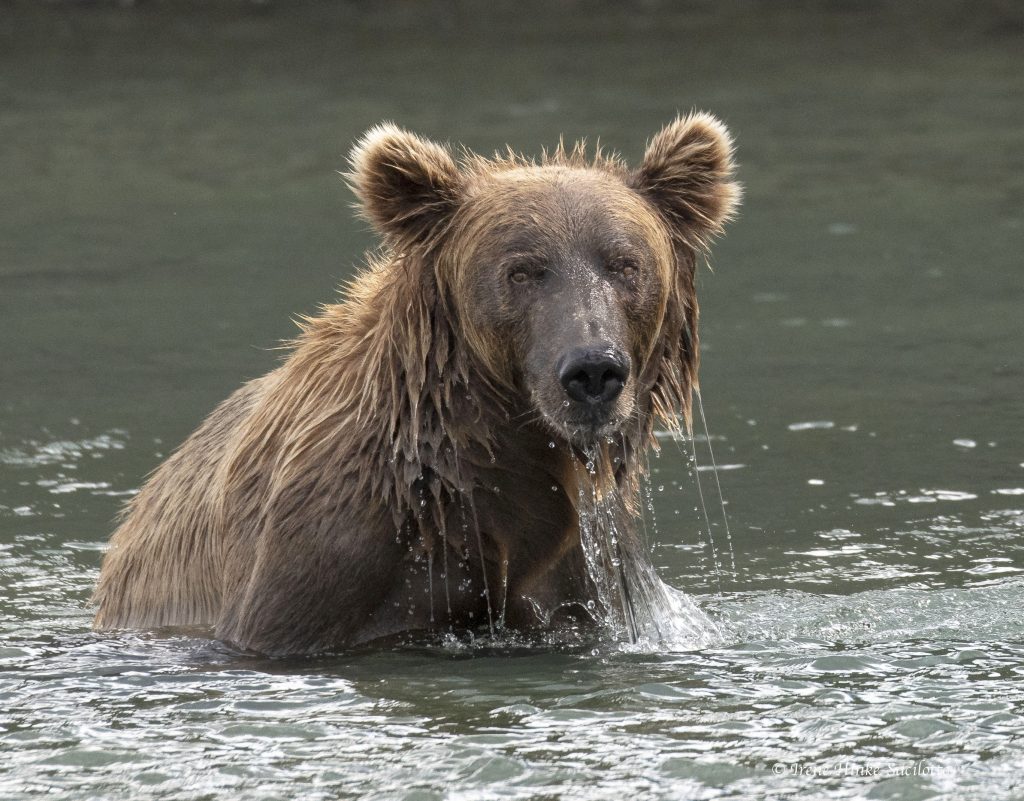
Coastal Brown Bear feeding in the waters at the lower falls of Mc Neil River.
What kind of world to you want to leave for your grandchildren?
What Makes America Great are places like Mc Neil River State Game Sanctuary where in July as many as 80 brown bears gather to feed on salmon, where millions of sockeye salmon spawn, and where wildlife thrives on the land and in the waters of Bristol Bay.
I believe that the Pebble Mine Draft Environmental Impact Statement should be resubmitted and replaced with one that is more comprehensive and backed by data that can validated. This project is huge with many ramifications and the potential of having far-reaching negative on the environmental and the delicate ecosystem of Bristol Bay. That which it will destroy, cannot be replaced.
See my previous blog on Mc Neil River State Game Sanctuary and Coastal Brown Bears.
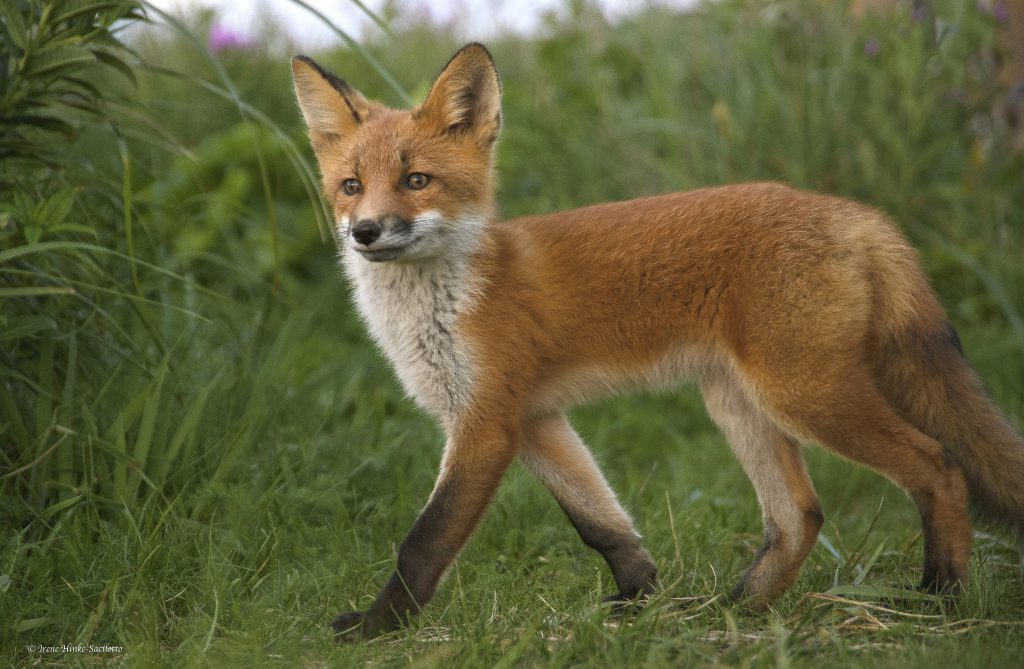
Young Red Fox in South East Alaska.
***********
For more info and links on the Pebble Mine and where you can comment to the Corp of Engineers regarding the project.
Orvis.com/nopebblemine
Regarding the Army Corp of Engineers approval of the Draft Environmental Impact Statement on the Pebble Mine you can go to their website. https://www.pebbleprojecteis.com/ A quote from their web page reads as follows: “The public comment period will run from March 1, 2019 through May 30, 2019. You can submit comments through testimony at public meetings, email to drafteis@comments.pebbleprojecteis.com or mail them to:
Program Manager
US Army Corps of Engineers
645 G St.
Suite 100-921
Anchorage, AK 99501
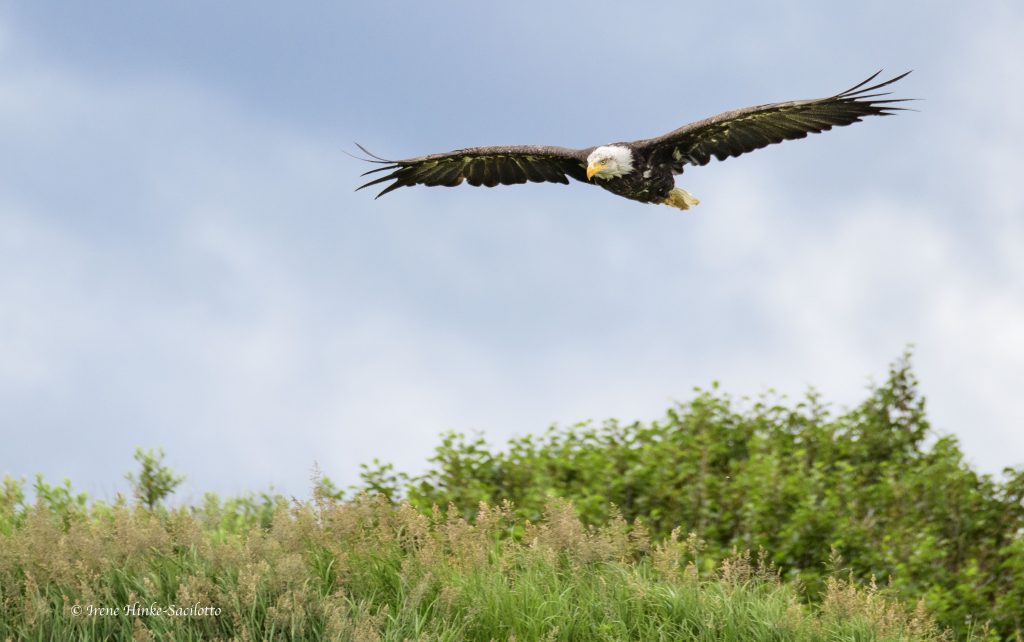
Bald Eagle flying over cliff at Mc Neil River State Game Sanctuary.

by Osprey Photo Workshops & Tours | Sep 4, 2018 | Alaska, McNeil River, Nature Photography, Wildlife, Wildlife Photography
McNeil River State Game Sanctuary

Brown bear clutching fish it just caught.
McNeil River State Game Sanctuary. I just returned from McNeil River State Game Sanctuary in Alaska, a location 100 miles from the nearest road system and the town of Homer. It is reachable primarily by float plane when tides are favorable for a safe landing. The area is one of the most remarkable places I have ever visited, with the world’s largest concentration of wild brown bears. Seasonally, after winter hibernation in the high country, the hungry bears gradually gather at McNeil River and Mikfik Creek on the sanctuary to feast on the salmon that spawn there each year. Here the bears are protected and there is no hunting.
Bear standing in McNeil River
The permits for “guided viewings” of the bears at McNeil River State Game Sanctuary are granted through a state-run lottery system. The number of visitors is limited to 10 at a time, for a period of 3 or 4 days. I had entered the lottery before but lost. But this year a friend and I were finally lucky enough to be selected for 4 days of guided viewing of the bears in the month of August.
From Homer, we flew to McNeil on a float plane which landed in the estuary where the Kamishak Bay meets the mouth of the McNeil River. The location is more beautiful than I had imaged with spectacular views of the distant 3000 to 5000-foot snow-capped mountains of the Aleutian Range. At their base and approaching the coast were rolling hills that met the sea in a series of bluffs, cliffs, lagoons, mud and sedge flats, rocks, and pebbled beaches. Each day, from approximately 10 a.m. to 8 p.m., we spent time in the field with a guide and hiked 4 to 5 miles a day to various locations for bear viewing and photography. One day, from a sand bank along the lower falls, our guide spotted 19 to 22 bears at one time, some close and others farther away and only visible with binoculars. Each seemed to have its own fishing technique—submarine style swimming under water to pouncing on a fish with its paws. Unbelievable!

Mountain view from camp.
As for all visitors, we stayed in a primitive campground with limited facilities designed to minimize disturbance to the environment. It was adjacent to a pebble strewn beach and was partially surrounded by stands of alders and fields of fireweed. We were required to bring in our own camping gear, food, and supplies. We pitched our tents on designated circular gravel beds which were somewhat sheltered from the wind. In terms of permanent structures in the compound, there was a cook house, sauna/wash house, and 2 pit toilets, a tool shed, plus several cabins for the staff. Immediately upon first arriving at the camp, all food and items with odors that might attract bears had to be stored in the cook house. This precaution was to minimize the chance of bears entering the camp and associating humans with food, which could influence bear behavior, creating a problem bear. In the cook house we prepared meals, socialized, and received briefing for each day’s outing. Pots and pans and several burners were provided for cooking. A wood stove offered warmth on chilly days and gave us a way to dry socks, towels and other clothing.
We were very lucky that during our stay the weather was moderate, approximately 60 during day and 50s at night. It only rained steadily part of one day. On the other days, there was a mix of sun and clouds.

Bear carrying fish after catching it.

Young bears sparing.
In August at the McNeil River State Game Sanctuary, most bear activity was confined to the lower falls with a little action at the upper falls due to a reduced number of salmon at this time. Each day we followed primitive, sometimes muddy uneven trails through sedge and mud flats, across slippery pebble-strewn beaches, up hillsides, through steams, and across a tidal lagoon. Waders were definitely required and crossing the lagoon could only be done when the tide was low. Each day we left camp at approximately 10 a.m. and arrived back in camp at 8 p.m. We hiked with our photo gear several miles to visit beaches and areas where we could safely observe and photograph the bears feeding on salmon and interacting. On two days, we visited the upper falls where there was a viewing platform and camp chairs were provided for comfort. The view was super but few bears were present. (In June, most bear activity is at Mitfik Creek and in July it is at the upper falls where up to 80 bears may congregate.
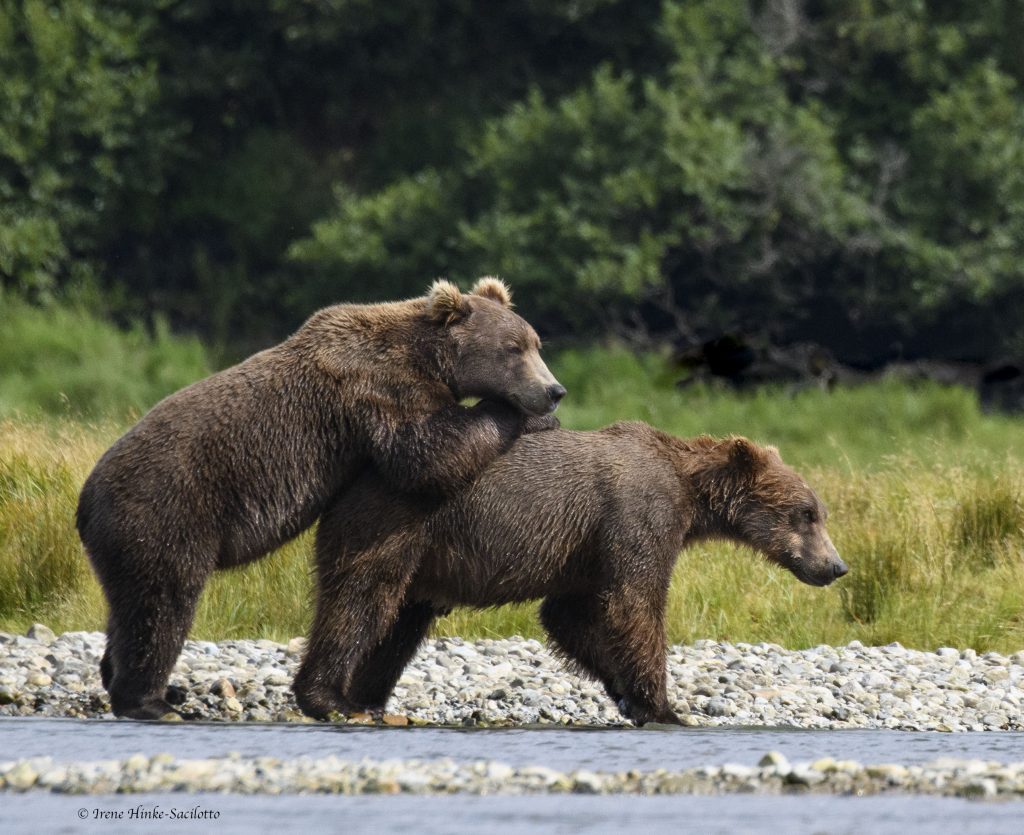
Young bears at lower falls
We followed the protocols established for visitors. We were required to be in the presence of a guide except at camp. In the field, the bears paid little attention to our presence and we felt relatively safe. These rules of human behavior around bears was developed primarily by a remarkable man, Larry Aumiller, who for over more than 30 years has studied the bears of McNieil. He concluded that human safety was more dependent on managing human behavior than managing the bears. For the last 40 years, no humans have been harmed nor has it been necessary to shoot any bears.
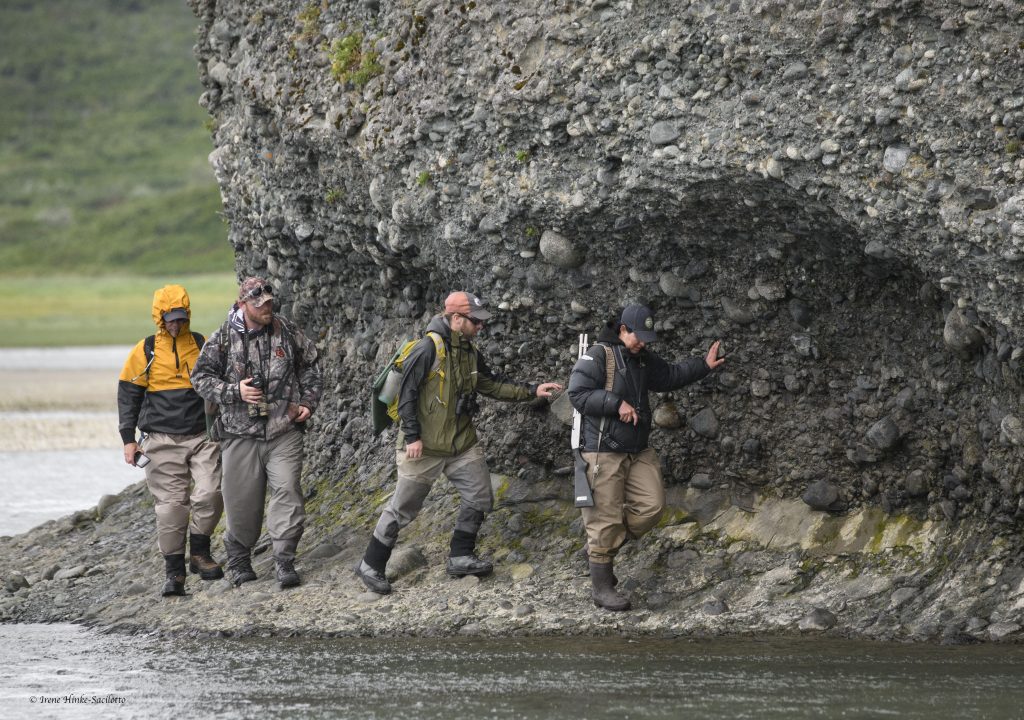
Trail to viewing point at McNeil River.
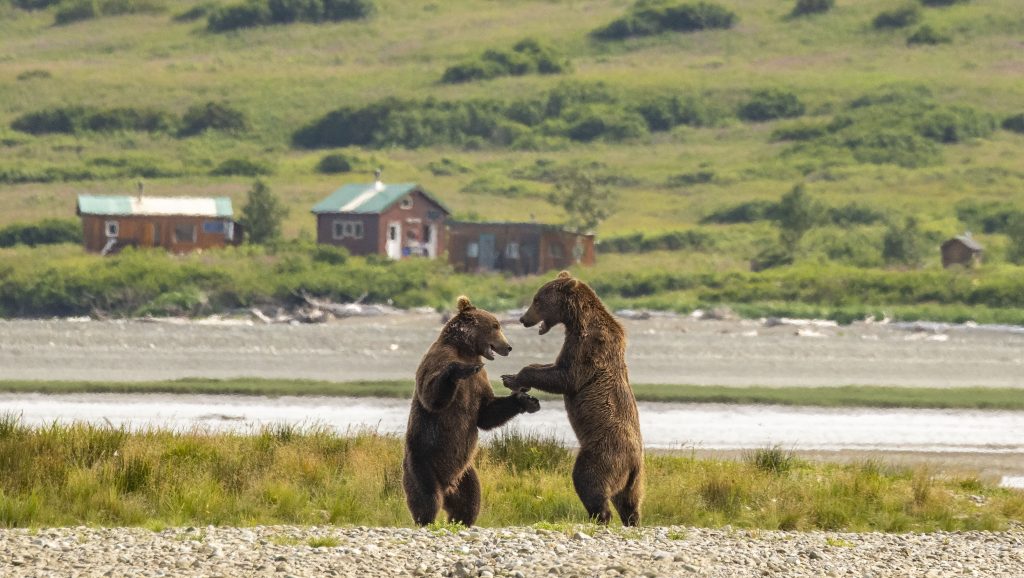
Bear sparing in front with camp in background
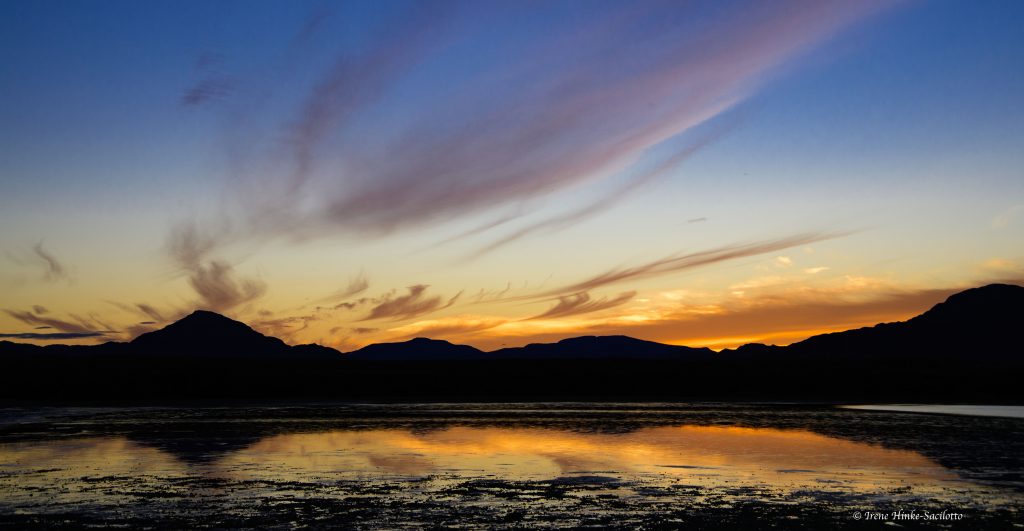
Sunset at McNeil River Camp. Overlooking lagoon.

Staff & guests going to fill containers with water that will then be filter by guests for drinking.

Least Sandpiper along McNeil River. One of the bird species that visit the sanctuary.

Bear shaking off water
The guides at McNeil River State Game Sanctuary were very knowledgeable about bear behavior and made it clear that our activities would not alter the animal’s activity. Part of the safety protocol was that neither guides or visitors were to surprise the bears. Hunan movement was to be consistent and nonaggressive, so the bears perceived humans as no threat. Group sizes were limited to no more than 10. Times of excursions and routes taken were roughly the same each day. As we hiked and whenever we stopped to photograph, we were required to stay in a tight group with no one making sudden movements, sounds, or bounding away from the group for a better photo. When leaving a location, we were reminded to be sure to leave nothing behind, particularly food scraps. The bears were allowed to decide their path and how close to approach. When we rounded blind corners or entered areas of heavy vegetation, the guide would repeat in a low voice phrases such as “hey bear”. If a bear seemed to be overly focused on us and could possibly be a threat, the guide used the least contentious aversion technique to dissuade it, such as clicking two stones together. This was never necessary. On several occasions, a bear passed by within 12 feet from the nearest member of our group and just slowly sauntered by. In the unlikely event of an attack, the guides do carry a 12-guage shotgun slung over their shoulder or lashed to side of their pack.
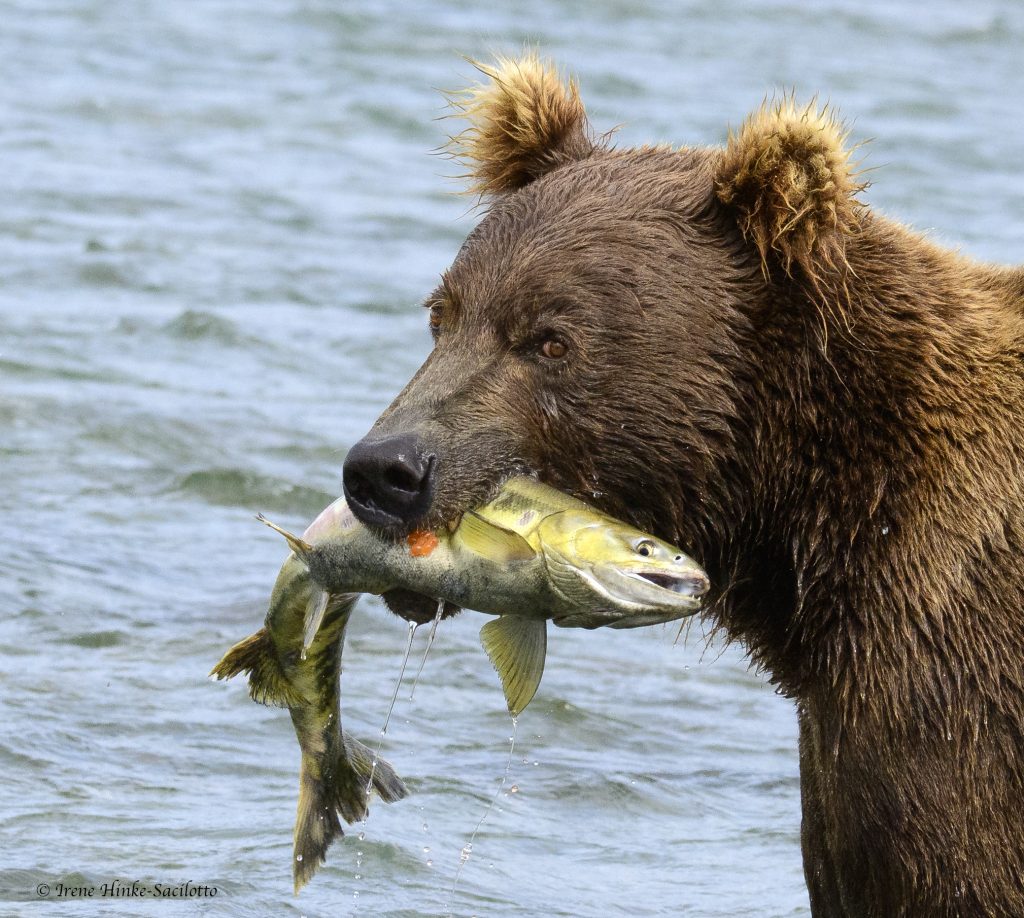
Brown bear with salmon.

Bear skinning salmon before eating it.

Red fox at sunset that hung out near the camp ground.
A red fox and her kits sometimes appeared at the camp in the evening. During our forays into the field, we often saw bald eagles perching on snags and cruising overhead. We were told ground squirrels and wolves were around but we did not see either. Picking up scraps of food left by the bears were Glaucous-winged and Mew Gulls. As we hiked at various elevations, besides fields of fireweed and sedges, we saw pea, Senecio, arctic daisy, Siberian asters, wild geraniums, cow parsnip, low growing willow, crowberry, bunch berry, mules tail, and low bush blueberry. When the supply of salmon at the end of the season runs low, the bears would feed on the sedges and berries, adding variety to their diet.

Sibling bears in McNeil River.

Adult bear with fish and with cub and Glaucous-Winged Gulls to pick up scraps.

Bear walking along rock wall along side McNeil River.
For me, the time spent on McNeil Sanctuary was one of the highlights of my life.
You can read more about the sanctuary in two books: “River of Bears”, with text by Tom Walker and photos by Larry Aumiller and a book about Larry Aumiller’s thirty years among the bears, “In Wild Trust”.

Young bears sparing.

Brown Bear eating salmon at lower McNeil River Falls.