
by Osprey Photo Workshops & Tours | Apr 6, 2015 | Nature Photography, Photo Technique, Photo Tours, Photo Workshops, South Dakota, Wildlife, Wildlife Photography

Prairie Dog. Approach low and slowly. Pausing periodically.
Stalking Techniques
- Emulate movements of subject. (For reindeer, a local guide suggested simulating antlers by holding tripod legs over our head.)
- Move slowly, pause periodically, & make no sudden moves.
- Keep a low profile to avoid appearing human and a threat.
-

Elephant seal. Approached with low profile.
- Observe the animal’s movement. Don’t walk directly towards it. Move on an indirect route. Where possible, move in a direction to intersect the path the subject is taking.
- Avoid wearing shiny objects, noisy clothing, perfumes, or anything that is not natural to their environment.
- Avoid intense eye contact with the subject & loud noises.
- Leave an escape route for the animal.
- Don’t block its path. (I accidentally did this once and had an elk run its antlers into the tree where I had taken refuge.)
- Animal curiosity can act in your favor.
-

Badger. Approached careful and kept distance using 600 mm lens. Only once when someone walked by me did it show signs of concern and briefly retreated to its burrow. Can be a nasty adversary.
- Photographing from the water seems to improve success in many cases where from a kayak, canoe, or wading.
- No matter if in a national park or refuge, animal behavior is Use your longer lenses. If the animal feels threatened, it may attack you and the attack can be lethal.
-

Black Bear. Shot from vehicle for safety reasons with long lens.
- Wearing camouflage clothes may be helpful since you better blend in with the surroundings. Like humans, animals can spot shapes and movements that are out of place. Literature says some but not all can detect colors so camouflage clothing may be a wise choice. In addition, camouflage clothing discourages approach by curious human who might disrupt your activities.
- I believe in some cases talking softly in monotone can provide an animal with a sense of security. The tone is not threatening, and the animal has a good sense of your location and is more comfortable with your presence.
- On windy days animals are often more nervous since noises can be confusing. It is harder for them to identify the direction noises and threats are coming from. This is not the case in places in South Texas where the wind blows constantly.

Moved into field taking a path that would intersect where the deer is moving.
by Osprey Photo Workshops & Tours | Feb 27, 2015 | Bird behavior, Nature Photography, Photo Technique, Photo Tours, Photo Workshops, Tangier Island, Wildlife, Wildlife Photography

Tangier Island
TANGIER ISLAND Photo Workshop
See Website for details (Schedule) & Photo Gallery: www.ospreyphoto.com
21-31 May 2015
In the middle of the Chesapeake Bay, just south of the Maryland line, is Tangier Island, VA. It is actually a series of small islands connected by narrow wooden bridges spanning marshes and tidal creeks. Tangier is a charming community and home to waterman who make their living, as did their ancestors, crabbing, fishing, and oystering. At dawn, we will photograph the waterman as they motor out to their crab shanties to gather supplies for the day. From a boat I charted, we will be able to capture images of the offshore structures and crabbers as they work. We will also explore the beach, tidal creeks, and wetlands in search of wildlife – ducks, herons, skimmers, pelicans, and osprey which nest in large numbers nearby. Includes golf cart transportation, 2 nights at B&B, and image critiques.

Workboat at Sunset


Sunrise Tangier Island

Black Skimmer w/fish
Tangier Island Description
Just south of the Maryland line, in the middle of the Chesapeake Bay, lies Tangier Island, VA. Covering approximately 1.2 square miles, Tangier Island is actually a series of small islands connected by a series of narrow wooden bridges spanning marshes and tidal creeks.

Tangier Island

Dunlin. Visit the island during the spring.
Tangier is a charming community of waterman and shop owners, often referred to as the soft crab capital of the world. Many born on the island speak a unique dialect of English dating back to the language used by those who settled the island from Cornwall England. For visitors, animated conversations between islanders can be somewhat difficult to understand. Inhabitants make their living as did their ancestors for more than 400 years by crabbing, fishing, and oystering. Each day well before dawn, the waterman depart the island for their off shore docks and crab shanties to retrieve their crab pots, soft crab scrapes, floats, and other gear required to harvest the blue crabs which are abundant near the island. After hours on the water, they return to off load their catch for shipment back to the mainland and to tend to their soft crab shedding tanks. It is a difficult life, with long days at the mercy of the weather and seas.

Wildlife is plentiful in the marshes, creeks, beaches, and waters surrounding the island. Ducks, geese, herons, rails, shorebirds, terns, and pelicans take advantage of the abundant food supply and shelter. To the delight of photographers, there is a healthy population of ospreys with many nesting on nearby structures and soaring overhead.
Isolated from the mainland, Tangier can only be reached by boat or small plane. Golf carts replace cars as the primary mode of transportation on the island since the streets are narrow and barely wide enough for 2 carts to pass. It’s a peaceful community with friendly people and no traffic lights or violent crime. There are no banks, arcades, and only 2 bed and breakfast accommodations. Bring cash since not all establishments accept credit cards. Cell phone connection difficult. Limited Wi-Fi.

Tangier Island is worth a visit for a rare opportunity to photograph a unique way of life that is slowly disappearing. Potential subjects include work boats, offshore crab shanties & docks, working waterman, an active waterfront, birds, beaches, and lots more. Best times to visit – mid April to early Oct. Favorite B&B – Bay View Inn (photo below).

Bay View B&B
by Osprey Photo Workshops & Tours | Feb 20, 2015 | Assateague, Bird behavior, Brazil, Chicoteague, Nature Photography, Photo Technique, Photo Tours, Photo Workshops, Wildlife, Wildlife Photography
Animals are more active early I the morning and late in the day as opposed to mid-day when the light is harsh and temperatures are higher. Therefore you have the best chance to capture images that are dynamic at these times. Cameras that perform well (little noise) at higher ISOs are beneficial when the light is low and yet fast shutter speeds are still required.

Spectacled caiman on a ranch in Ibera Argentina. Late afternoon and warm color.
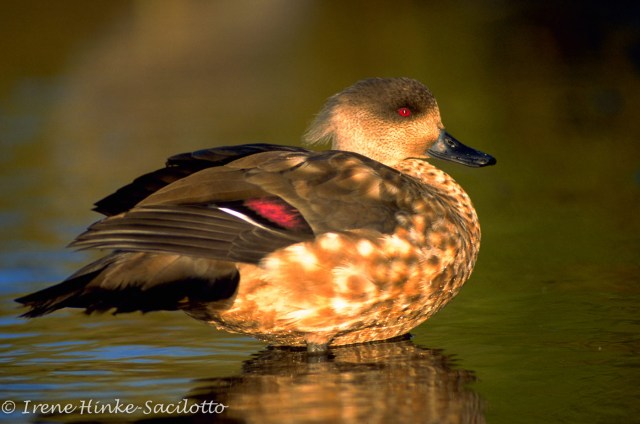
On a pond in the Falklands. Skipped dinner to photograph this and other birds on the pond.
Careful observation of your subject over time is the key to capturing action and behavior. Alterations in body posture, shifting weight, and adjustment in muscle tension (whether noted cognitively or sensed subliminally) can suggest some change in behavior. For instance, shifting of body weight of a resting animal may indicate it is ready to stand or possibly stretch.
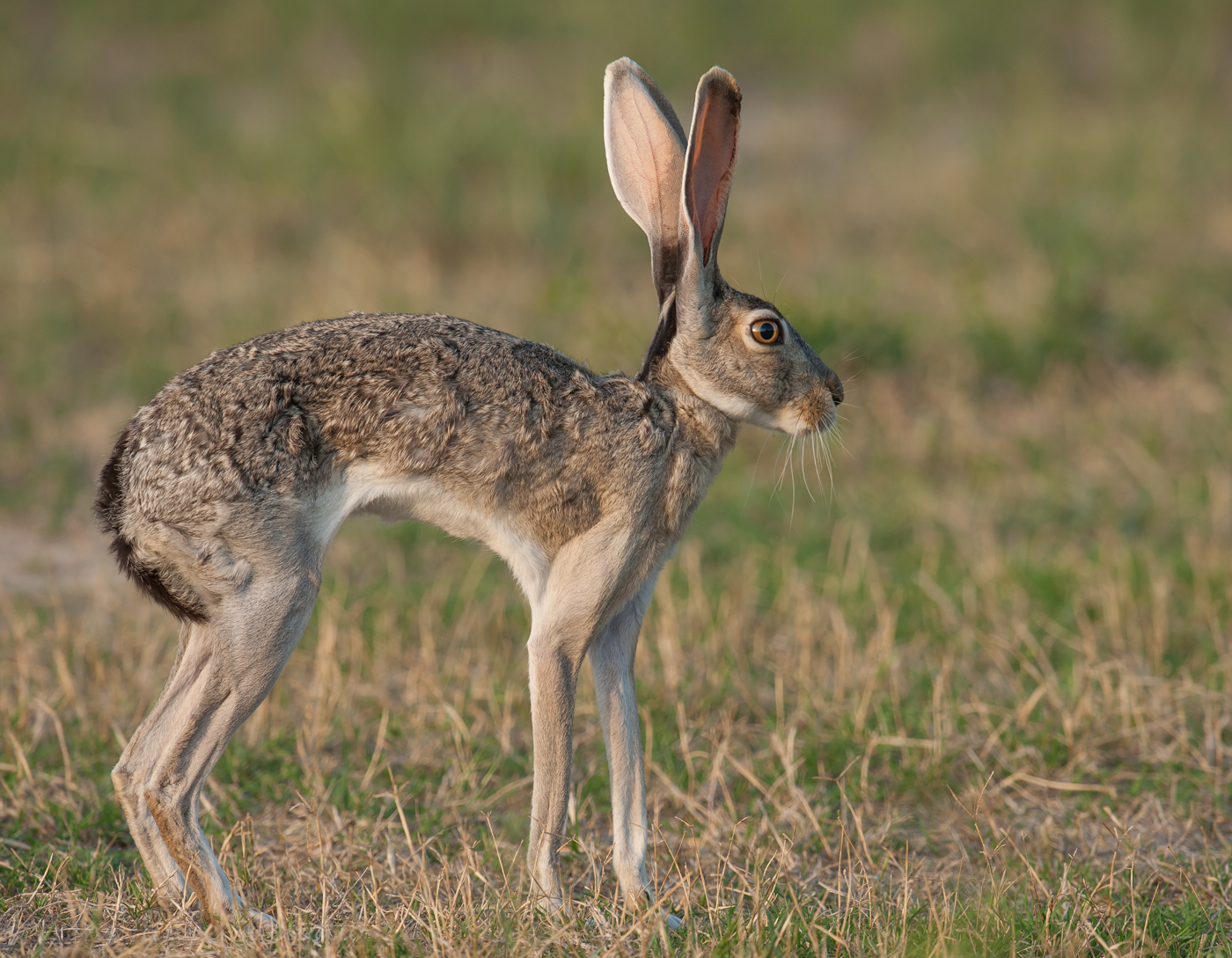
Jack Rabbit stretching.
Birds stretching or flapping wings can often precede flight. Sandhill cranes lean forward before flying. Herons often bend knees and stretch out neck before flying. Seabirds landing on rocky cliffs often employ their wings to provide stability. Birds bathing typically splash while cleaning feathers and then shake off the excess water.

Catching its balance after landing on rock ledge.

Canvas back bathing.

Cinnamon teal bathing.

Black-necked swan taking off from pond. Neck outstretched preceded flight.

Humpback whale preparing to dive. Can predict the point at which the fluke will appear dripping water by observing the curvature of the tail at its base.

Leaning forward before flight. Sandhill cranes, Bosque del Apache.

Bends knees and leans forward before flight.
Chattering and agitated movements within a flock of birds frequently precedes the arrival of more members of their flock, the departure of birds, or the approach of a threatening predator.

Puffin landing. Birds on the ground became animated as the other approach.

Greese were vocal and agitated before leaving the pond.
Photography during breeding season is often rewarding since activities increase – turkeys strut, elk lock antlers, deer mark territory, etc. Nurturing behavior between adult and young often results in touching photos.

Black Browed Albatross preening each other. Pair bonding during breeding season.

Otter protecting young. Difficult to get this photo since rocks were slippery.

King penguin caring for new born.
by Osprey Photo Workshops & Tours | Feb 2, 2015 | Bird behavior, Nature, Nature Photography, Photo Technique, Photo Tours, Photo Workshops, Wildlife, Wildlife Photography
If you can predict what your subject may do next, you can select equipment, settings, and camera angle to take advantage of the information. There are a number of hints suggesting an animal’s next move. I will discuss some of them in this and the following blog. 1) Repeated behavior, 2) reaction to the approach of another animal (friend or foe), 3) assuming a subservient pose, 4) behavior after preening, 5) preparation for flight, 6) nervousness (turning head side to side or bobbing) suggesting flight, and 6) changes in muscle tone or shifting of weight. If I am lucky, such observations allow me to capture the action. See the following images.

Osprey carrying grass to next

It was easier to capture the images of these birds in flight since I knew where the birds were going – to their nest.

American oystercatchers attempting to fighter off black skimmers attempting to nest nearby.

Pelican landing initiates defense on part of other pelicans with young in the area.

Egrets fighting over fish concentrated in a small pool of water

Guanaco fight. Anticipated when one approached other running with its head down and neck out-stretched.

One puffin invades the territory of another and a fight ensues.

Turkey. As it happens with other species of birds, female assumes subservient position in the presence of a strutting male indicating its willingness to mate.

Sanderlings fighting. When meeting another bird entering what it considers its territory, the defender sometimes puffs up making itself look more formidable or it may immediately attack the other bird. If it squats, it is indicating that it is the weaker of the two trying to avoid confrontation.

Puffins announcing to intruding bird that they are a pair.
When one animal approaches another it initiates some kind of behavioral response – a warm reception, indication of a willingness to mate, or an aggressive reaction. I prepare to capture whatever occurs when I always prepare for a photo opportunity when this occurs. See descriptions above.

Bufflehead in channel at Chincoteague, VA after preening.

Puffin after preening.

Canvasback Duck flapping wings to rid itself of loose feathers.
Preening is often followed by the flapping of wings in terms of birds to rid itself of loose feathers.

Black skimmer baring gifts as part of courtship.
If see one adult bird approach another adult with a fish or other gift, watch carefully for what will happen next. In this case, both are carrying fish. Predicting behavior often requires careful observation of the scene in front of you. More info & photos in next blog.
by Osprey Photo Workshops & Tours | Jan 24, 2015 | Assateague, Brazil, Chicoteague, Digital Photography, Nature Photography, Pantanal, Photo Technique, Photo Tours, Photo Workshops, Wildlife, Wildlife Photography
CAMERA CLUBS & OTHER SOURCES OF INFO
Your fellow camera club members can be helpful pointing out local hotspots for wildlife photography. At one such club meeting in Manassas where I was delivering a lecture, I learned that elk herds exist in Pennsylvania, near Benesette http://elkcountryvisitorcenter.com/drupal/ . They are typically found where there is fresh browse. In the fall, the males bugled just like courtship in Yellowstone. Magazines such as Outdoor Photographer www.outdoorphotographer.com can be a great resource describing favorite locations for photography. Robert Hitchman has a newsletter “Photograph America” with detailed info on trails and photo perspectives for all types of photography. It’s a great resource if planning a trip. www.photographamerica.com Well worth the price.

WATER
Animals require 3 key things for survival, food, water and shelter. Therefore areas that provide these elements attract wildlife add offer photo opportunities. They are also good locations to place photo blinds (later discussion). For example, a pond or spring in an arid area can draw wildlife from great distances. On a ranch in south Texas I placed blinds (hides) near ponds that contained water during the hotter months of the year. At the end of the summer at Chincoteague NWR, water evaporates from the impoundments and waterways. Fish become trapped in the shallows where water remains and attract large numbers of hungry herons, raccoons, and other wildlife. Similarly, during the dry season in the wetlands of Brazil(the Pantanal) http://www.pantanal.org/Mainpant.htm, completion for food becomes fierce and animals become more visible as the water disappears.

Coatimundi drinking at pond in Mexico.

Roadrunner drinking at small pool of water during drought in South Texas.

Deer drinking in one of the few ponds with water on a ranch in south Texas.
Bufflehead in channel at Chincoteague, VA
FOOD
A reliable source of food will attract wildlife. Ripening seeds, acorns, crab apples, and fruit will attract monkeys, bears, and squirrels, as well as songbirds and other bird life. The upwelling of nutrients and food caused by strong currents such as those off the southern tip of South America attract marine life and provide food for whales, seals, sea lions, and penguins as seen in the Falkland Islands. The protected waters around Peninsula Valdes in Argentina offer shelter to elephant seals, southern sea lions, penguins, and calving southern right whales and attract photographers from around the world. But you don’t have to go to exotic places to attract and photograph wildlife. In your own backyard you can put out feeders with seed or suet, add a source of water and include an interesting perch nearby so you can capture images in what appears to be a natural setting.

Squirrel storing nut for the winter.

Chickadee feeding on berries.

Giant River Otter eating fish in the Pantanal.

Great Blue Heron with fish.

Rose-breasted Grosbeak at bird feeder.
FAVORITE PERCHES
Birds such as kingfishers, cormorants, and kiskadees often dive for fish from the same perch and return there to consume their fish offering excellent opportunities for photographs. Turkeys, vultures, snail kites, and other birds often roost in the same location each night. These are perfect places to stake out with your camera.

Kiskadee fishing from favorite branch.

Thick-billed tern perched on pole preening and fishing.

Belted Kingfisher fishing from its favorite perch.
DUSTING AREA & MINERAL LICKS
Mineral licks are also great places to photograph wildlife. At Custer State Park, SD http://gfp.sd.gov/state-parks/directory/custer/ buffalo, mule deer, and pronghorn frequent these bare patches of ground rich in minerals and nutrients. These spots are easy to recognize by the reddish color of the dirt. Other locations where animals return repeatedly are dusting areas, sections of bare ground and loose dirt where “wild burros”, buffalo, guanaco, horses, road runners and other animals kick up and roll in the dust to rid themselves of pests.

Burro dusting in Custer State Park, SD

Elephant seal throwing sand perhaps to cool off.
ICE, ROCKS & ISLANDS
If on a boat in Alaska, ice flows area good areas to look for seals. Round Island is prefect if interested in photographing walrus.

Walrus warming in the sun on Round Island.


