by Osprey Photo Workshops & Tours | Feb 2, 2015 | Bird behavior, Nature, Nature Photography, Photo Technique, Photo Tours, Photo Workshops, Wildlife, Wildlife Photography
If you can predict what your subject may do next, you can select equipment, settings, and camera angle to take advantage of the information. There are a number of hints suggesting an animal’s next move. I will discuss some of them in this and the following blog. 1) Repeated behavior, 2) reaction to the approach of another animal (friend or foe), 3) assuming a subservient pose, 4) behavior after preening, 5) preparation for flight, 6) nervousness (turning head side to side or bobbing) suggesting flight, and 6) changes in muscle tone or shifting of weight. If I am lucky, such observations allow me to capture the action. See the following images.

Osprey carrying grass to next

It was easier to capture the images of these birds in flight since I knew where the birds were going – to their nest.

American oystercatchers attempting to fighter off black skimmers attempting to nest nearby.

Pelican landing initiates defense on part of other pelicans with young in the area.

Egrets fighting over fish concentrated in a small pool of water

Guanaco fight. Anticipated when one approached other running with its head down and neck out-stretched.

One puffin invades the territory of another and a fight ensues.

Turkey. As it happens with other species of birds, female assumes subservient position in the presence of a strutting male indicating its willingness to mate.

Sanderlings fighting. When meeting another bird entering what it considers its territory, the defender sometimes puffs up making itself look more formidable or it may immediately attack the other bird. If it squats, it is indicating that it is the weaker of the two trying to avoid confrontation.

Puffins announcing to intruding bird that they are a pair.
When one animal approaches another it initiates some kind of behavioral response – a warm reception, indication of a willingness to mate, or an aggressive reaction. I prepare to capture whatever occurs when I always prepare for a photo opportunity when this occurs. See descriptions above.

Bufflehead in channel at Chincoteague, VA after preening.

Puffin after preening.

Canvasback Duck flapping wings to rid itself of loose feathers.
Preening is often followed by the flapping of wings in terms of birds to rid itself of loose feathers.

Black skimmer baring gifts as part of courtship.
If see one adult bird approach another adult with a fish or other gift, watch carefully for what will happen next. In this case, both are carrying fish. Predicting behavior often requires careful observation of the scene in front of you. More info & photos in next blog.
by Osprey Photo Workshops & Tours | Jan 4, 2015 | Digital Photography, Nature, Nature Photography, Photo Tours, Photo Workshops, Wildlife, Wildlife Photography
Requirements
Knowledge of Equipment —
- Check settings heading out for a day of shooting. If camera has be to the shop for repair or cleaning, often the service people change the settings back to the defaults.
- Make sure the camera batteries are fully charged and there is a memory card of an appropriate size in place. Always carry spares.
- When traveling I back up my images onto two 1 or 2 T portable drive connected to my laptop. Then I import them into Lightroom and verify that they were transferred without any glitches or corrupted files. Only then do I format my memory card. I prefer to start with a clean card each day, 16 or 32 G. At home, I will copy the files from the smaller drives to a larger one.
- As you approach your subject, from a distance preselect the lens and settings that are most appropriate. for the situation. Consider the direction, quality, and color of the light when choosing your approach. Be aware of subtle changes in muscle tension and poses that may indicate action (addressed in later blog) and be prepared to act instantaneously.

Sandhill crane. Saw this crane approaching a pond filled with other birds. Selected my 600 mm lens and set aperture large enough so would be using a fast shutter speed. SInce it was the end of the day, also elevated my ISO. Locked focus on bird at a distance and continued to follow it as it landed. Took a series of shots.

Osprey Nest – Selected 80-400 mm zoom lens and elevated ISO. Waited patiently for the osprey t leave the nest. Took a series of shots. Photographed from the water but nearly drowned my camera when stepped into a hole where the water reached my waist.
Knowledge of Subject —
- Research your subject’s behavior. Where and when is it found? What is its temperament?
- Speak with others familiar with your subject including researchers, biologists and even learning tips from hunters as to the subject’s behavior and tolerance.
- Approach from down wind if animal has an elevated sense of smell as does the Giant Anteater. Those with long/pointy noses tend to have better sense of small than others.

Capuchin Monkey. All animals are attracted to food and are easier to photograph when their attention is on something other than you,

Giant Anteater at termite mound, Pantanal, Brazil. Long nose and good sense of smell so approach animal from down-wind.
Patience and persistence —
- Spend as long as possible with your subject. It some times takes a long time to capture what you are after and may required repeated attempts on different days and with different weather conditions. Avoid distractions and keep your focus. However if another great photo opportunity comes along, go ahead and pursue it.
- Before beginning a project and while at the scene, develop in your mind a vision of what you hope for in terms of results but never limit yourself to just this.
- Continue to develop your skills, trying to surpass previous accomplishments.
- Don’t give up. Look at other ways to achieve your goal. Perhaps move to achieve a better camera angle, light, and background.

Herring Gulls, Common bird by interesting pose.

Canvasback. Often after preening, birds flap their wings to get rid of loose feathers. Watched and waited for one of the ducks to splash water as it flapped its wings.

King Eider, Watched the eiders approach to the beach and waited for nearly an hour before captured this shot.
Curiosity & ability to observe —
- Help you be engaged with the subject and become sensitive to subtle changes in posture, etc. that may precede some behavior of interest.
- No time for snoozing. I find my mind engaged in a detective game. What it happening & why”. What’s next? What do you want to show? What fascinates you?

Billing – greeting and pair bonding. Showing intruder that this is there territory.

Northern Shovler. Anticipated flapping affer some time preening.

Atlantic Puffins. When one animal approaches another there is likely to be some interaction – friendly or otherwise.
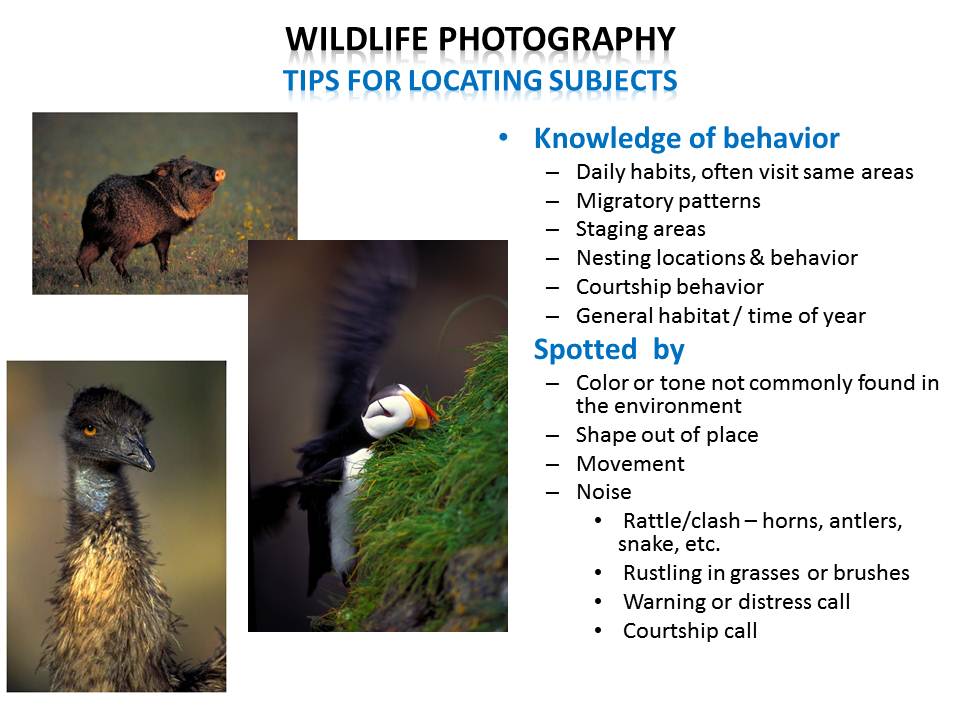
See next installment regarding wildlife photography – locating subjects.
by Osprey Photo Workshops & Tours | May 14, 2013 | Digital Cameras, Nature, Photo Technique, Wildlife
Heading upstairs at a friend’s house, I looked out the large window facing the backyard and spotted two squirrels rolling around in a ball on the grass. I was fascinated by their antics but was skeptical that I could get shots of the action. I took a chance and I ran back downstairs and grabbed my Nikon D4 camera fitted with the newer 80-400 mm lens. To avoid detection and disturbing the action, I had to shoot from inside through glass, a technique that typically results in less than satisfactory results. Luckily the pane was clear and recently cleaned. I removed the lens shade and moved the lens face close to the window to avoid reflections. Since the squirrels were in moderate shade, I had to increase my ISO to 1250, an ISO easily handled by the D4. See the results here and in a small album on Facebook.com/ospreyphotoworkshops

by Osprey Photo Workshops & Tours | Oct 21, 2012 | Nature, Photo Workshops, Wildlife
Catch my wildlife photography lecture at Assateague Island National Seashore on 3 Nov or join my Natue Photography Workshop on 16-18 Nov (weekend program) at the same location.
 Learn tips on how to capture exciting images of your favorite wildlife subjects. Includes info on attracting, locating, and approaching animals plus stalking techniques and using photo blinds.
 .
. 
For info Contact: Christina Hulslander 443-614-3547 www.assateagueislandalliance.org