Check our Upcoming Photo Workshops & Tours

Costa Rica Photo Tour & Photo Tips

Costa Rica Photo Tour & Photo Tips

Butterfly, La Paz, Costa Rica

Butterfly

The first time I visited Costa Rica, it was during an alumni bus tour where photography was not the focus.  The trip and people were nice, but the country was not high on the list of places I wished to revisit. However recently, I was fortunate to meet some friends who invited me to their home in Costa Rica this August. They took me to a number of locations within a 2 hour drive from their home that were super for photography that changed my opinion of the country’s photographic potential. By the end of my week’s stay, we were discussing the possibilities of my developing a photography workshop locally. The volcanoes and mountains were spectacular, with tall waterfalls, low hinging clouds, huge ferns, gigantic trees, and brightly colored bromeliads, orchids and other flowering plants. The trip was only a week long, so I only saw a small portion of the country but what I saw was impressive.

Coatimundi, Costa Rica,

Coatimundi, Costa Rica, Different coloration compared to those in Brazil an Argentina.

The hummingbirds were my favorite subjects to photograph, so many species and colors. I hoped I could ID them from their photographs but light effects their colors and they alter feather position and change colorization. I know now, I realize need expert help. I had hoped for photos of male quetzals an iridescent green bird with a long elegant tail.  We visited an area where they feed and saw them flying at a distance but I will have to wait until my next trip to capture an acceptable image of one. However, during my Costa Rica photo tour I photographed coati, spider and capuchin monkeys, iguanas, crocodiles, red squirrels, a raccoon, a rhinoceros beetle, red crab, parakeets, hummingbirds, tanagers, woodpeckers, and other bird species. Places visited included La Paz, Poas Volcano, Paraiso Quetzal, Hotel Savegre, & Manuel Antonio NP.

Flame-colored Tanager Costa Rica, Sevegre Lodge

Flame-colored Tanager Costa Rica, Sevegre Lodge

Most nights I spent at my friend’s house in Tabaca, overlooking San Jose and its suburbs and a mountain range. The elevation was high and to my surprise temperatures dropped quite low at night requiring a warm jacket.  My host’s home was surrounded by a wonderful garden with a small waterfalls, colorful flowers, and hummingbird feeders. The only night away from Tabaca was spent at the lovely Hotel Savegre in the heart of a jungle preserve where Quetzals are found. Outside the guest rooms were beautiful gardens and feeder stations where bananas and other fruit were placed to attract flame-colored tanagers, blue-gray tanagers, rufus-collared sparrows, acorn woodpeckers, and an assortment of hummingbirds.

The downside of the trip was the traffic. Every day there were rush hour traffic jams in the area around San Jose. Double “no passing” lines in the middle of the road seem to have no meaning to locals and motor bikes are plentiful and are constantly darting between cars.  Overall, major roads were in good shape except where mud slides required repair. The small towns we encountered were charming with churches dating back hundreds of years. However, driving through them was challenging with frequent turns and few street signs. All things considered, these inconveniences are minor when you consider all Costa Rica has to offer.  Keep your eye on my schedule. I suspect I will be adding Costa Rica to my list of photo tours in 2016.

Hummingbird, Costa Rica, Paraiso Quetzal

Hummingbird, Costa Rica, Paraiso Quetzal

Tips for shooting in Costa Rica and similar habitats:

Days with soft light were the best for shooting in the jungle.  Stronger light produces hot spots in the background and deep shadows that obscured details.

On overcast days when shooting hummingbirds, I used a high ISO, fast flash sync speed, and fill flash set on -1 or -2. The flash brought out the bird’s iridescent colors even on a rainy day.

To freeze the wings, I would like to return with several flashes set on a manual setting (1/32 sec) and 2 or 3 placed near the bird and 1 or 2 on the background.  All would need to be in the shade so no ghosting will occur. The flashes would be fired at the same time by a set of Pocket Wizards (radio trips). Ideally you would put out a feeder and train the hummers to come to it. By blocking several holes you can control the hummers approach and increase you chances of success. You can go further and replace the feeder with a flower baited with sugar water.

Flash with a “better beamer” attached to extend the flash power can be used to throw light onto subjects in the shade of the canopy.

Cameras with small built-in flashes often proved satisfactory if used in a jungle setting but close to the subject.

With flash exposure, if a subject is moving and there is enough sunlight hitting the subject to produce a daylight exposure (can happen at high ISOs or large lens openings), you may get ghosting (an overlap of a sharp flash image and blurred daylight image.) If the subject is still and you use daylight as the primary source of light and the flash as fill (-2), ghosting may not be a problem.

Spider Monkey, Manuel Antonio NP, Costa Rica

Spider Monkey

Bring a ponchos or other covering for you and your camera equipment for sudden rain showers.

80-400 best or similar best for hummers – they are not very timid if you move slowly. If you use a longer focal length, it is a bit difficult to capture the birds in flight due to the narrower angle of view. The zoom feature will make it possible to zoom out and catch interaction. Tried several techniques to capture the birds after they sip at the feeder. Pre-focus where I thought they would be when they pull back. Auto focus on very edge of feeder and they catch the bird when it backs away from the feeder.

Adding the 1.4 tele-converter was not a good idea. The hummers move rapidly and the tele-converter slows the auto focus

With birds in bushes, I found manual focusing preferable to auto. Auto resulted with the focus often being on the plant and not the subject

If you want to close focus on a small subject, you can focus closer using manual focus.

600 mm lens was good for birds near a feeder in a bush but not necessarily for hummers. The narrow angle of view made it a bit difficult to find them in the viewfinder.

Tabaca

Host’s Garden


Mobile Blinds & Beanbags for Supporting Camera Lenses

Mobile Blinds & Beanbags for Supporting Camera Lenses

Photo taken at Bosque del Apache in NM along dike road from rental vehicle.

Photo taken at Bosque del Apache in NM from rental vehicle

I often photograph animals from vehicles, which serve as mobile photo blinds with a telephoto lens supported on its foot by a beanbag resting on the window sill. In wildlife refuges and places where animals are protected and are used to seeing vehicles, you and your vehicle are not perceived as a threat.  When photographing, if your subject moves, you can move with it and slowly close the distance between you and it.  My bean bags are homemade and are filled with rice.  When I travel by air, the bags can be emptied by opening the Velcro closure and refilled once I reach my new destination. The material used allows the lens position to be easily altered. I have several sizes suitable for different lenses.  They can be stacked to raise the lenses to the height needed or they can brace a lens solidly in place in an awkward situation. I can also use the beanbag to support a long lens when shooting from ground.

10 to 12 pounds of rice.  Len foot placed on the bean bag.

10 to 12 pounds of rice. Len foot place

Shot from beanbag placed on ground to shoot at eye level.

This Eastern Cottontail was photographed from my vehicle on Assateague Island where I conduct photo workshops each year.

This Eastern Cottontail was photographed from my vehicle on Assateague Island where I conduct photo workshops each year.

Shot at entrance to wildlife refuge in NC from vehicle.

Shot at entrance to  Mattamuskeet National Wildlife Refuge in NC from vehicle.


I was on the wrong side of the car to use the window for shooting.  I slipped out of the passenger set and placed  the bean bag on hood of car and the lens on top;

I was on the wrong side of the car to use the window for shooting. I slipped out of the passenger seat and placed the bean bag on hood of car and the lens on top;

On Tangier Island, I found them useful to secure my tripod in place while photographing from one of the golf carts, which are the main means of transportation on the island.  With my setup, I was able to photograph from the driver’s seat of the vehicle or slip out of the cart and shoot from other angles where I am minimally visible.  Since the animals are used to seeing the carts and they are relatively quiet, they often do flee when I approach. The heron with the turtle in its bill was shot from my golf cart. It took 15 minutes and several drinks of water before the bird finally swallowed it. The night heron was also photographed in a similar fashion.  (Later article will provide tips for using stationary blinds.)

Braced tripod in place in a golf cart to support my 600 mm lens. Animals were more cooperative than if I was on foot

Braced tripod in place in a golf cart to support my 600 mm lens. Animals were more cooperative than if I was on foot

Heron used water to help swallow the turtle.

Night Heron with crab. Walking into a marsh can be dangerous.  Mud can suck off your shoes, you can fall, and may have difficulty finding firm ground.  In many areas tidal guts criss-cross the marsh and make it difficult to navigate. On the coast changing tides can complicate the problem.

Night Heron with crab. Walking into a marsh can be dangerous. Mud can suck off your shoes, you can fall, and may have difficulty finding firm ground. In many areas tidal guts criss-cross the marsh and make it difficult to navigate. On the coast changing tides can complicate the problem.

Wildlife Photography, Value of Patience

Wildlife Photography, Value of Patience

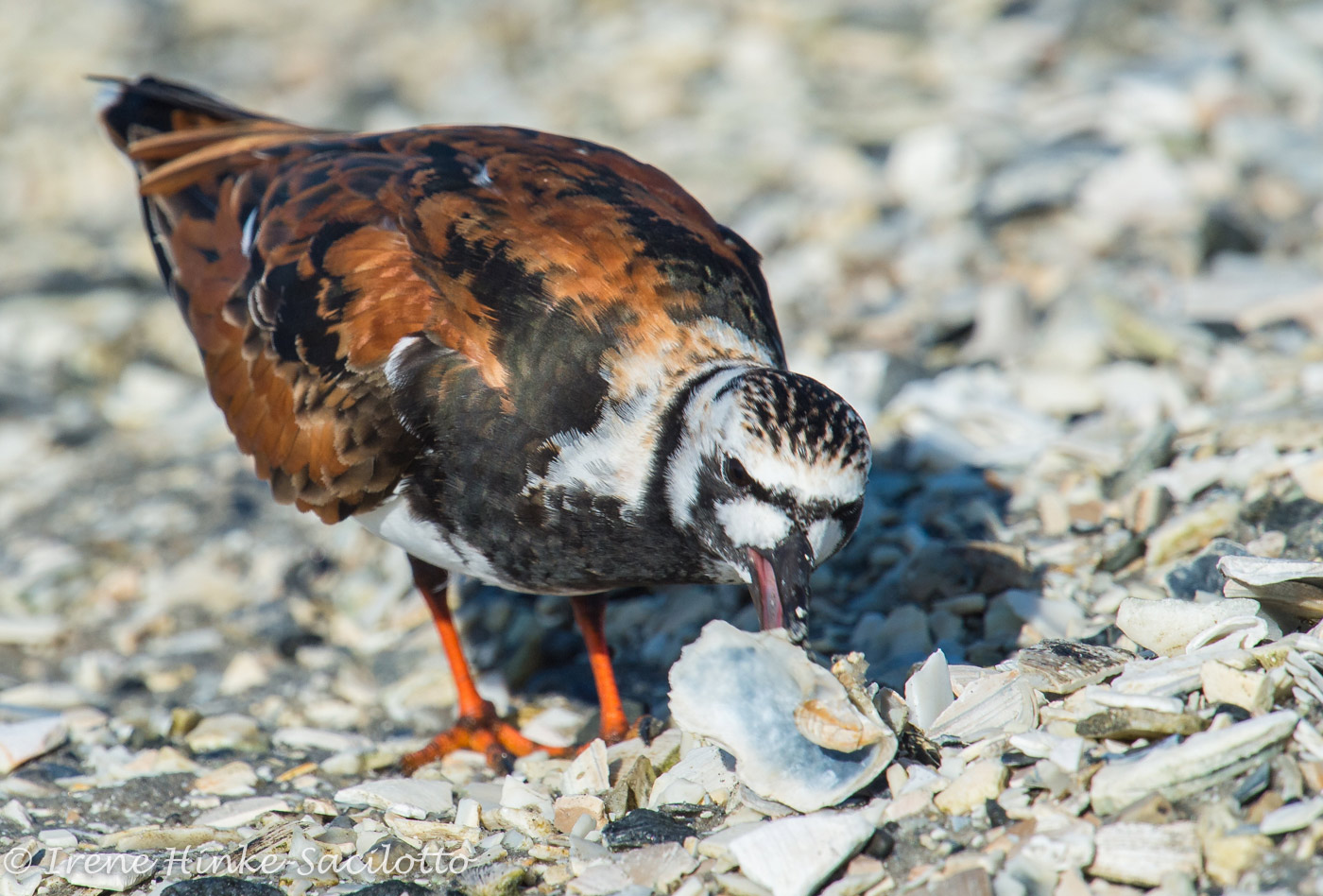
Rudy Turnstone.  Photographed on Assateague Island stretching its wings.

Rudy Turnstone.

Value of Patience when photographing wildlife.

The key to good wildlife photography is patience.  During my photo workshop on Assateague Island, I observed two ruddy turnstones at Ferry Landing.  Class participants took several fine photos capturing interaction between the two.  Since I don’t typically photogrpah with the class, I could not resist returning to the same area on the following day in hopes of having similar success.  That morning I spent several hours photographing ruddy turnstones, willets, and least sandpipers until canoers arrived interested in launching their boats from the shore.  My patience resulted in several great shots including one showing the turnstone flipping shells in search of food, another feeding on eggs, one bathing, another stretching its wings, etc. If you want to capture action, you must watch and wait.  If lucky, you will be able to capture behavior that you can not see with your eye. Of course you need fast shutter speeds for this.  That is where fast lenses and cameras that perform well at high ISOs give you an advantage,  With careful observation, you may be able to predict what is coming next which makes your images more unique. This sense of satisfaction is part of the reward for pursuing wildlife photography.
When photographing wildlife, you can capture unique behavior.

RuddyTurnstone

This shorebird has dug up eggs from horseshoe crabs. Wildlife photography reveals details of behavior missed by the eye

Ruddy Turnstone

Wldlife photography captures action we cannot see.

Ruddy Turnstone bathing.

The camera captured the bird in mid air.

ruddy turnstone

Photo Selected for NANPA’s Daily Sampler, 26 Apr 15

Photo Selected for NANPA’s Daily Sampler, 26 Apr 15

Message from NANPA.  Your photo entitled “Skimmer moving sand to create scrape for eggs” has been selected for NANPA’s Daily Sampler for Sunday, Apr 26, 2015.   Each day NANPA posts different images from its members.  Mine show up periodically.  Nice to  see what members are doing.   See the link

Black Skimmer

Black Skimmer

http://www.nanpa.org/daily_sampler.php

“Upcoming Classes, Tours & Workshops” Outdoor Photographer Magazine Website. Tangier Island.

“Upcoming Classes, Tours & Workshops” Outdoor Photographer Magazine Website. Tangier Island.

3osprey1down-5124

Each month I and other photographers post info and images on our photo workshops and classes in the “Upcoming Classes, Tours & Workshops” section of the Outdoor Photographer Magazine website  www.outdoorphotographer.com 

This month you will find info on my Tangier Island, VA workshop, 29-31 May 2015.  Located in the middle of the Chesapeake Bay, the island is perfect for photographing community life, waterman at work, crab shacks, peers and waterways, and the wildlife that lives in the marshes and along the shoreline.

ADospreytakeoff-5368

It is a terrific location to see and photograph ospreys.  There are many platforms near Tangier Island in the waterways and on nearby islands and jetties where the birds nest.  Part of the credit for the success of the ospreys in this portion of the bay goes to the mayor of Tangier Island, James “Ooker” Eskridge who loves watching the birds soaring overhead as works and helps maintain the nesting platforms.FaceOspreyfish4-1857More images of Tangier Island and ospreys on my web gallery https://www.ospreyphoto.com

OSPREYLANDINGwithTailHold-0382