by Osprey Photo Workshops & Tours | Sep 4, 2018 | Alaska, McNeil River, Nature Photography, Wildlife, Wildlife Photography
McNeil River State Game Sanctuary

Brown bear clutching fish it just caught.
McNeil River State Game Sanctuary. I just returned from McNeil River State Game Sanctuary in Alaska, a location 100 miles from the nearest road system and the town of Homer. It is reachable primarily by float plane when tides are favorable for a safe landing. The area is one of the most remarkable places I have ever visited, with the world’s largest concentration of wild brown bears. Seasonally, after winter hibernation in the high country, the hungry bears gradually gather at McNeil River and Mikfik Creek on the sanctuary to feast on the salmon that spawn there each year. Here the bears are protected and there is no hunting.
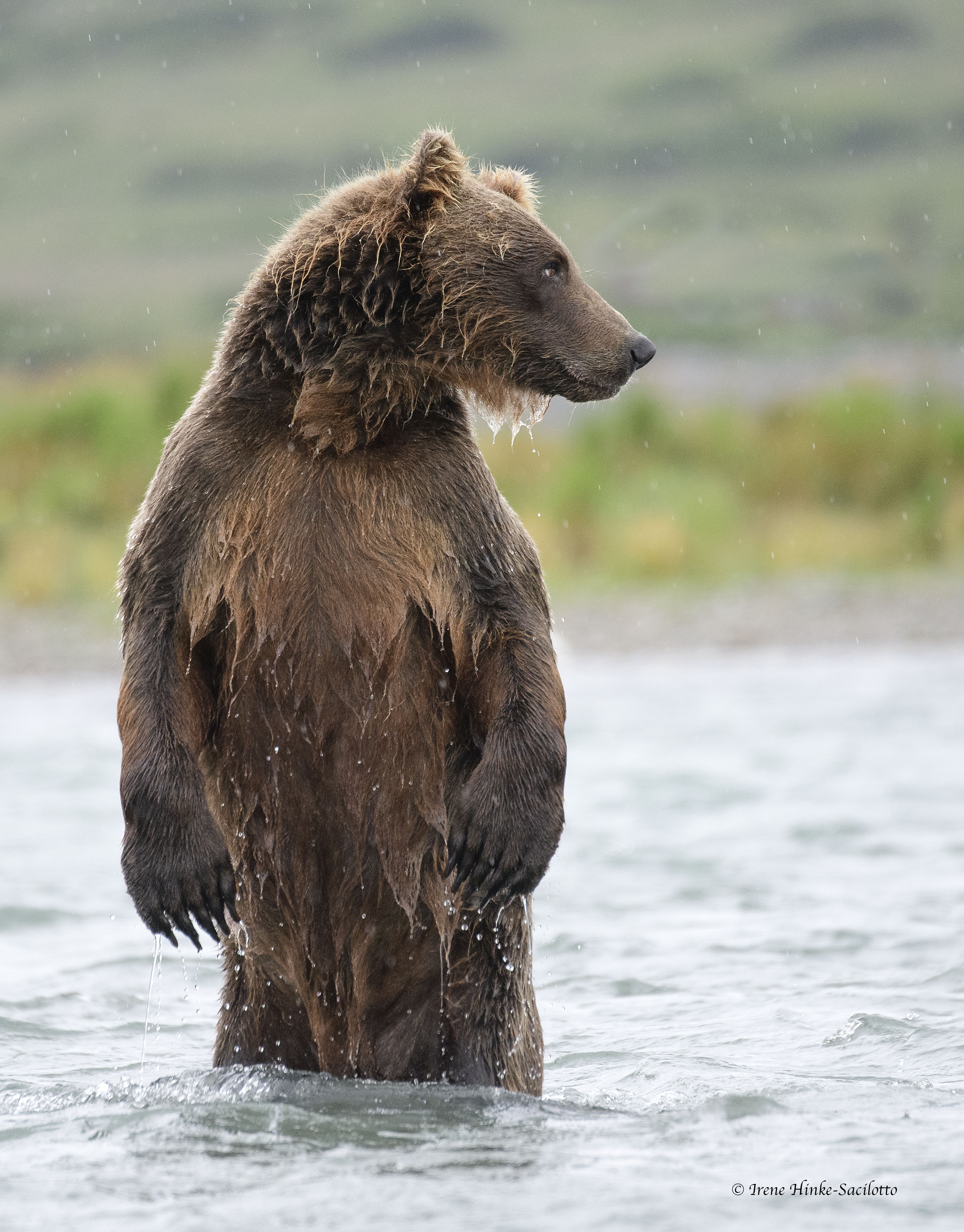
Bear standing in McNeil River
The permits for “guided viewings” of the bears at McNeil River State Game Sanctuary are granted through a state-run lottery system. The number of visitors is limited to 10 at a time, for a period of 3 or 4 days. I had entered the lottery before but lost. But this year a friend and I were finally lucky enough to be selected for 4 days of guided viewing of the bears in the month of August.
From Homer, we flew to McNeil on a float plane which landed in the estuary where the Kamishak Bay meets the mouth of the McNeil River. The location is more beautiful than I had imaged with spectacular views of the distant 3000 to 5000-foot snow-capped mountains of the Aleutian Range. At their base and approaching the coast were rolling hills that met the sea in a series of bluffs, cliffs, lagoons, mud and sedge flats, rocks, and pebbled beaches. Each day, from approximately 10 a.m. to 8 p.m., we spent time in the field with a guide and hiked 4 to 5 miles a day to various locations for bear viewing and photography. One day, from a sand bank along the lower falls, our guide spotted 19 to 22 bears at one time, some close and others farther away and only visible with binoculars. Each seemed to have its own fishing technique—submarine style swimming under water to pouncing on a fish with its paws. Unbelievable!

Mountain view from camp.
As for all visitors, we stayed in a primitive campground with limited facilities designed to minimize disturbance to the environment. It was adjacent to a pebble strewn beach and was partially surrounded by stands of alders and fields of fireweed. We were required to bring in our own camping gear, food, and supplies. We pitched our tents on designated circular gravel beds which were somewhat sheltered from the wind. In terms of permanent structures in the compound, there was a cook house, sauna/wash house, and 2 pit toilets, a tool shed, plus several cabins for the staff. Immediately upon first arriving at the camp, all food and items with odors that might attract bears had to be stored in the cook house. This precaution was to minimize the chance of bears entering the camp and associating humans with food, which could influence bear behavior, creating a problem bear. In the cook house we prepared meals, socialized, and received briefing for each day’s outing. Pots and pans and several burners were provided for cooking. A wood stove offered warmth on chilly days and gave us a way to dry socks, towels and other clothing.
We were very lucky that during our stay the weather was moderate, approximately 60 during day and 50s at night. It only rained steadily part of one day. On the other days, there was a mix of sun and clouds.

Bear carrying fish after catching it.

Young bears sparing.
In August at the McNeil River State Game Sanctuary, most bear activity was confined to the lower falls with a little action at the upper falls due to a reduced number of salmon at this time. Each day we followed primitive, sometimes muddy uneven trails through sedge and mud flats, across slippery pebble-strewn beaches, up hillsides, through steams, and across a tidal lagoon. Waders were definitely required and crossing the lagoon could only be done when the tide was low. Each day we left camp at approximately 10 a.m. and arrived back in camp at 8 p.m. We hiked with our photo gear several miles to visit beaches and areas where we could safely observe and photograph the bears feeding on salmon and interacting. On two days, we visited the upper falls where there was a viewing platform and camp chairs were provided for comfort. The view was super but few bears were present. (In June, most bear activity is at Mitfik Creek and in July it is at the upper falls where up to 80 bears may congregate.
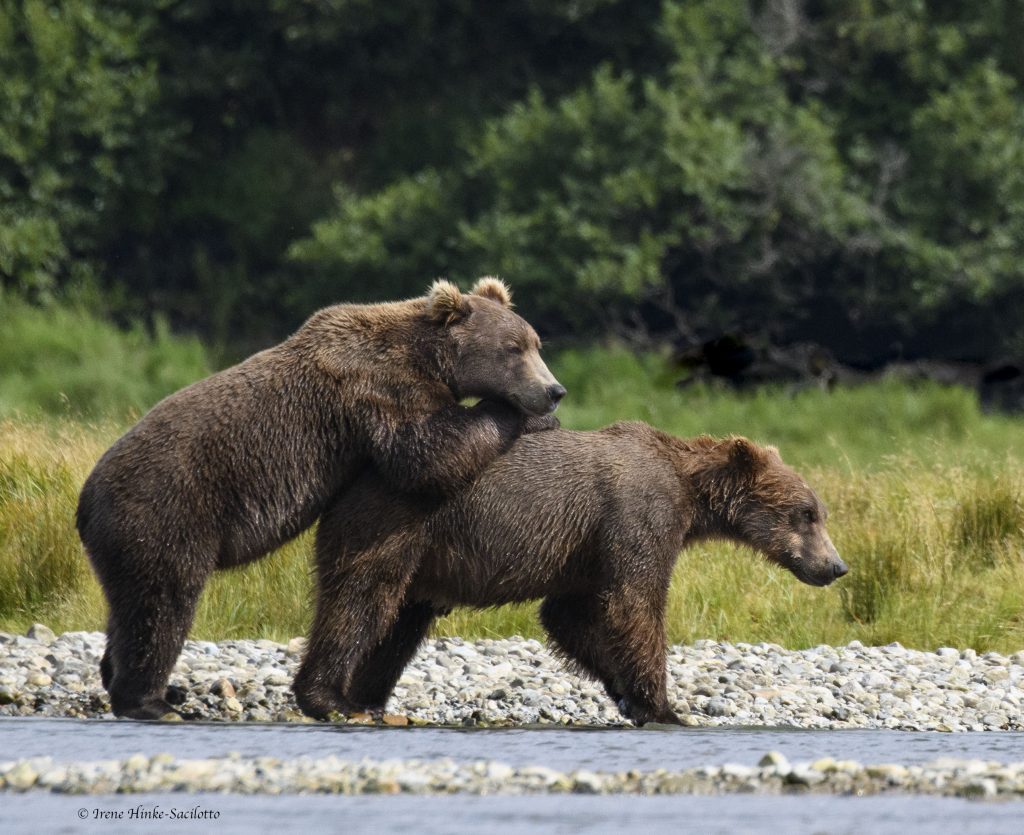
Young bears at lower falls
We followed the protocols established for visitors. We were required to be in the presence of a guide except at camp. In the field, the bears paid little attention to our presence and we felt relatively safe. These rules of human behavior around bears was developed primarily by a remarkable man, Larry Aumiller, who for over more than 30 years has studied the bears of McNieil. He concluded that human safety was more dependent on managing human behavior than managing the bears. For the last 40 years, no humans have been harmed nor has it been necessary to shoot any bears.
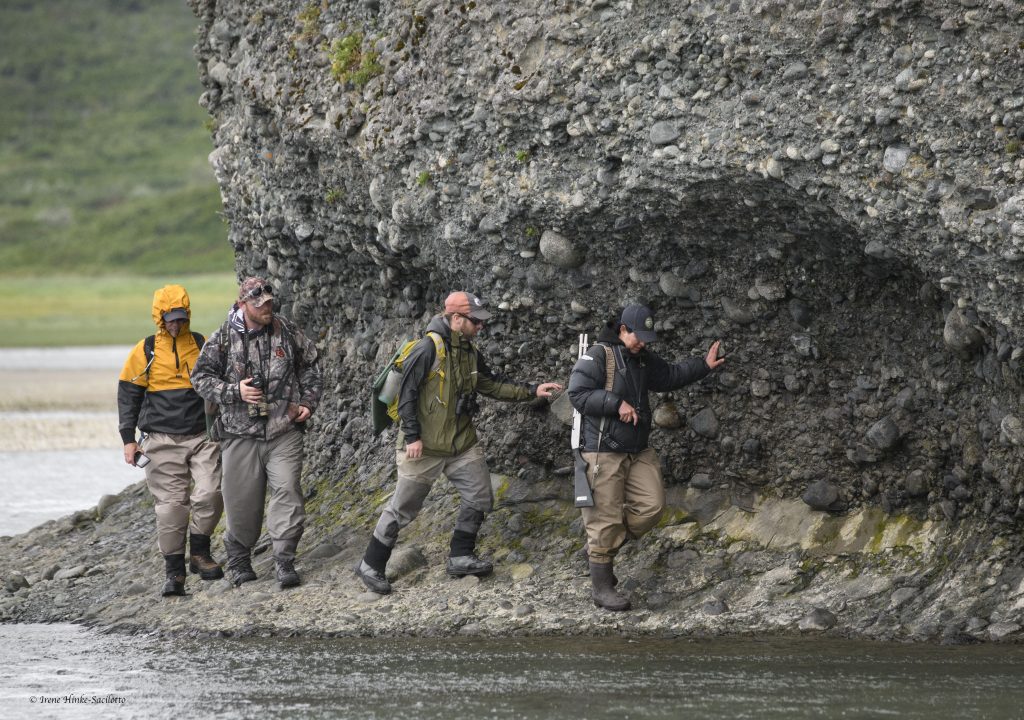
Trail to viewing point at McNeil River.
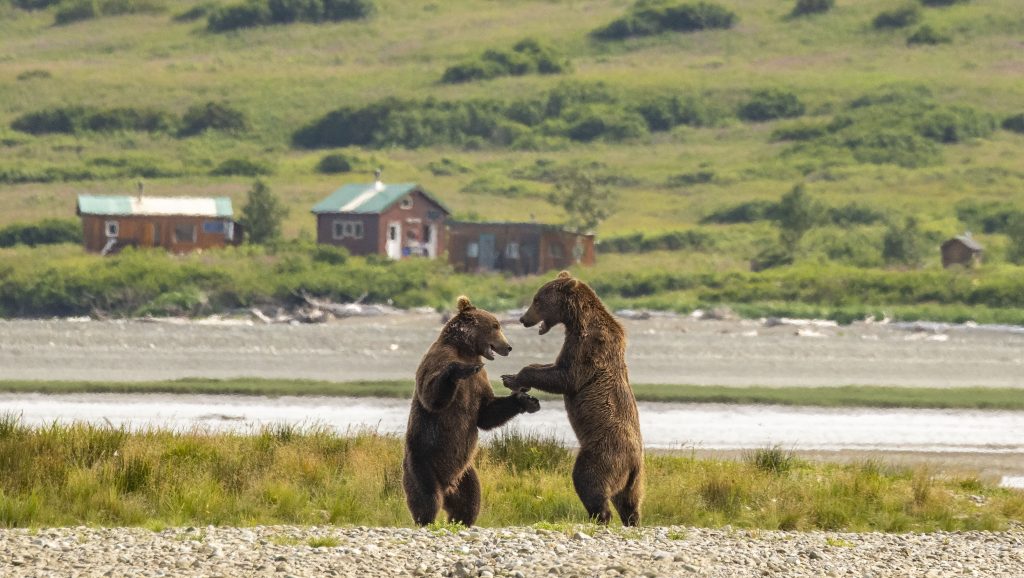
Bear sparing in front with camp in background
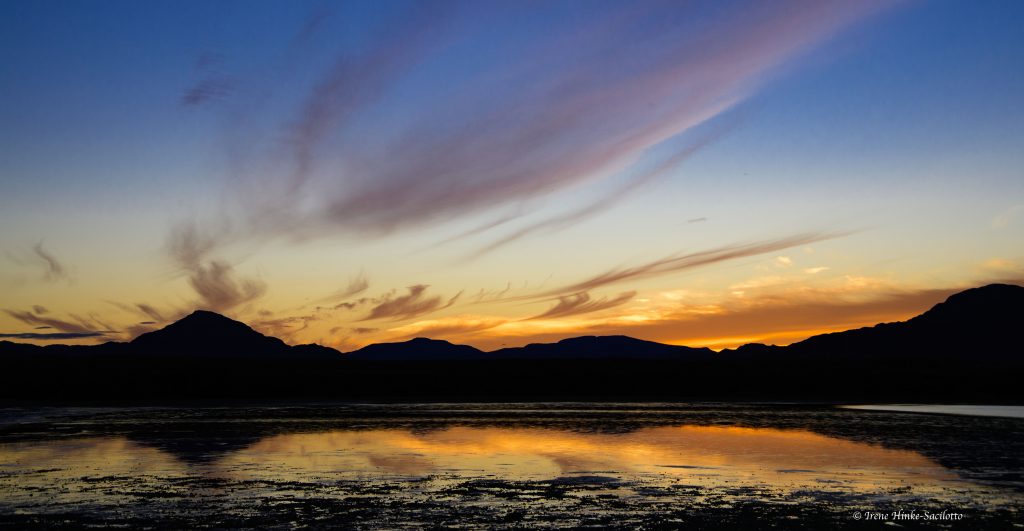
Sunset at McNeil River Camp. Overlooking lagoon.

Staff & guests going to fill containers with water that will then be filter by guests for drinking.

Least Sandpiper along McNeil River. One of the bird species that visit the sanctuary.

Bear shaking off water
The guides at McNeil River State Game Sanctuary were very knowledgeable about bear behavior and made it clear that our activities would not alter the animal’s activity. Part of the safety protocol was that neither guides or visitors were to surprise the bears. Hunan movement was to be consistent and nonaggressive, so the bears perceived humans as no threat. Group sizes were limited to no more than 10. Times of excursions and routes taken were roughly the same each day. As we hiked and whenever we stopped to photograph, we were required to stay in a tight group with no one making sudden movements, sounds, or bounding away from the group for a better photo. When leaving a location, we were reminded to be sure to leave nothing behind, particularly food scraps. The bears were allowed to decide their path and how close to approach. When we rounded blind corners or entered areas of heavy vegetation, the guide would repeat in a low voice phrases such as “hey bear”. If a bear seemed to be overly focused on us and could possibly be a threat, the guide used the least contentious aversion technique to dissuade it, such as clicking two stones together. This was never necessary. On several occasions, a bear passed by within 12 feet from the nearest member of our group and just slowly sauntered by. In the unlikely event of an attack, the guides do carry a 12-guage shotgun slung over their shoulder or lashed to side of their pack.
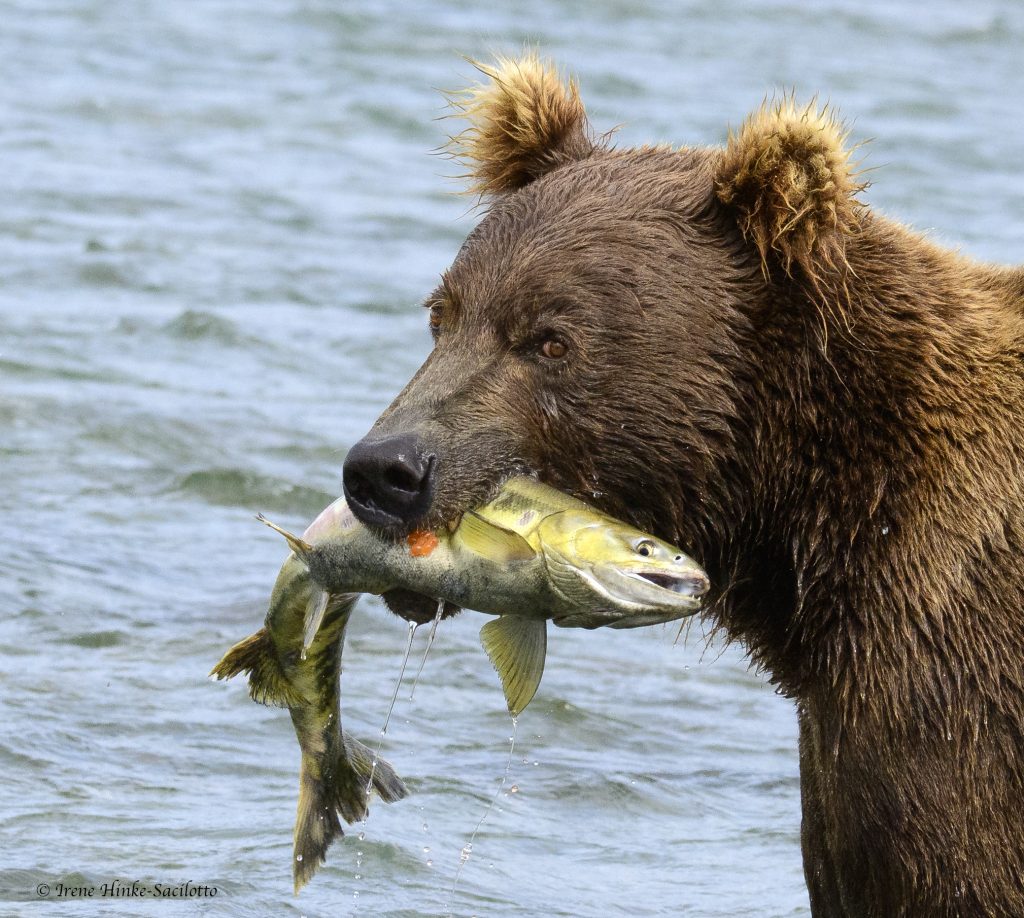
Brown bear with salmon.

Bear skinning salmon before eating it.

Red fox at sunset that hung out near the camp ground.
A red fox and her kits sometimes appeared at the camp in the evening. During our forays into the field, we often saw bald eagles perching on snags and cruising overhead. We were told ground squirrels and wolves were around but we did not see either. Picking up scraps of food left by the bears were Glaucous-winged and Mew Gulls. As we hiked at various elevations, besides fields of fireweed and sedges, we saw pea, Senecio, arctic daisy, Siberian asters, wild geraniums, cow parsnip, low growing willow, crowberry, bunch berry, mules tail, and low bush blueberry. When the supply of salmon at the end of the season runs low, the bears would feed on the sedges and berries, adding variety to their diet.

Sibling bears in McNeil River.

Adult bear with fish and with cub and Glaucous-Winged Gulls to pick up scraps.

Bear walking along rock wall along side McNeil River.
For me, the time spent on McNeil Sanctuary was one of the highlights of my life.
You can read more about the sanctuary in two books: “River of Bears”, with text by Tom Walker and photos by Larry Aumiller and a book about Larry Aumiller’s thirty years among the bears, “In Wild Trust”.

Young bears sparing.

Brown Bear eating salmon at lower McNeil River Falls.

by Osprey Photo Workshops & Tours | Nov 6, 2016 | Autumn photography, Fall photography, Nature Photography, North Dakota, Photo Tour, Photo Tours, Photo Workshops, South Dakota, Wildlife, Wildlife Photography

NORTH AND SOUTH DAKOTA BADLANDS, Trip Report, September 2016.
While scouting locations with Sandy Zelasko and preparing for our spring workshop, we visited both the Badlands in North Dakota (Theodore Roosevelt NP) and the Badlands and Black Hills in South Dakota.
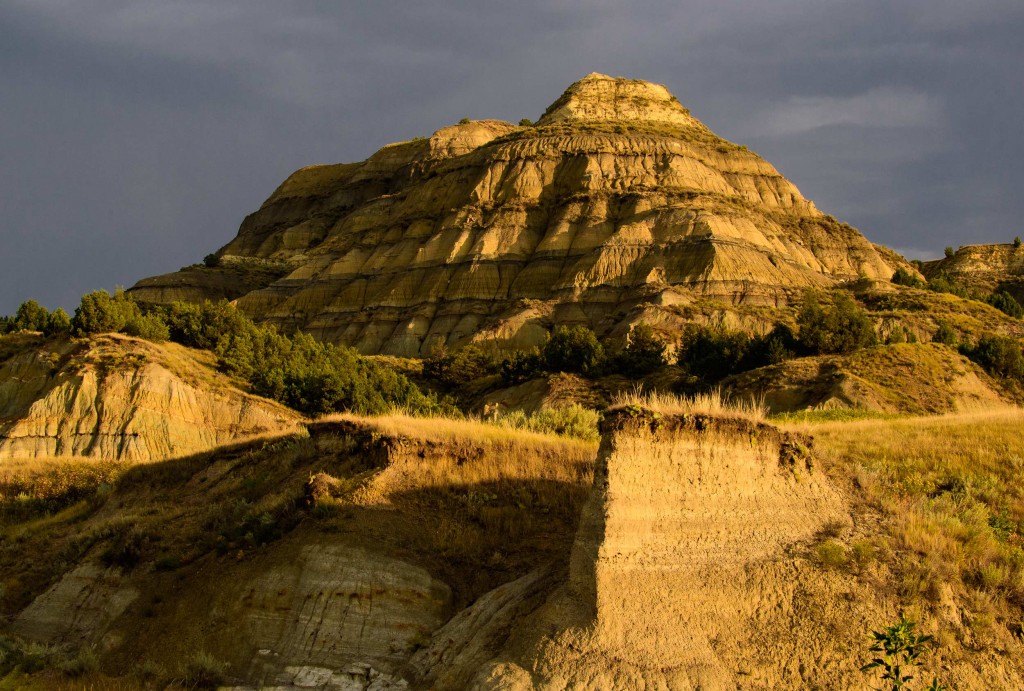
Badlands in North Dakota, Theodore Roosevelt NP.
The Badlands of THEODORE ROOSEVELT National Park (NP) in North Dakota were impressive but not as colorful as those in South Dakota. However some eroded formations were unique including spheres and other oddly shaped rocks balanced on top of ridges or embedded in canyon walls. My favorite subjects were the wild horses, which we encountered in several locations. In North Dakota, the wildlife was not as visible or easy to photograph as in South Dakota Badlands where we found bighorn sheep, pronghorn antelope, mule deer, prairie dogs, buffalo, turkey, grouse, and in the past, badger. From our modest but comfortable motel (Cowboy Inn) in the town of Belfield, ND, we were approximately a 20-minute drive from the southern entrance to the park and an hour from the northern segment. Both areas are worth visiting. However after comparing our experiences in both North Dakota and South Dakota, we decided that the best photo opportunities with a mix of wildlife and landscape photography was in the South Dakota Badlands where we will offer our next photo workshop in early June 2017.
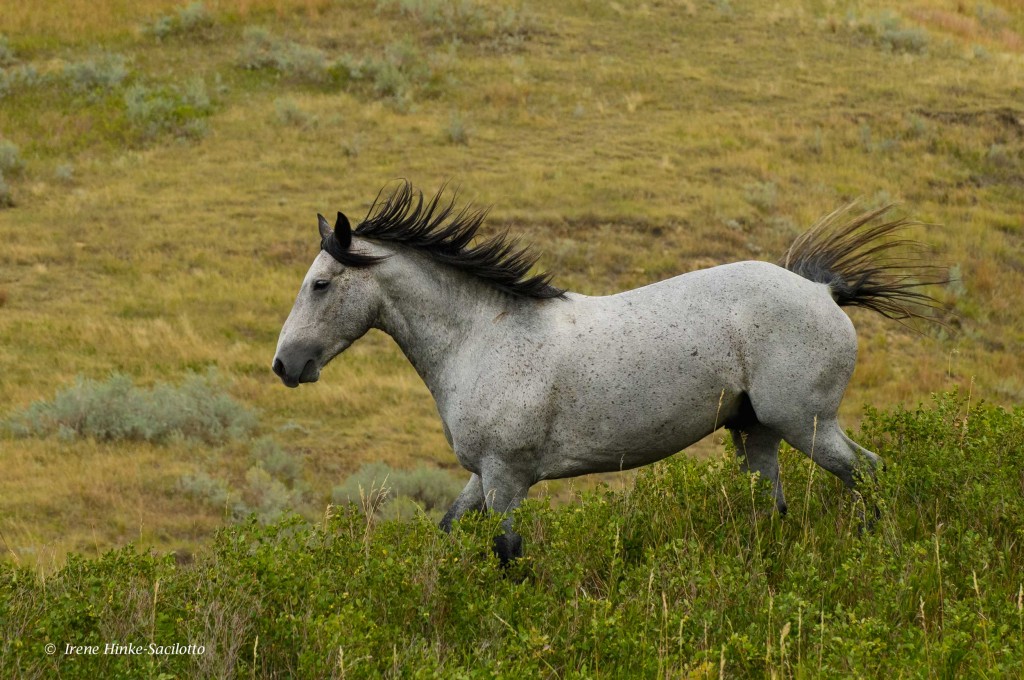
Wild horse

Deer a field in North Dakota
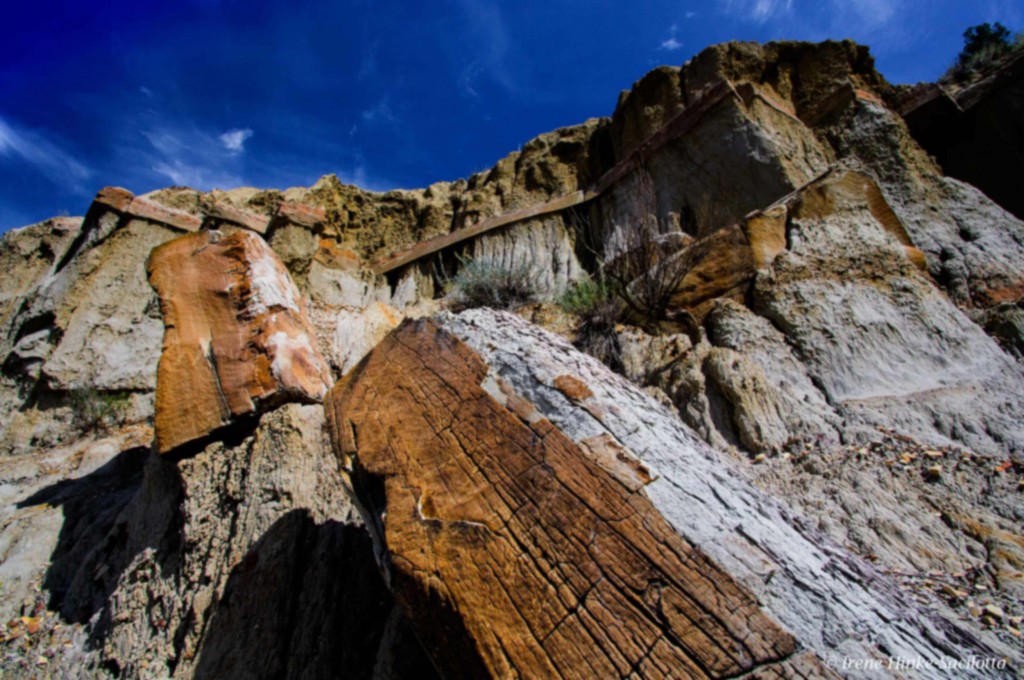
North Dakota Badlands with slanted rock.

Buffalo at sunset.
A paved road loops through the 24,000 acre Badlands NP in South Dakota with scenic overlooks and traveling between the sharply eroded buttes, pinnacles, pedestals, and spires and undisturbed mixed grass prairie that characterizes the park. The badlands were formed from alternating layers of hard and soft rocks and soil. Easily eroded materials such as clay or mud-stone is topped by more resistant materials, such as sandstone, with the harder horizontal layer protecting the soft deposits. There are a number of hiking trails to provide a closer look at the unique geology of the region. North, Door and Window trails near the North East entrance to the park meander amongst the formations, for an up-close and personal look at the rocks layers.
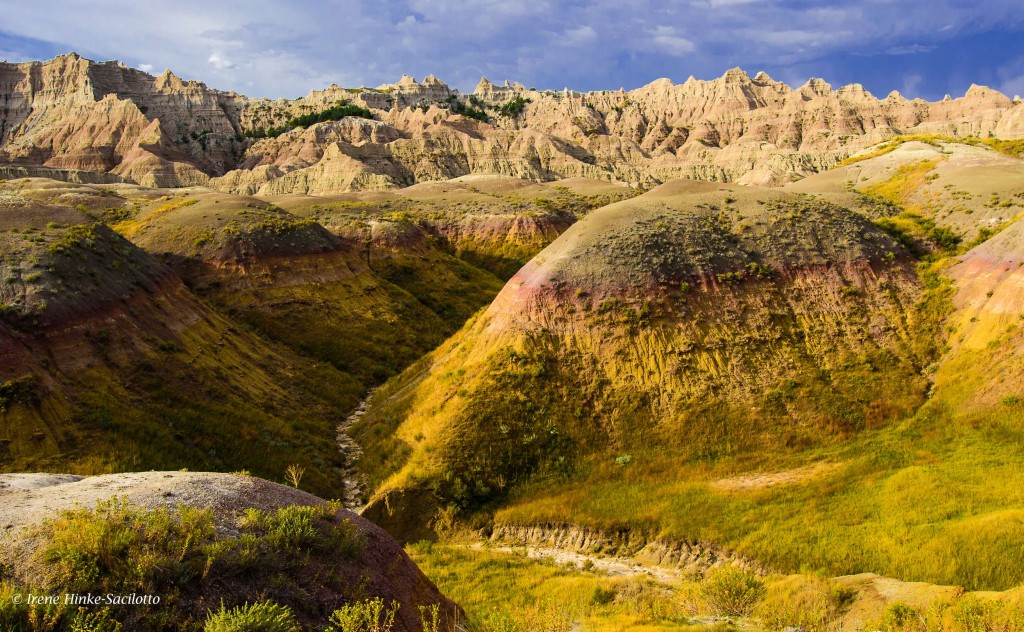
Yellow Mounds
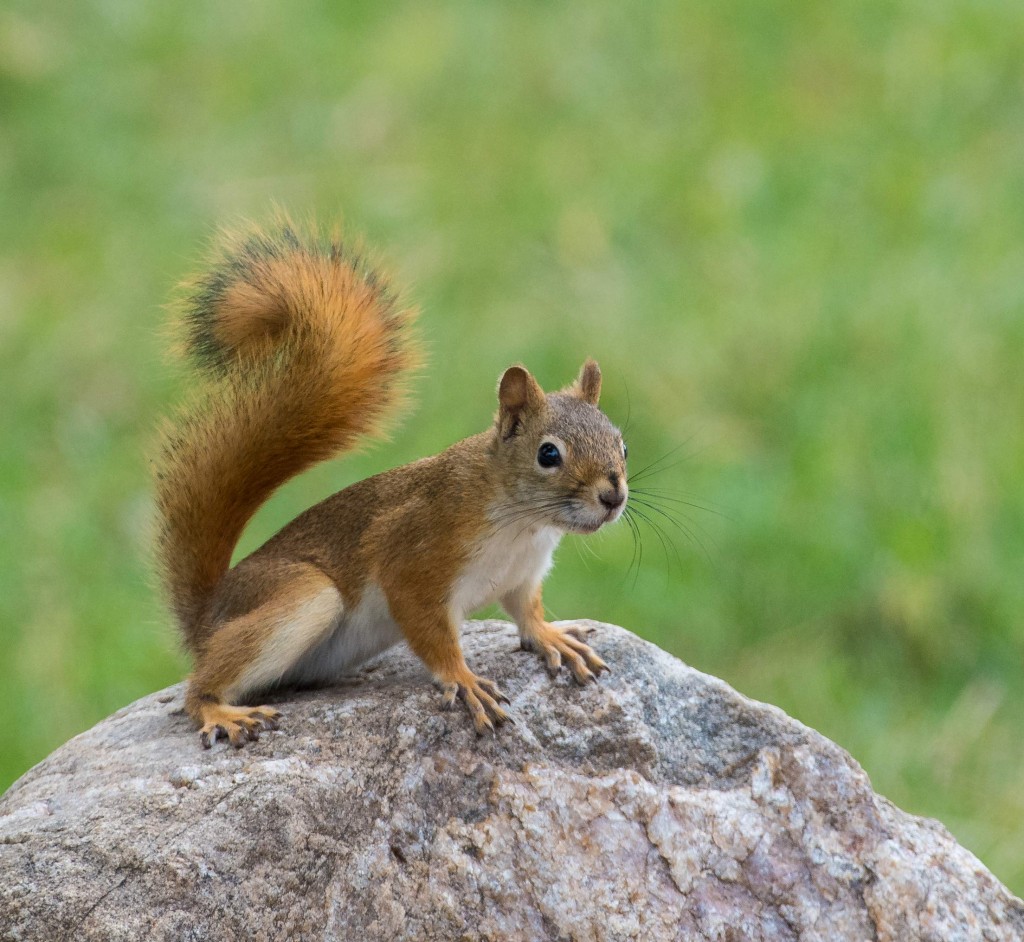
Red Squirrel
It s hard to pick a favorite location for photography within the park since there were so many sites to choose from. I loved the sulfur mounds and eroded formations near Dillon Pass and Conata Basin but was equally fascinated by the alternating tan and rusty bands of color from oxidized iron near Saddle Pass Trail. Southern views from Sage Creek Rim Road also offered great opportunities for landscape photography with deep ravines and colorful mounds eroded by wind and rain. Along the
gravel road is a good place to spot wildlife in and about Roberts Prairie Dog town. Buffalo, pronghorn, and bighorn sheep graze on the grasses while coyotes stalk unsuspecting prey. It was here I photographed a badger at close range during my last visit. Actually the best place this year for prairie dog shots was along a less traveled dirt side road running north as you head east past Contata Road and Dillon Pass. With little disturbance from traffic, the prairie dogs were more cooperative and allowed us to shoot belly down on the ground. More remarkable, along the same road, a coyote slowly walked towards our car and crossed the road in front us into the grassland paying little attention to the sound of our cameras firing off a burst of shots.

Bighorn Sheep
Sheep Mountain Table in the Southern Stronghold area of the park is worth a visit if you have a car with high clearance able to climb the steep dirt road that leads to the top of the mesa. It’s a peaceful place with few visitors where you can enjoy views in all directions from the high vantage point. On the Western edge of the Badlands on the way to the mesa from Sage Creek Rim Road, Scenic is a nearly abandoned town off the main highway that offers you a glimpse in the past with unique photo opportunities. Here you can photograph your friends behind bars in a historic jail or in front of the once lively Longhorn Saloon where steer skulls line the roof of the building. If you look hard at the sign on the face of the building, you will notice a somewhat disturbing message indicating who was welcome. If you look hard, the first word “NO” is painted over.
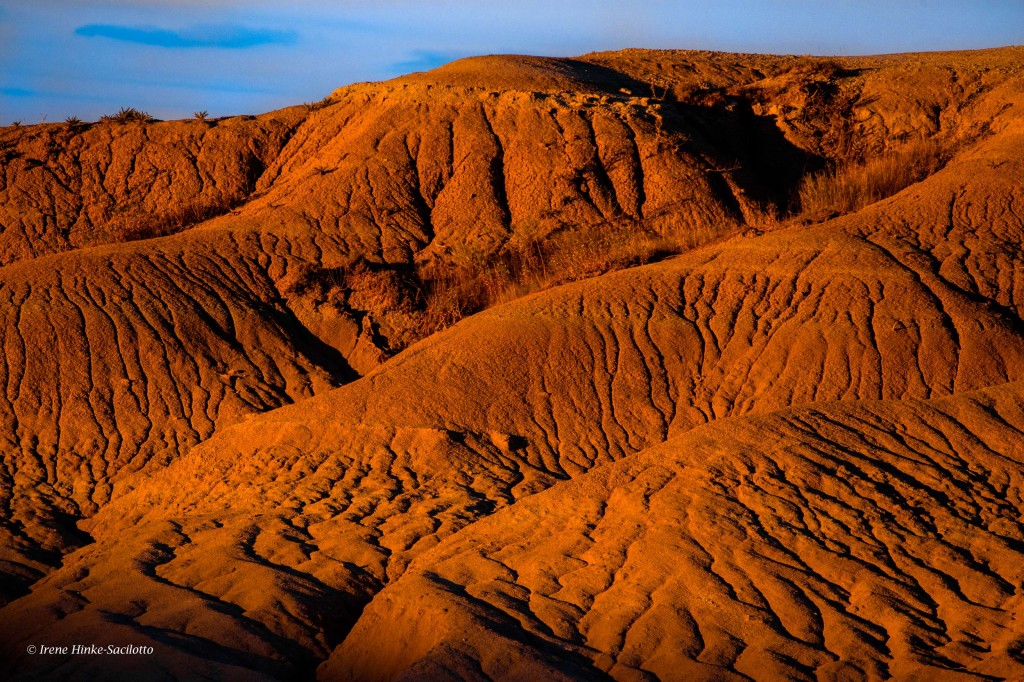
Eroded mounds at Sunset
GIGANTIC FIELDS OF SUNFLOWERS. On the first leg of the trip, Sandy and I explored the back roads from Rapid City to Belfield, ND, where we stayed while exploring the area. From there headed south to Wall and the Badlands of South Dakota. Along route 73 south of Lemmon and elsewhere, we discovered huge fields of sunflowers, much larger than any I have seen in Maryland. Although some flowers were past their prime, we stopped to take photos of several fields in prime condition with macro, telephoto, and wide-angle lenses. Surprised at the number and size of the fields, I checked the Internet to find that this area is one of the highest producers of sunflowers in the U.S. The seeds are used in the production of sunflower oil as well as for consumption by humans and birds.
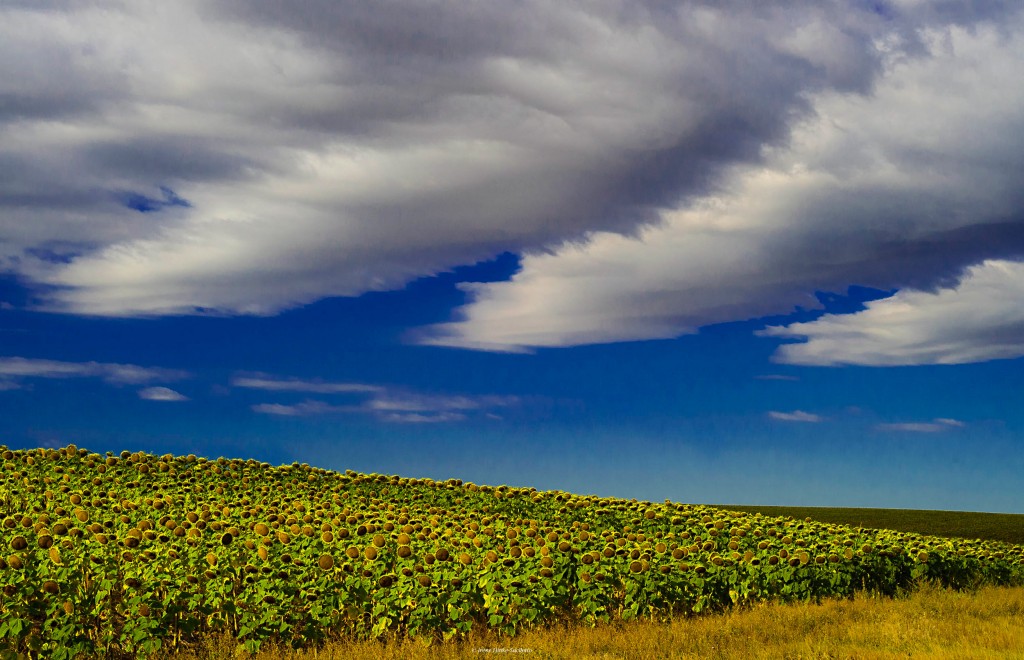
Sunflower field

Marmot
It was 13 September, not a holiday weekend, when we entered the southern gate of CUSTER STATE PARK and encountered bumper-to-bumper traffic on the loop road. There were several tour vehicles with park visitors and accompanied by guitar-playing singers. Needless to say, this was not the environment I had remembered from past visits. Instead of the “wild” burrows grazing on the hillsides and dusting in areas devoid of grass, they gathered on the road, sticking their heads into car windows and begging for food. Also there were more fences than I remember from a previous trip limiting photography in certain areas, but we were told the fences were there to protect sensitive habitat from overgrazing. As we moved further along the loop road the situation improved. We did encounter a large herd of buffalo, lots of bluebirds, a few mule deer, bighorn sheep, and pronghorn. Our favorite areas were along the gravel roads that branched off the main route. Here there was little traffic and the rolling hills were beautiful particularly on the route that led into the backcountry of Wind Cave NP. We encountered buffalo, herds of pronghorn, and the possibility of seeing elk. We found photographing in Wind Cave National Park was more productive with pronghorn on hillsides, energetic red squirrels retrieving and storing pinecones for the winter, wild turkey, and mule deer adjacent to the road.
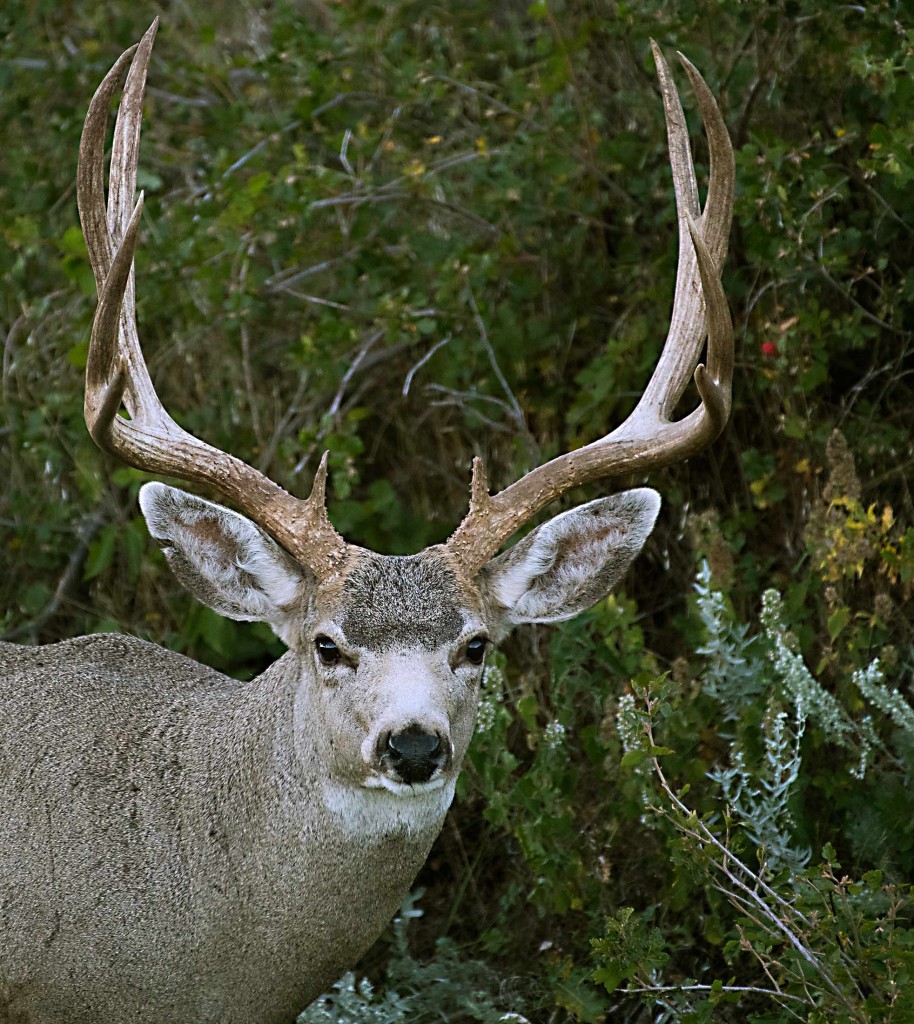
Needles Highway in the Black Hills not far from the town of Custer includes 14 miles of sharp turns, low tunnels and impressive granite spires. It is a good spot to look for mountain goats, which are known to frequent the high country near Cathedral Spires and Needles Eye Tunnel. They have even been photographed inside the tunnel licking minerals from the rock walls. With little time remaining on our scouting trip, we drove the highway one morning in search of goats but when a heavy fog engulfed the Needles, we could hardly see the car in front of us let alone spot their white coats. The highlight of the drive was witnessing a full sized tour bus carefully position itself and pass unscathed through Needles Eye Tunnel while the extended side mirror of a pick-up truck that entered before the bus scrapped the inside of the wall.

Tour bus
We made a short side trip to Spearfish Canyon on 16 September. We were a bit early for fall color in the canyon, which I had enjoyed on a previous trip. The waterfalls were impressive particularly Roughlock Falls. Bridal Veil falls had little flow and would have been more impressive if it was surrounded by fall color or snow covered trees. Spearfish Falls is near the Southern entrance to the canyon and is photographed best in soft light in the early morning.
NOTE: You are likely to encounter the best leaf color in the South Dakota Badlands and Black Hills the last two weeks of September.
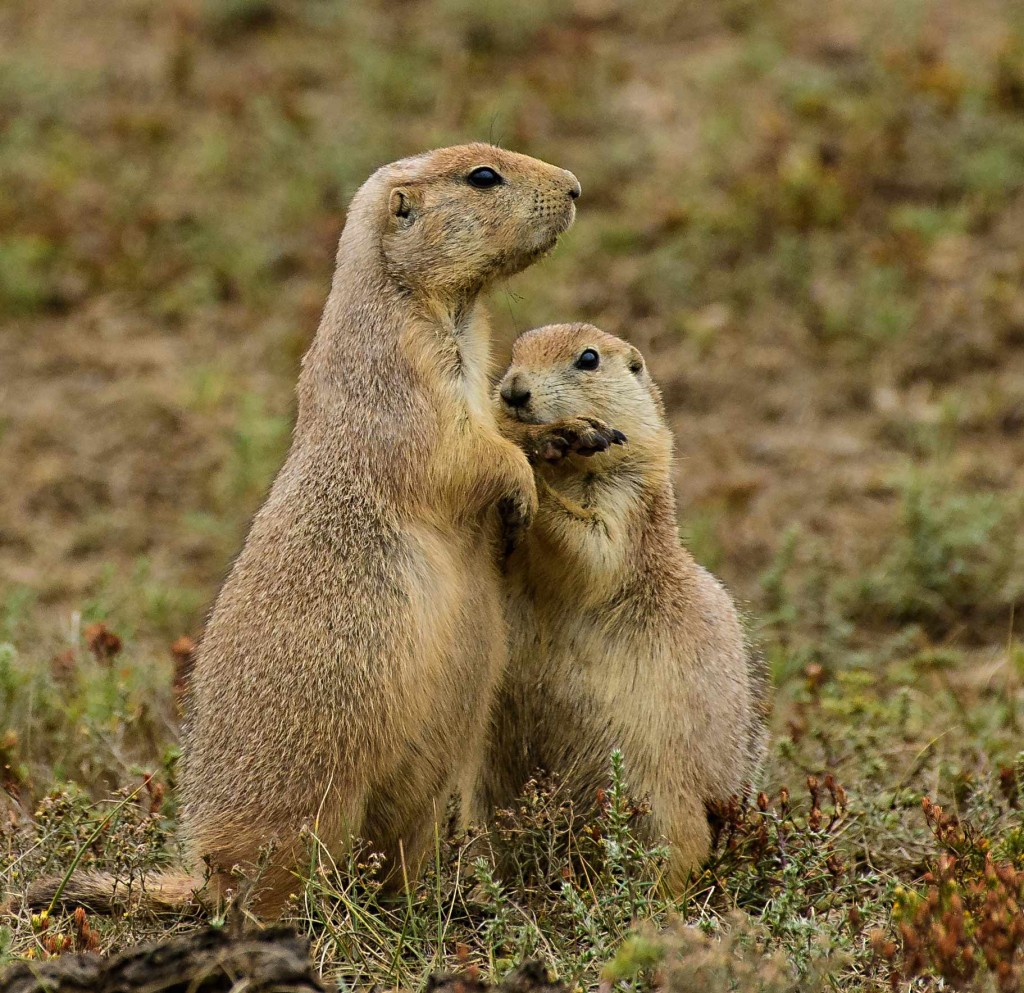
Praire Dog biting paw.

by Osprey Photo Workshops & Tours | Aug 22, 2016 | Brazil, International photo tours, Nature Photography, Pantanal, Photo Tours, Wildlife, Wildlife Photography
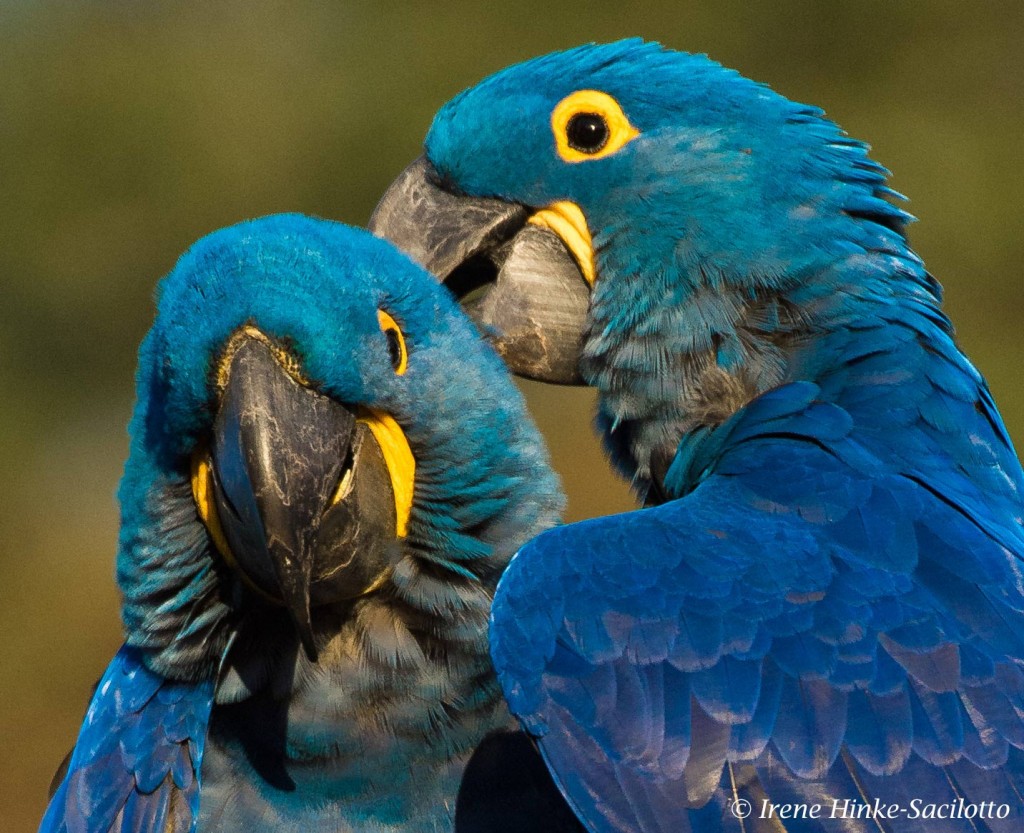
Hyacinth Macaw
The Pantanal of Brazil is a UNESCO World Heritage Site. Why is it unique?
The majority of the Pantanal is located in Brazil with smaller portions in Bolivia and Paraguay. It covers 81,000 square miles, with the Bazilian portion in the states of Mato Grosso and Mato Grosso do Sul
The Pantanal is huge gently sloping basin and the largest seasonally flooded tropical wetland. It is10 times the size of the Everglades and is a mosaic of habitats created by water with distinctive wet and dry seasons. 80% is submerged during the rainy season, the months November through March. The nutrient rich floodwaters deposit sediments that enrich the soil and create a fertile environment capable of supporting highly diverse collection of plant and animal species. It’s home to some of the rarest animals on earth–the jaguar, marsh deer, giant river otter, hyacinth macaw, crowned solitary eagle, maned wolf, giant anteater, South American tapir, yellow anaconda, and yacare caiman. They share the habitat with howler monkeys, capybara, toucans, parrots, iguanas, armadillo, tegu lizards and other wildlife. It is estimated that there are more than 3500 species of plants, thousands of invertebrates, and hundreds of bird, mammal and reptile species.
In addition to benefiting wildlife, the Pantanal is important for flood abatement, water purification, recharging ground water, climate stabilization, and serving as a nursery for aquatic life.
Wet Season: The rainfall is approximately 1,000–1,400 mm (39–55 in) per year. But the majority of the water comes from runoff from the surrounding upland areas including the Paraguay River and its tributaries flowing from the surrounding plateau. As water levels rise, these rivers inundate the Pantanal’s grasslands and gallery forest, creating a vast temporary wetland bounded by dry and humid forests, grasslands, & savannas. During the rainy season water level rises 2 to 5 meters.
Dry Season: May to late November is considered the dry season in Pantanal, and the water level drops dramatically. In November, very little of water persists except in some ponds and permanent rivers and streams. Tourists visit primarily June through Oct. The average temperature in the Pantanal is 25 °C (77 °F), but temperatures can fluctuate from 0 to 40 °C (32 to 104 °F).
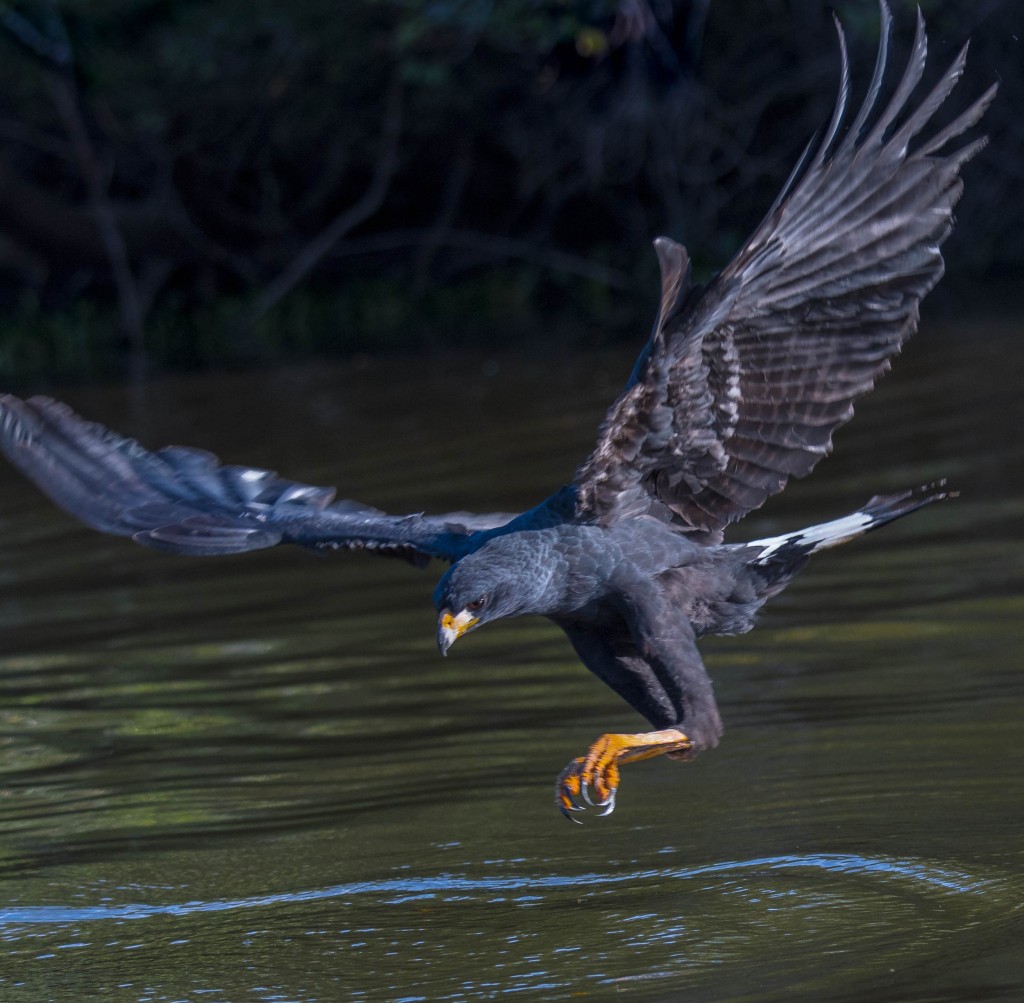
Black Hawk
Access:
The main gateways into the Pantanal are the cities of Cuiabá (capital of the state of Mato Grosso) and Campo Grande (Capital of the state of Mato Grosso do Sul).
The Transpantaneira Highway is an elevated 160 km long dirt road. With dozens of bridges, many of them wooden, it crosses the Pantanal over savannahs, lakes, seasonal streams, rivers, lagoons, marshes and shrub wetlands until finally reaching the Cuiabá River where it ends at Porto Jofre. Along the way, there are many opportunities for roadside photography of wildlife.
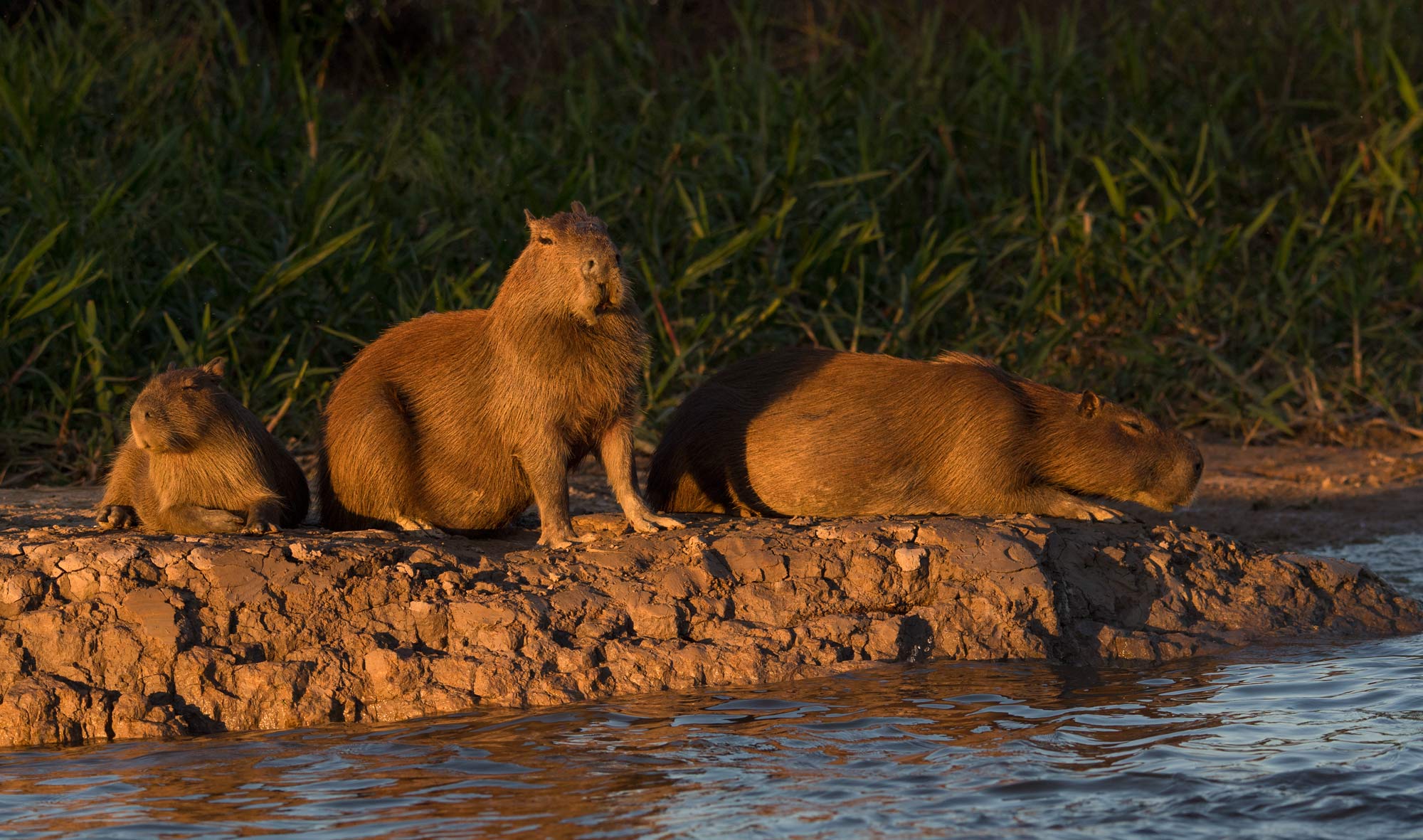
Capybara
Economy: The economy of the area is based on cattle ranching, agriculture (rice, soy beans, corn, sugar cane, etc.), agroindustries, mining (gold, diamonds, iron, manganese), professional fishing, sportfishing and eco-tourism.
Concerns: Approximately 99 % of the Pantanal is privately owned with thousands of ranches (fazendas) and 8 million cattle. Current threats to the ecosystem include hunting, poaching (exotic species trade), pesticides from agricultural runoff, pollution from sewage and mining, and infrastructure development effecting hydrology. But compared to the Everglades, it is relatively untouched despite the lack government protection.
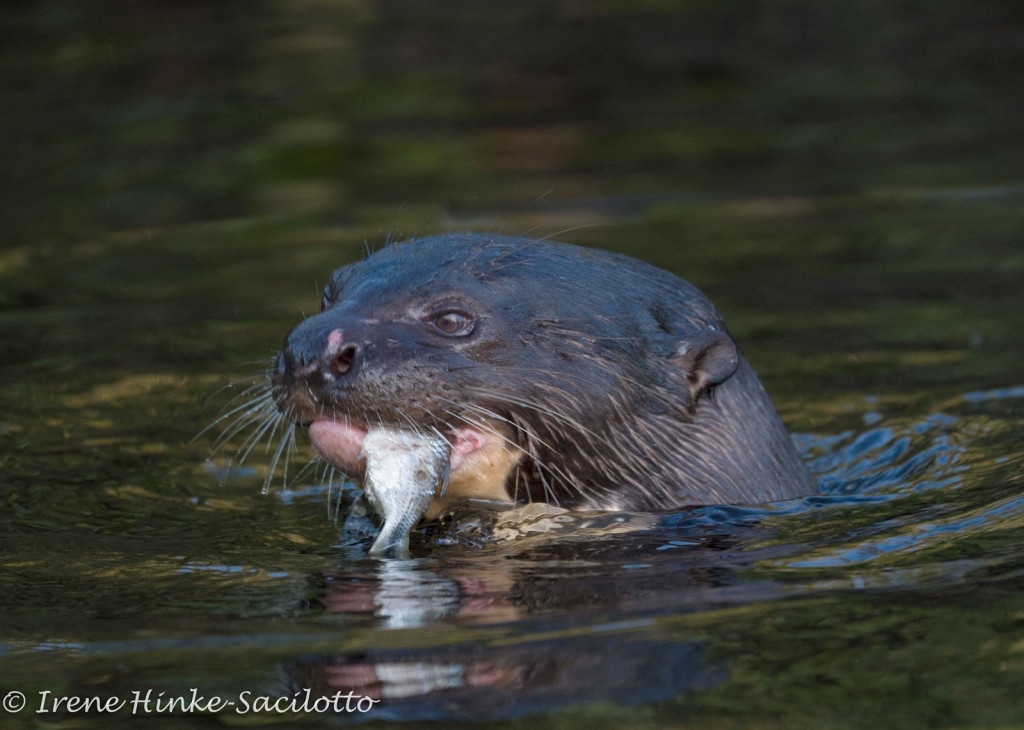
Giant River Otter eating fish.

by Osprey Photo Workshops & Tours | Mar 27, 2016 | Bird behavior, Digital Photography, Nature Photography, South Texas, Tangier Island, Wildlife, Wildlife Photography

Black-Bellied Tree (whistling) Duck feeding along the edge of pond.
Photo Blinds for Wildlife Photography
Blind Construction
Blinds or hides are used by both hunters and photographers. By the word blind, I mean a tent or structure made of camouflage material to hide you and your camera from the animal you intend to photograph. Typically they are placed in locations where animals visit frequently. They allow you to photograph wildlife in its natural state, without its behavior being altered by human presence – feeding, courting, caring for young, interacting with other, etc. Typical places to locate a blind are near a watering hole, food source, den, lodge, nesting site, baited area, backyard bird feeder, etc. Blinds need not be fancy or perfectly match the surrounding as long as their shape is somewhat disguised by the pattern of the fabric or materials used in construction. It is important that the fabric does not flap noisily in the wind. Success is most likely when the blind is in place for enough time for the animal to become acclimated to it.

Blinds along side lake. Wooden frame.
I have used blinds suitable for photography from the following web sites: http://www.sportsmansguide.com, http://www.basspro.com, http://www.cabelas.com, http://www.dickssportinggoods.com, and http://www.rue.com. The best are lightweight, easy to set up alone, and relatively inexpensive. Even cheap tents can be modified to suit your purpose by camouflaging them using spray paint. I typically modify the blind I purchased to better suit my needs for photography, adding openings for my lenses on 3 or 4 sides. I fit the holes with sleeves made from camo mesh (2 or 3 layers) to cover the lens and I add an elastic closure to adjust the sleeves to the diameter of the lens. The mesh disguises the lens while allowing me to look for the approaching animals. I also add small observation windows of the same multi-layered mesh for the same purpose. More permanent blinds that I have constructed, I have a wooden frame made from cheap 1 x 4 and 2 x 4 pieces of lumber, approximately 42 inches long. I cover the frame with cotton camo material purchased from a fabric store, which I staple in place. Burlap is a cheaper cover used by many photographers but I am allergic to it. Side pockets inside the blind are useful for storing small accessories. You can further disguise your blind adding branches or grasses local to the area.

Blind opening with flash using dropped mesh fabric rather than sleeve.
Hot Climates
When working in hot climates, I add ventilation holes made of camo netting near the top of the blind to allow the hot air to escape. Photographers have been known to suffer from heat stroke when exposed to high temperatures for a long period of time. Always take water into the blind. If extremely hot, carry a spray bottle filled with water and spray it on your skin. The cool water drops your body temperature. Even wetting down the interior wall of the blind can lower internal temperatures. When working in hot humid conditions, avoid bring the camera and lenses indoors unprotected where the moisture from outdoors will condense on the glass. Place camera and lenses in a plastic bag where any moisture will form on the surface of the bag and not the equipment. Similar problems can develop when lenses are taken from a warm room into cold. In humid conditions, consider storing camera gear in a bag with silica gel, a drying agent.

Blue wing teal attracted to corn in the bottom of the pond in South Texas where temperatures can soar into the high 90s & low 100s in the summer.
Entering a Blind
I enter the blind at times of low activity or in the dark. For a nervous subject I place the blind at some distance away from the final position and move the blind in place over a period of time. A tactic to fool your subject into thinking the blind is empty is to have two people go into the blind and then one person leave. By watching the animal’s reactions, you can determine if they have accepted you and the blind. In its presence, they should resume their normal behavior.

Osprey landing on nest. Placed blind a distance away to observe the osprey’s behavior.
Placement
For placement of the blind, I consider the background behind the subject and the surroundings where the subject will be photographed. Bright rocks, shiny objects, bright colors, and dark strong forms if distracting should be avoided. The direction of the sun at the time of day you plan to photograph should be considered. Usually I prefer to have the sun to my back or to the side. On ponds, I often have two blinds, one for morning and one for evening shooting. Some photographers working on long-term projects place their blinds over a dug out trench. Chairs are placed inside so the photographers can shoot at eye level with their subjects. I find with a long lens such as a 600 mm and a little extra distance from the subject, the angle of view is relatively horizontal giving the illusion that you are shoot eye to eye with the subject. For best results, while in the blind stay alert. Animals approach very quietly. Listen carefully and watch for movement. It is not the time to read a book.

Deer attracted to water near one of my blinds during a dry period.
Cover Scents, Game Calls
If the animal has a good sense of smell such as a coyote, then fox urine, skunk and other cover scents distributed around the blind will help disguise your presence. Like hunters, you could use game calls to attract animals closer to the blind. Duck and turkey calls, courting sounds, and predator calls can be bought in most hunting stores. Decoys placed in front of the blind can also increase your chances of success. Decoys are available for ducks, geese, turkey, etc. From their stands or camouflaged boats, duck hunters use both calls and decoys placed in the water in front of their blinds to attract waterfowl flying overhead.

Turkey are attracted to game calls during breeding season.
Baiting
On privately owned ranches and farms, baiting is a great tool to attract wildlife. Obviously you must have the owner’s permission to be on their land. You typically want to bait areas where you want your subjects. For deer, javelina and waterfowl, I have used whole corn (in water it sinks under surface). For songbirds bird, sunflower and other birdseed is perfect and for woodpeckers depending where you are located, suet or fruit may be effective. Cat food works well for raccoons and some other mammals. On federal land, private blinds and baiting are typically prohibited. However on some refuges, blinds are provided for visitors. Without bait and decoys, these are often not as effective as a blind where you can add enticements. I spent a lot of time in South Texas on a ranch where I could deploy blinds where I desired, at watering holes etc. In many cases, I enhanced the environment with logs, bushes or perches. I have also placed a blind in a ditch or pond using a float designed for fishing or a Styrofoam platform of my own making.

Turtle on a prop provide in pond near my blind.
No mater what approach you use, working from blinds can be very exciting and rewarding. There is nothing like being just a few feet from wildlife and walking away with great photos.

Hawk drinking shot with 600 mm lens which gave the illusion that I was shooting on eye eyelevel.
Skimmers courting. Blinds help capture behavior otherwise seldom seen at close range.

by Osprey Photo Workshops & Tours | Apr 6, 2015 | Nature Photography, Photo Technique, Photo Tours, Photo Workshops, South Dakota, Wildlife, Wildlife Photography

Prairie Dog. Approach low and slowly. Pausing periodically.
Stalking Techniques
- Emulate movements of subject. (For reindeer, a local guide suggested simulating antlers by holding tripod legs over our head.)
- Move slowly, pause periodically, & make no sudden moves.
- Keep a low profile to avoid appearing human and a threat.
-

Elephant seal. Approached with low profile.
- Observe the animal’s movement. Don’t walk directly towards it. Move on an indirect route. Where possible, move in a direction to intersect the path the subject is taking.
- Avoid wearing shiny objects, noisy clothing, perfumes, or anything that is not natural to their environment.
- Avoid intense eye contact with the subject & loud noises.
- Leave an escape route for the animal.
- Don’t block its path. (I accidentally did this once and had an elk run its antlers into the tree where I had taken refuge.)
- Animal curiosity can act in your favor.
-

Badger. Approached careful and kept distance using 600 mm lens. Only once when someone walked by me did it show signs of concern and briefly retreated to its burrow. Can be a nasty adversary.
- Photographing from the water seems to improve success in many cases where from a kayak, canoe, or wading.
- No matter if in a national park or refuge, animal behavior is Use your longer lenses. If the animal feels threatened, it may attack you and the attack can be lethal.
-

Black Bear. Shot from vehicle for safety reasons with long lens.
- Wearing camouflage clothes may be helpful since you better blend in with the surroundings. Like humans, animals can spot shapes and movements that are out of place. Literature says some but not all can detect colors so camouflage clothing may be a wise choice. In addition, camouflage clothing discourages approach by curious human who might disrupt your activities.
- I believe in some cases talking softly in monotone can provide an animal with a sense of security. The tone is not threatening, and the animal has a good sense of your location and is more comfortable with your presence.
- On windy days animals are often more nervous since noises can be confusing. It is harder for them to identify the direction noises and threats are coming from. This is not the case in places in South Texas where the wind blows constantly.

Moved into field taking a path that would intersect where the deer is moving.
by Osprey Photo Workshops & Tours | Feb 27, 2015 | Bird behavior, Nature Photography, Photo Technique, Photo Tours, Photo Workshops, Tangier Island, Wildlife, Wildlife Photography

Tangier Island
TANGIER ISLAND Photo Workshop
See Website for details (Schedule) & Photo Gallery: www.ospreyphoto.com
21-31 May 2015
In the middle of the Chesapeake Bay, just south of the Maryland line, is Tangier Island, VA. It is actually a series of small islands connected by narrow wooden bridges spanning marshes and tidal creeks. Tangier is a charming community and home to waterman who make their living, as did their ancestors, crabbing, fishing, and oystering. At dawn, we will photograph the waterman as they motor out to their crab shanties to gather supplies for the day. From a boat I charted, we will be able to capture images of the offshore structures and crabbers as they work. We will also explore the beach, tidal creeks, and wetlands in search of wildlife – ducks, herons, skimmers, pelicans, and osprey which nest in large numbers nearby. Includes golf cart transportation, 2 nights at B&B, and image critiques.

Workboat at Sunset


Sunrise Tangier Island

Black Skimmer w/fish
Tangier Island Description
Just south of the Maryland line, in the middle of the Chesapeake Bay, lies Tangier Island, VA. Covering approximately 1.2 square miles, Tangier Island is actually a series of small islands connected by a series of narrow wooden bridges spanning marshes and tidal creeks.

Tangier Island

Dunlin. Visit the island during the spring.
Tangier is a charming community of waterman and shop owners, often referred to as the soft crab capital of the world. Many born on the island speak a unique dialect of English dating back to the language used by those who settled the island from Cornwall England. For visitors, animated conversations between islanders can be somewhat difficult to understand. Inhabitants make their living as did their ancestors for more than 400 years by crabbing, fishing, and oystering. Each day well before dawn, the waterman depart the island for their off shore docks and crab shanties to retrieve their crab pots, soft crab scrapes, floats, and other gear required to harvest the blue crabs which are abundant near the island. After hours on the water, they return to off load their catch for shipment back to the mainland and to tend to their soft crab shedding tanks. It is a difficult life, with long days at the mercy of the weather and seas.

Wildlife is plentiful in the marshes, creeks, beaches, and waters surrounding the island. Ducks, geese, herons, rails, shorebirds, terns, and pelicans take advantage of the abundant food supply and shelter. To the delight of photographers, there is a healthy population of ospreys with many nesting on nearby structures and soaring overhead.
Isolated from the mainland, Tangier can only be reached by boat or small plane. Golf carts replace cars as the primary mode of transportation on the island since the streets are narrow and barely wide enough for 2 carts to pass. It’s a peaceful community with friendly people and no traffic lights or violent crime. There are no banks, arcades, and only 2 bed and breakfast accommodations. Bring cash since not all establishments accept credit cards. Cell phone connection difficult. Limited Wi-Fi.

Tangier Island is worth a visit for a rare opportunity to photograph a unique way of life that is slowly disappearing. Potential subjects include work boats, offshore crab shanties & docks, working waterman, an active waterfront, birds, beaches, and lots more. Best times to visit – mid April to early Oct. Favorite B&B – Bay View Inn (photo below).

Bay View B&B