

Passion for Wildlife Photography
Passion for Wildlife Photography

Inspiration
Why is wildlife my favorite subject to photograph? To begin, I inherited love of animals from my father. He lived in the Baltimore’s inner city in a row home with 12 siblings, but escaped whenever possible, walking great distances beyond city limit into the woods with his dog by his side. I am grateful for the knowledge he shared and reserving free time to take me for walks in the woods turning over logs looking for salamanders and in treetops for squirrels. He instilled in me an appreciation for nature and love of animals, no matter how common or unusual.

The Eastern Gray Squirrel is commonly found on the east coast of the U.S. They are known for their acrobatic skills. With specialized feet that you can see here, they can hang upside-down on trees trunks, run along the top of a fence, and gain access to the most sophisticate bird feeders.
Engagement & Mindset
I am curious by nature and love the challenges that wildlife photography presents to include locating animals and anticipating behavior. For me, the pursuit of wildlife photography has a calming influence in my life. I call it “Photo Yoga”. When observing animals, my attention is totally focused on the subject. Negative thoughts, worries, and concerns disappear. Immersed in moment, I often instinctively sense what is going to happen next as my subconscious recalls past encounters and visual cues. Even if I never take a shot, each encounter provides me with a mental database that helps me take better images in the future and with stories to share. The observations are often interjected in my presentations for camera clubs and entertain friends. For some photographers, post processing is the favorite part of rendering an image. For me, my greatest joy is capturing images in the field.

Humor is infectious. I had to laugh when watching this young Black-tailed Prairie Dog playing with the tail of its sibling.
Patience & Perseverance
Patience and perseverance are critical for capturing great images of wildlife behavior. Maybe nothing is happening at the moment. But if you wait, conditions may change. Stay focused but be open to other possible images, different than those you originally had in mind.

This wallaby mom and her joey hung out near my room at O’Reily’s Guest House in Australia. I looked for the pair each day when I walked passed the area. One day, both were in the open and allowed me to capture this and other images.

I spent a long time with this pair of wallabies and took a number of photos of them. This one shows the size of the joey. I suspect junior may shortly be too large to be fit in mom’s pouch.
Knowledge, the Key to Success
The more you know about your subject, the better your photography. Careful observation of animal behavior and research are crucial. Now web searches make gathering information much easier than years ago. Talking to researchers, hunters, fellow photographers, and birders can be quite helpful understanding what you are observing and making it easier to anticipate action.
I saw this Great Egret beginning to stretch after sitting on this branch for a long time. It extended its wing and then stretched its leg. I was lucky to capture this image at the exact moment that the bird’s leg was extended with the wing behind.

After this Belted Kingfisher caught a crab, it shifted the position of the crab in its bill a number of times trying to eat it. By taking a series of photos in rapid succession, captured this shot at the exact moment that the crab’s claw showed against the background.
Relax and Let your Imagination Soar
Give up preconceptions or labels. Keep an open mind with child-like curiosity and enthusiasm. Be flexible and experiment. Move and change your camera angle. I might lie on my back for an interesting point of view or shoot while lying on my belly. Zoom out for wider views of the surrounding or increase magnification to capture detail. Sometimes I give myself assignments designed to stretch my imagination. I go into the field with a single lens or shoot only with slow shutter speeds.

Ribbon Snake photographed while lying on my belly for a unique point of view.
Identify the Attraction
When photographing, it is important to identify what initially attracted you to the subject. Is it rim-light, texture, patterns, repeating elements, reflections, detail, surprising behavior, unique appearance, etc.? Once you realize what attracted you, then select the lens, approach, and lighting that best captures that feature. Look for shots that tell a story and unique behavior.

This image shows Great Egret fighting over something. In this case, the squabble was over a pool of water filled with small fish. Apparently, the third bird wanted no part of the disagreement.

Sanderlings are small shorebirds that feed along the shoreline. When waves retreat, the birds follow and feed on mole crabs and other organisms as wet sand is exposed. With incoming surf, they run ahead of it to avoid being swamped.

This photo of this Long-billed Dowitcher yawning, shows that the bill is not rigid. The tip with tactile receptors can be manipulated as it feeds making it possible for it to locate prey by touch.
Refining your Images
In the field, I continuously refine my images. Typically if there is time, I take a series of photographs attempting to make each one better than the last. I examine the composition, carefully scan the edges of the frame, and look for potential flaws and distractions. I also consider alternative points of view so I can take full advantage of each situation. I look for lines, contrast, color, etc. that can lead to the subject and keep the viewer’s eye engaged and within the frame. I may spend hours with one subject or return day after day.
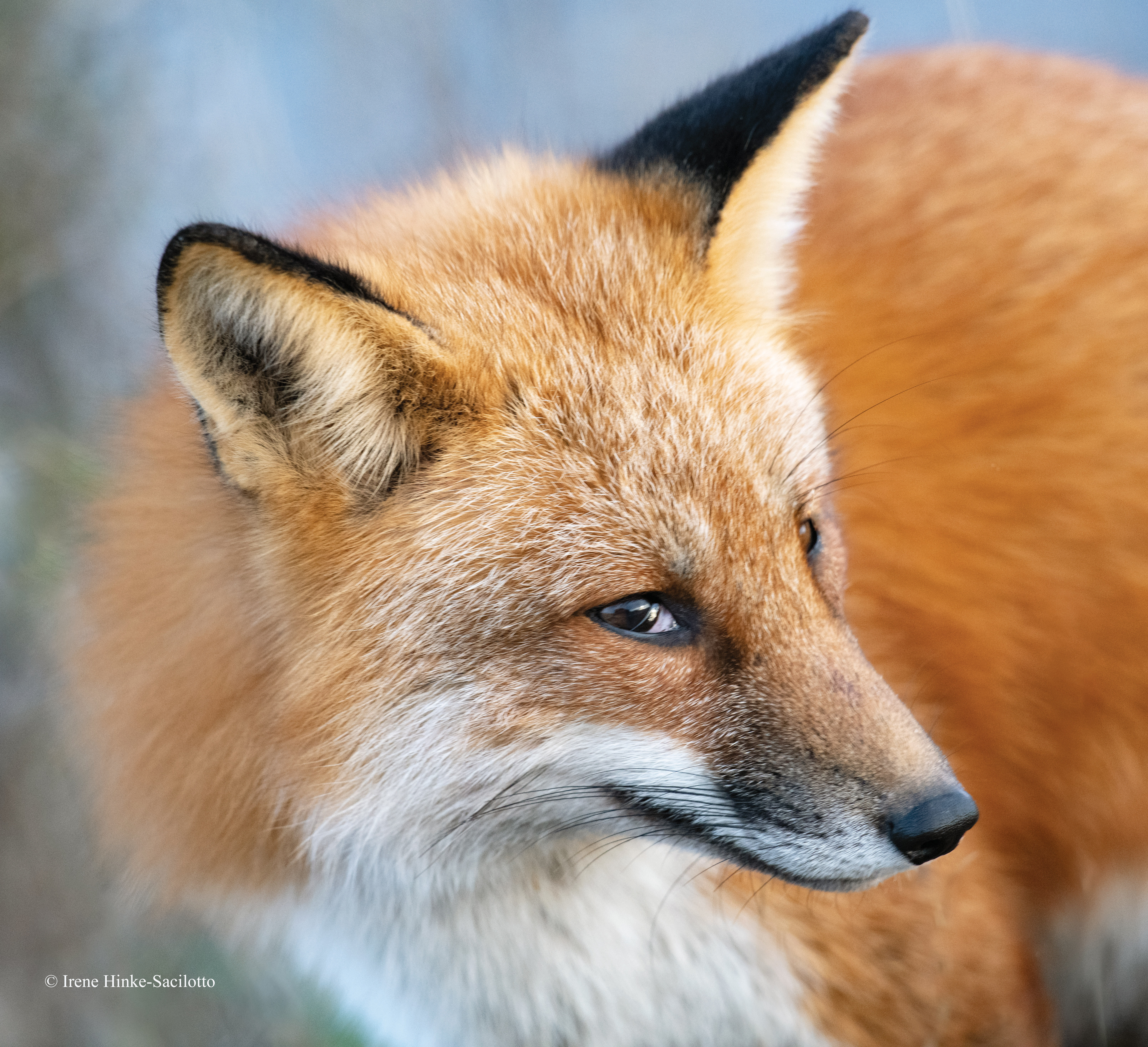
Red Fox image captured with an expression that suggests the saying “sly as a fox”. I took several shots of the fox at the time but this was the only one with this look.

Red Fox standoff with mouse at Chincoteague, NWR. Every day during this trip I looked for fox in same area where I first saw it. Eventually I spotted it toying with a mouse and moved in to take this photo.
Background Control
Sometimes I squint my eyes when looking at a scene to exclude less important details and see what stands out (including lines, forms, etc.) or could present a problem. For example, I use this technique when photographing a subject as a silhouette to be sure its shape does not blend with other unlit portions of the scene and that the animal is recognizable by outline alone.

Silhouette of heron with fish in bill.
For close-up photography, I sometimes shift my camera’s focus off the subject and focus on the background for an instant. This technique allows me to more easily see if strong forms, bright highlights, or other distractions are in the background and may be a problem. Then I refocus on the subject with this information in mind.
The longer the focal length of the lens, the narrower angle of view. So, these telephoto lenses can help you exclude a something distracting in the background. Small shifts in the camera position can dramatically control what appears behind your subject. In some situations where the subject is in sunlight but the background is distracting, I position camera so that a shadowed area falls behind my subject. This approach creates a dramatic image, as is if the animal is lit by a spotlight.

Yellow-Crowned Night Heron after catching soft crab. The bird was in sunlight but the background was in shadow. I made the image a bit more dramatic by darkened the backgound even more during post-processing .
Shooting from a position level with your subject is often desirable, producing less distortion of the image and suggesting a more intimate relationship between you and your wildlife subject. The lower angle can also help isolate the subject if the background is distant and well out of the depth of field.

Black-Tailed Prairie Dog family

Black-Tailed Prairie Dogs nose to nose.
Capturing the Unusual
I love capturing the unique aspects of an animal’s morphology and behavior. I look for the unexpected, humor, or the emotion evoked by the scene. Every situation is unique, for the behavior, environment, and lighting is never the same. Don’t pass up on an opportunity expecting it to be there tomorrow. It won’t!

Unique photo of Atlantic Puffin using wing for balance while scratching.

Atlantic Puffin eating flowers. This was so unexpected, that I took a number of photos at the time but only one best showed what the puffin was doing. The distant background and relatively shallow depth of field helped make the bird bird and flowers standout.
Imaginary Gallery
To judge the impact of a photograph, I sometimes imagine it hanging on the wall in a gallery. I examine the photo as if seeing it for the first time. Then I ask myself, have I conveyed the thoughts and feelings I experienced while taking the photo? Is the composition static – perhaps with the subject centered or with the horizon in the middle of the frame? Is the viewers eye drawn into the scene? Does it convey a story?

This is a humorous shot of a young Brown Bear struggling to hold onto a slippery salmon at McNeil State Game Sanctuary in Alaska. I love the story.
I always am learning something new from magazine articles, youtube, experiences in the field, and from other photographers. I keep my workshops small so I can provide individual attention to each person, no matter their skill level. No one should ever be embarrassed to ask questions. I typically learn something each time I conduct a program. If you have an open mind and see disappointments as opportunities, you will gain from your experiences. Everyone has his own unique vision. This becomes very obvious during my workshop image reviews. Even though the photographers are at the same location at the same time, the resulting mages are normally quite different.


