by Osprey Photo Workshops & Tours | Jul 17, 2017 | Badlands, Badlands National Park, Nature Photography, Photo Tour, Photo Workshops, Wildlife Photography
South Dakota Badlands Photos and Tips

The following blog introduces you to South Dakota Badlands Photos and Tips from my photo workshop this June.
In early June, I conducted a photo workshop in the Badlands of South Dakota with co-leader Sandy Zelasko. It is a great location for dramatic landscapes with striped limestone formations, sharp pinnacles, canyons, and sprawling prairie grasslands frequented by pronghorn and mule deer. In the past, I conducted photo tours in the Badlands and Blackhills in the fall. But this time, Sandy and I elected to hold the workshop in early June when newborn animals were plentiful along with vibrant spring colors. On most days, temperatures were comfortable in the morning but rose as the day progressed. Therefore, we were on location to shoot sunrise and photographed throughout the early morning. Then we took a mid-day break at our hotel in Wall to rest, review images, photograph around town, and grab an early dinner before returning into the field until sunset. From Wall, it was only a 25-minute drive to the park’s northeast entrance and 15 minutes to Pinnacles Overlook. The small town of Wall has several good restaurants, a grocery store where we bought snacks and food for breakfast, and a gas station plus a few convenience stores.

Note: Many of images you see in this newsletter were taken while scouting locations I the Badlands for the workshop. Sandy and I did photograph with clients at times but only if we were demonstrating techniques or in the event they did not desire our assistance.

Bighorn sheep are social animals with the females and lambs living separately from the males until breeding season. Rams, we encountered several times at the northeast end of the park near Big Badlands Overlook and the parking area at Notch, Door, and Windows trails. Remarkably, the length of the rams curled horns are managed as not to block their vision. While we photographed, they occasionally engaged in mock fighting which will become quite aggressive during rutting season in November and December as they compete for the attention of the females and run at each other heads down and horns clashing. The sound of the impact reverberates throughout the canyons. Even the youngsters engaged in shoving matches practicing for their roles later in life. The sheep’s ability to climb steep slopes even when small is amazing and is possible because of the rough pads on the bottom of their flexible two-toed hooves. It is wise to use long lenses (300 mm or greater) when photographing wildlife as not to alter their behavior. Wild animals are not predictable and these sheep can actually run at speeds of 30 mph over level ground.

These bighorn sheep once populated the park and other areas in the western U.S. in large numbers. But due to hunting and habitat loss their numbers dropped to near extinction at the beginning of the century. The bighorn seen the Badlands are Rocky Mountain sheep that were reintroduced into areas of the western U.S. In the Badlands, researchers monitor the health and distribution of the bighorn population by capturing lambs just after birth and attaching collars with tracking devices that will eventually fall off.

Young prairie dogs were one of the most entertaining but challenging subjects in the park to photograph. Our favorite family group was along Quinn Road where there was little traffic or disturbance. We photographed the youngsters at eye-level, lying on our bellies and using bean bags or low tripods for camera/lens support. This approach provided us with an intimate view of the animals and an out of focus background. Even though the background was blurred, we had to carefully examine the image in the viewfinder to be sure there are no strong forms or bright objects that could distract the viewer’s attention. The small prairie dogs were more animated than the adults particularly in the morning and during the cooler parts of the day. Therefore, we concentrated our effort on photographing them under those conditions, trying to capture their interactions — nuzzling, tail pulling, and playing.

Bison
Sage Creek Rim Road was the best location for bison. Late one afternoon as the sun was setting, I photographed a bison lit by the setting sun with the warm light illuminating the badlands in the background. One of my favorite photos from the trip.

Landscape Photo Opportunities
For dramatic landscape photos, we shot when the sun was low in the sky, warming and intensifying colors, and emphasizing the relief of the land. In the spring the weather is less stable than at other times of the year resulting in large cumulus clouds appearing in the afternoon along with dark, threatening storm clouds. Both add interest to images by replacing boring washed out or solid blue skies.
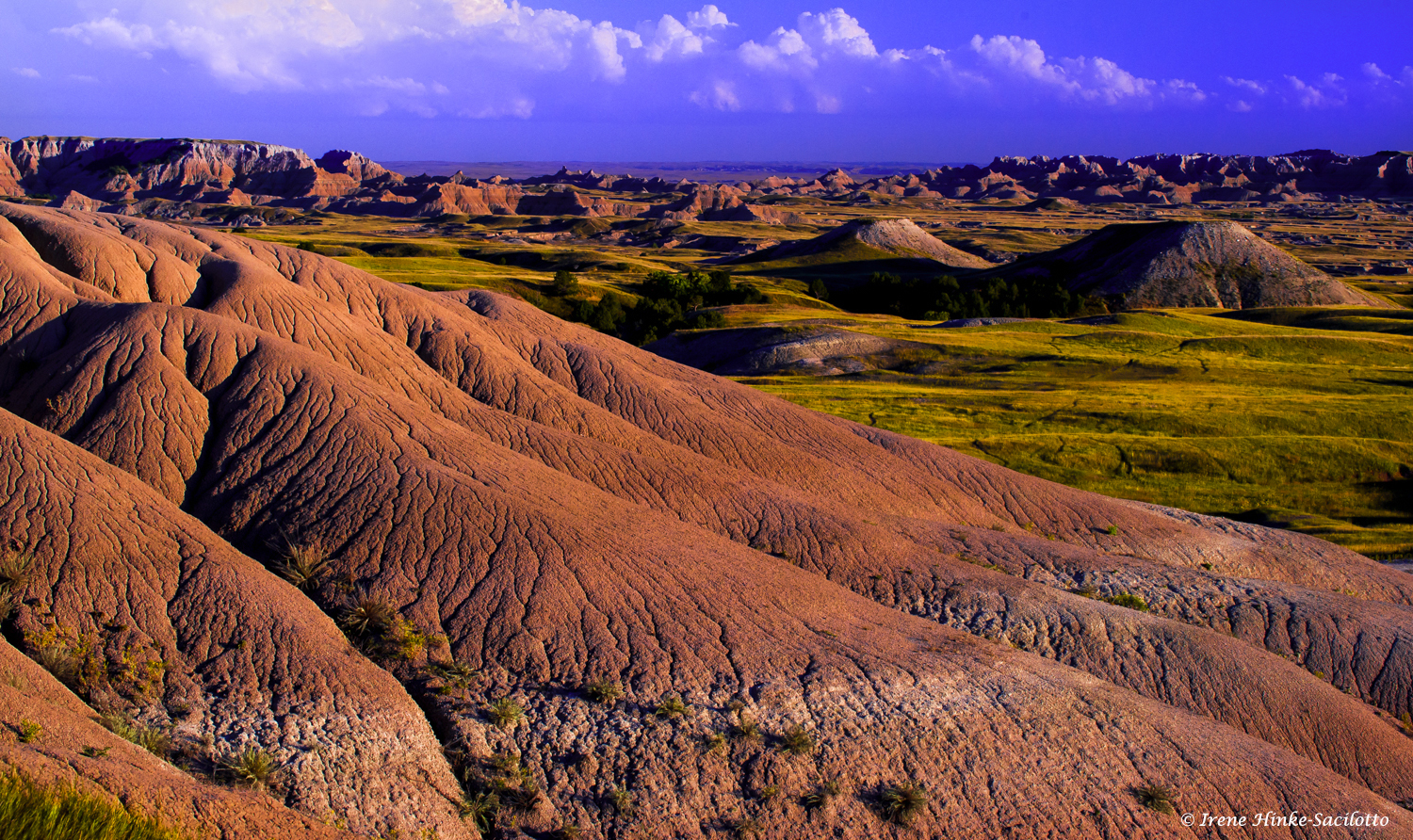
Some of the better views of the Badlands were at Yellow Mounds, Conata Basin, and Panorama Point Overlooks and the area from the Ben Reifel Visitor Center to Norbeck Pass. I particularly liked the views along the loop road from Pinnacles Overlook to Conata Road. There were convenient pull-offs along the way where we could stop and photograph multi-colored yellow mounds with contrasting banded formations in the background.
Some of the locations we used for sunrise and sunset photography were at or near Pinnacles Overlook, the red eroded rocks along Sage Creek Ridge Road, Big Badlands Overlook and at Windows, Door, Notch Trails.

Sheep Mountain Table
Sheep Mountain Table is in the south unit of Badlands NP. At the base of the plateau there are unusual rock nodule and toadstool-like formations. The road leading to the top is narrow and dirt can be treacherous after hard rains. We had a limited amount of time to explore the area due to an approaching storm with ominous dark clouds. However, it was the storm that added dimension to our images of the surrounding badland formations. Among the grasses on top of the table, we found the giant fuzzy puff balls containing seeds for the flower goat’s beard. One participant with a mirrorless camera took photos of the plant using a macro lens with a modeling light built-in. When comparing his images taken with this set-up to mine, his were far superior as the light penetrated to the center of the sphere. Great job Jim!

Lessons Learned
When the light on a scene was flat due to heavy clouds or deep shade, I still took photos using high ISOs to freeze action and hoped for the best. In many cases, the high ISOs resulted in unacceptable noise levels in my images (looks similar to film grain). I used Nik and Topaz software plug-ins with Adobe Photoshop and Lightroom to reduce the noise but I was not always satisfied with the results.
What was worse, the subjects appeared unrealistically flat and blended with the background. On the last day of the trip, I resorted to shooting video with my Nikon D500 camera, something I had only tried once before. My results from that day were not always perfect due to the wind, a focus issue, and my inexperience. However, because the animals were moving and interacting during the video. they no longer blended into the background and the images were much more engaging. Needless to say, I plan to learn more about filming videos and plan to experiment with the technique more in the future.

Images in this blog are from scouting trip and photo workshop in the South Dakota Badlands. Planning similar program in 2018.
To see details from June workshop go to https://www.ospreyphoto.com/event/badlands-national-park-spring-escape/

by Osprey Photo Workshops & Tours | Apr 7, 2017 | Badlands, Badlands National Park, Landscape Photography, Nature Photography, Photo Tours, Photo Workshops, Scenic Photography, South Dakota, Wildlife Photography
South Dakota Badlands
Badlands National Park
Article on Outdoor Photographer website by Irene Hinke-Sacilotto
Site of June Photo Workshop with Sandy Zelasko & Irene Hinke-Sacilotto
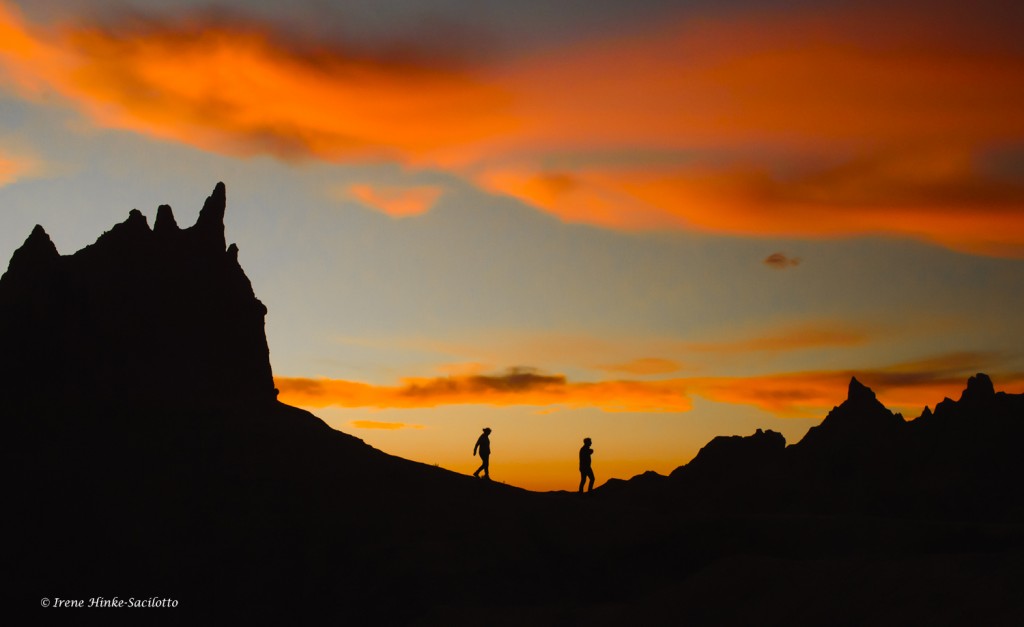
Hikers at Sunset
Badlands National Park is a terrific destination for landscape and wildlife photographers. It is the location of my June 2017 photo workshop, co-lead by Sandy Zelasko. The park is a convenient hour drive east from Rapid City on Interstate 90. North of the Pinnacles Entrance lies the town of Wall where you can find accommodations and other amenities. Near Cedar Pass, at the eastern end of the park, there are campgrounds, cabins, and a few other places to overnight.
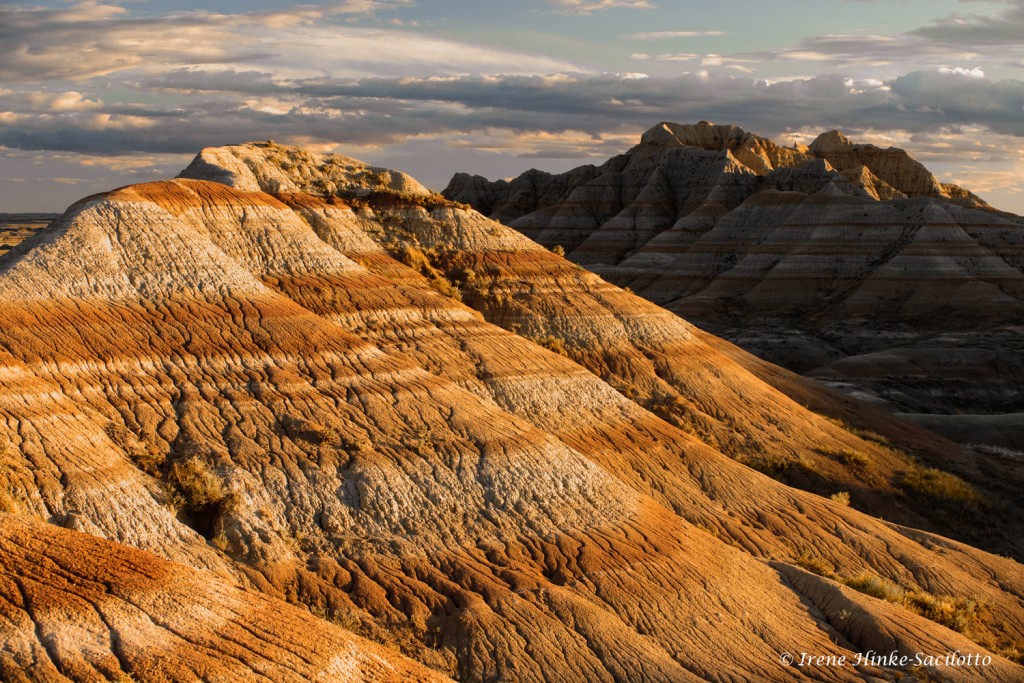
Banded sandstone formations
Badlands National Park Geology
Once the site of an ancient sea, the South Dakota Badlands have been transformed over thousands of years by wind and rain into the land you see today. Layers of sediment and ash eroded away leaving behind a rugged landscape with red and tan banded buttes, jagged escarpments with narrow gorges, and brightly colored yellow mounds. In the north unit of the park, there is a thirty-mile scenic loop road that meanders past unique geological formations. Along the way, there are convenient vehicle pull-offs, overlooks, and trails to explore.

Bighorn Sheep Ram.
Wildlife
At first glance, the land seems sterile, dry and wind-swept. Yet close examination reveals a variety of creatures including 39 mammal species. Bighorn sheep, pronghorn antelope, mule and white-tailed deer, bison, prairie dogs, coyotes, badger, jack-rabbits, cottontails, thirteen-lined ground squirrels, chipmunks, and fox squirrels make this park their home. If lucky, you might even spot the rare black-footed ferret, a species reintroduced into the area. Birds include hawks, eagles, magpies, meadowlarks, northern flickers, sharp-tailed grouse, turkey, and pheasant, just to name a few. Wildlife can be easily spotted from the road and are not as timid as elsewhere, due protection by the park service. Search picnic areas and campgrounds for photo opportunities including local free-loaders, such as magpies, squirrels and other foraging animals looking for food scraps and handouts.
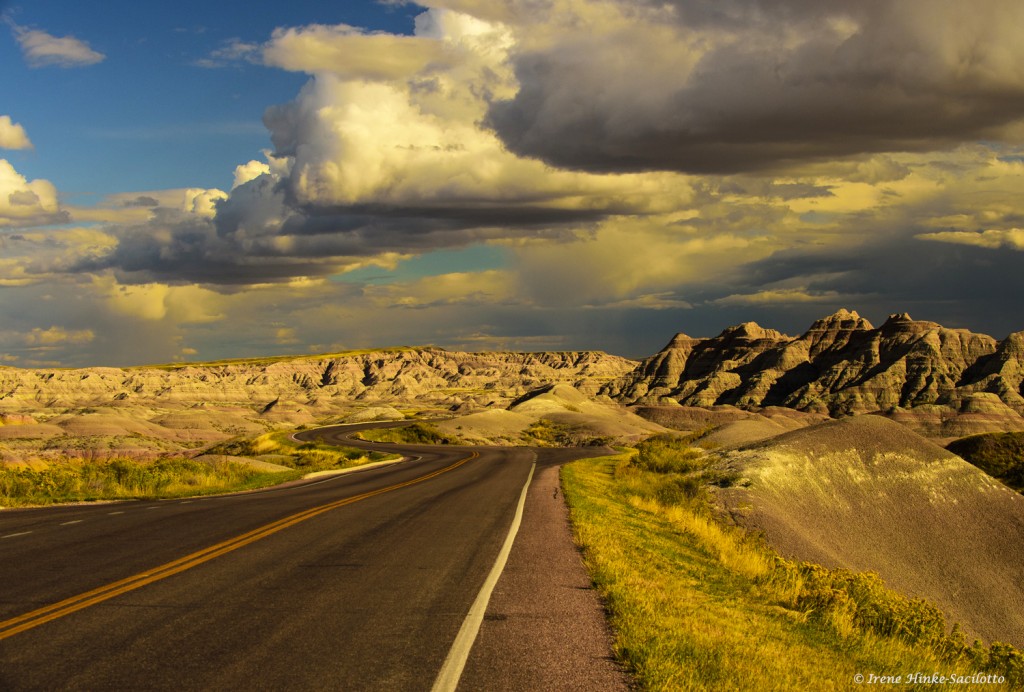
Badlands Loop Road
Photo Opportunities
From the town of Wall, it is only a short drive to Pinnacles Overlook, a favorite of visitors for sunrise and sunset photography. Watch as the light slowly creeps across the landscape, illuminating and darkening sandstone formations in the distance. As you head east from Pinnacles Overlook towards Dillion Pass, the loop road travels through some of the most dramatic landscapes revealing yellow mounds in the foreground and jagged peaks behind. At Dillon Pass, you can take the Conata Road south through Buffalo Gap National Grasslands, a tiny remnant of the prairie that once covered huge expanses of land in North America and Mexico. If you climb east on Badlands Loop Road, you will reach Rainbow and other overlooks for great opportunities to photograph the “wall” that separates the lower and upper prairies. At every turn along the road, the topography changes, offering even more photo ops. Storm clouds can add drama to your photos filling up an empty sky and casting shadows across the landscape resulting in alternating patterns of light and dark.
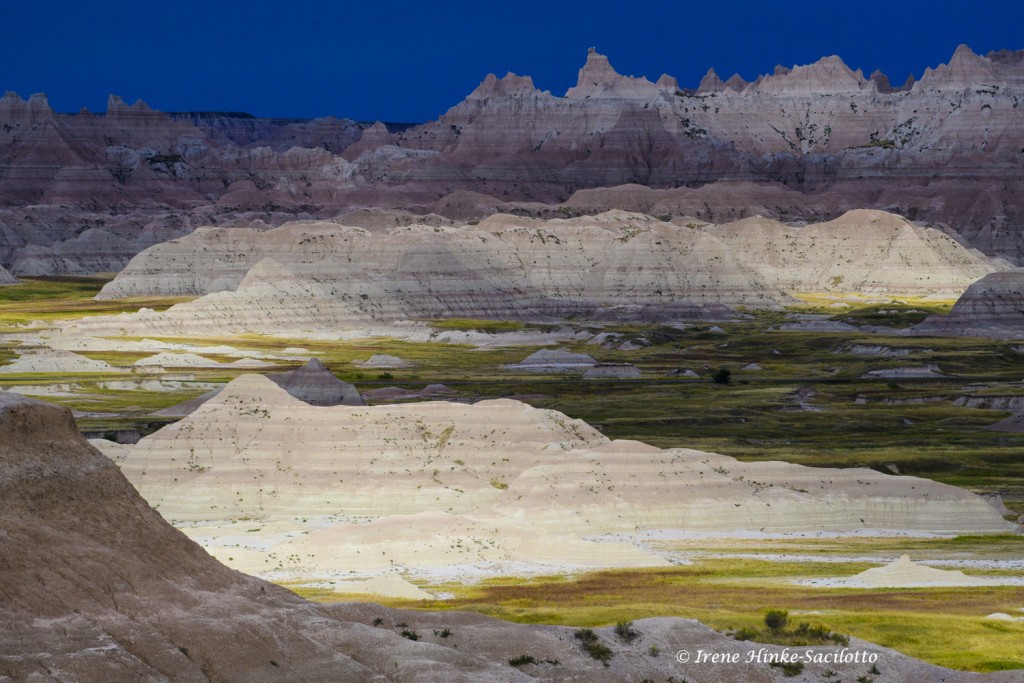
Moving Shadows

Black-tailed prairie
dog
Black-tailed prairie dog towns can be found throughout the park and their occupants are among my favorite subjects to photograph. During our recent scouting trip, we determined one of the best colonies for photography was along Quinn Rd, a dirt road running north off of the loop road where traffic was sparse and there was little disturbance. Here the prairie dogs were more tolerant and allowed us to photograph them at eye level from outside of our vehicle. It was nearly impossible to predict which animal was going to pop out of its burrow and “bark” an alarm call. For the best chance of capturing one barking, carefully observe the colony looking for individuals that seemed more vigilant and concentrate your attention on them. Since the alarm call suggests the presence of danger, be on the lookout for coyote or other predators nearby.
There are a number of trails that you can explore throughout the park for unique photo opportunities. They vary from easy to strenuous in difficulty. Always carry plenty of water. Take time to stop in at the Ben Reifel Visitors Center to learn more about the park, check weather forecasts and ask rangers for up-to-date information on recent wildlife sightings.

Bighorn sheep along Sage Creek Rim Road
Don’t skip Sage Creek Rim Road, a well-maintained dirt road heading southwest and accessed just after the Pinnacles Entrance to the park. Beautiful vistas abound as you glance left (south) near the roads entrance. Rust-colored mounds with deeply furrowed patterns dominate the foreground. In the setting sun, they almost glow red with the reflected warm light. Check out the areas with prairie grasses and browse for bison, antelope and bighorn sheep. At dawn, you may be able to silhouette one of these animals on a ridge against the rising sun. Roberts Prairie Dog Town is a popular stop to see prairie dogs. Often an abundance of visitors fright them back into their burrows making this location not ideal for photography. I suggest looking farther down the road for better opportunities. On the fringes of the colonies, look for coyote and badger which sometimes hunt as a pair.
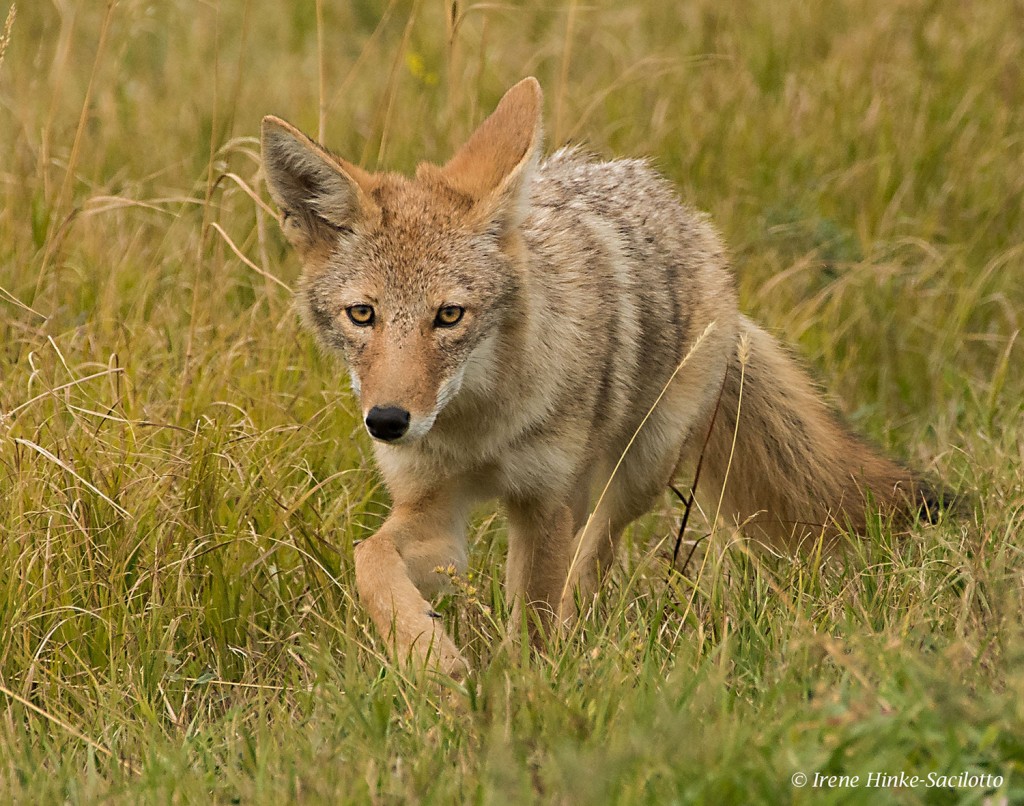
Stalking Coyote
Also check out woody draws where there is enough moisture to support shrubs, trees, and other plants. These sheltered areas are often havens for fox, deer, rabbits, squirrels and other wildlife. In autumn, these groves of trees add a splash of color to the dry landscape with leaves of yellow and gold. Be careful when stepping off trails. Burrows and prairie rattlesnakes might be concealed beneath the grass. Wear sturdy boots to negotiate uneven terrain and protection against cactus spines.

Fall color
Approaching & Photographing Wildlife
Make note of where you commonly see animals and check these locations on subsequent trips past the area. Photographing wildlife often relies on the animal accepting your presence as non-threatening. That means patience is important. Stalking tips: Move slowly, emulate their behavior, stop periodically, take an indirect route to close the distance, assume a low profile, and avoid direct eye contact. Minimize loud noises, perfumes, or anything not typically found in their environment. Camouflage clothing can help you merge with the surroundings and avoid curious human on-lookers from approaching you.

Pronghorn at rest
When photographing, make sure you do not disturb the animal’s behavior. If it reacts, stop and wait before resuming your approach. Curiosity may even bring them closer to you. Never block an animal’s means of escape or stand in their path. Just because they are in a national park, wildlife is unpredictable and can be dangerous particularly if traveling with young. Obey park regulations. Don’t feed wildlife.

Bison Scratching
Suggested equipment:
- DLSR camera with good response in low light at high ISOs
- Lenses from wide angle to telephoto. (My 200 – 500 mm Nikon zoom lens was handy when I needed to react quickly to wildlife subjects.)
- A matching tele-converter
- A macro lens if you enjoy close-up photography
- Large bean bag to support your camera when photographing from a vehicle
- Sturdy tripod mounted with a ball or gimbal head.
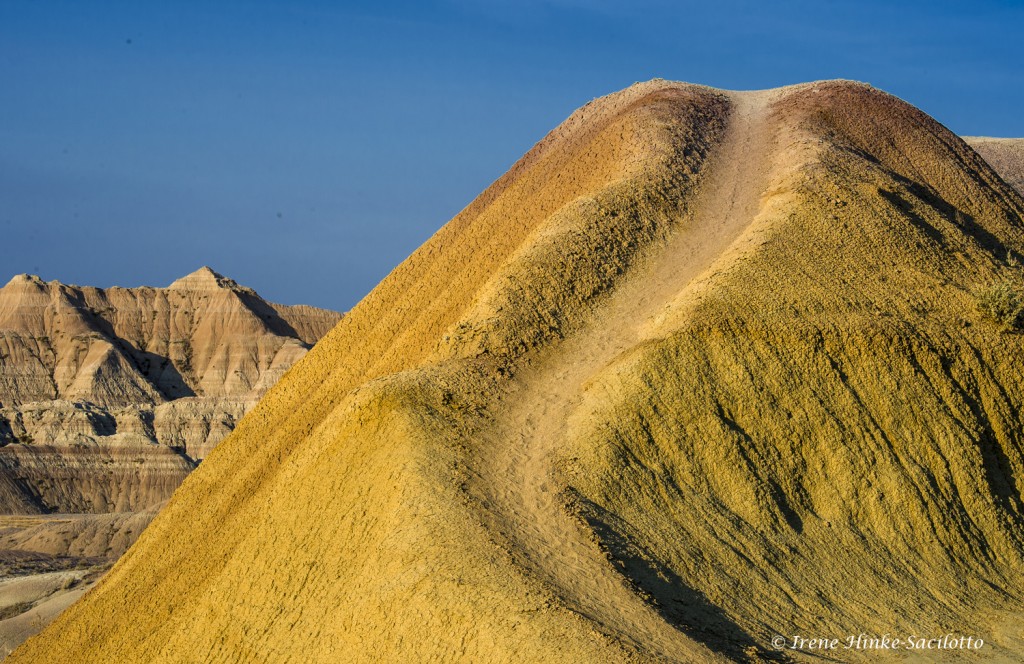
Yellow Mounds Near Dillon Pass
Check out the upcoming Photo Workshop 4-9 June, 2017 with Irene Hinke-Sacilotto & Sandy Zelasko. www.ospreyphoto.com

Meadow Lark Singing
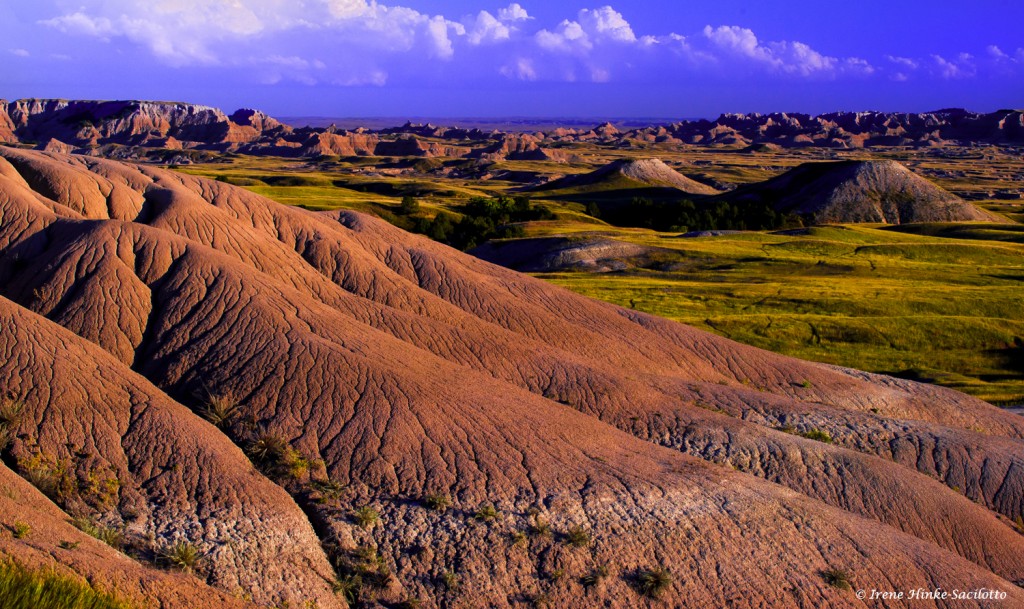
Eroded Landscape